Dream Eater: the Eater Of Dreams
Dream Eater
夢喰い獏
The Eater of Dreams
A perfume for the one who is called three times into the pillow, who comes without a sound, and who takes the nightmare whole.
- Perfumer
- Jake Smoak
- Concentration
- Extrait · 33%
- Character
- Animalic Iris
- Year
- 2026
Dream Eater was composed for the hour after midnight, when the lamp is out and the room has gone quiet and the thing you were afraid of has already found you. It is a perfume of powder and fleece and something warm breathing in the dark, and it was built for the moment after a bad dream is taken, when the relief is real and you are not entirely sure what went with it.
The figure at the center of it is the baku, written 獏, the eater of dreams. Most people meet her first as a cartoon, a round friendly thing with a trunk, and never learn that she is twelve centuries old, that she crossed a sea and changed her work, that she was painted on screens and carved over doors and sewn into pillows, and that a great many frightened people have whispered to her in the dark and believed she came.
A word before I begin. The baku is a living figure in Japan, carved on shrines that still stand, printed on charms still sold, spoken of to children who still wake afraid. I come to her as a guest. Where this house has given her a shape of its own, I say so plainly when we reach it.
Baku-san, come eat my dream.
My Vision Behind the Perfume
The idea arrived as a texture before it arrived as a story. I wanted a perfume that smelled like bedding with a body still in it. Iris powder in a dark room, lavender gone past sleep into something narcotic, and underneath all of it the warmth of an animal that had come very close. Purple, plush, herbal, and alive. That was the whole brief for a long time.
Then I found her. The eater of dreams was the only figure in any mythology who belonged in that room. She comes when the lamp is out. She comes because you are afraid. She eats the thing that frightened you and leaves the warmth behind. Once I had her name, the perfume knew what it was.
What follows is her history as far back as it goes, and then the place where this house took her up.
The Mo of the Southern Mountains
China, and the Pelt on the BedShe begins in China, and she begins as a beast. The old bestiaries describe the mo, written with the same character she still wears, as an animal of the southern mountains with the trunk of an elephant, the eyes of a rhinoceros, the tail of an ox and the paws of a tiger, an animal that fed on copper and iron and could not be harmed by a blade. Hunters went after it for the pelt. Sleep on the hide of a mo, the belief ran, and sickness could not reach you, and nothing ill could come near the bed.
The pelt was the first form of her protection. Twelve hundred years before anyone said her name into a pillow, the whole of her power lay in a warm hide spread across a sleeping body. Remember that. It matters at the end.
In the ninth century the poet Bai Juyi, one of the great voices of the Tang court, had a mo painted on a folding screen and set the screen beside his bed. He wrote a short inscription for it, and in it he says what everyone then believed: that the image of the beast worked as well as the beast, that sleeping behind her fur turned away pestilence and drawing her form turned away evil, and that a man could rest behind her in peace. The mo had become a picture. That was the first of her changes, from an animal you hunted into a shape you kept near you, and the screen beside the poet's bed is the oldest room we can be sure she was ever in.
The Crossing
Muromachi, and the WordsShe came to Japan in the age of the shoguns, sometime in the fourteenth and fifteenth centuries, the period Japan calls Muromachi. She came as a picture and a character, the way she had left the poet's bedside, and the Japanese kept her name and her borrowed body and her post at the edge of sleep. Then they changed the work.
Nowhere in the Chinese material does the mo eat a dream. That is a Japanese gift. On the far side of the water she became the baku, and the thing she consumed was the nightmare itself, drawn out of a sleeper and swallowed whole so that it lost its power to come true. In the last years of the Muromachi period people in their final illness were given a picture of her to hold, so that whatever waited at the end would have to pass her first. And somewhere in those years the words were settled, the ones a child still learns.
Baku-san, come eat my dream. Three times, into the pillow, into the dark. Then she comes, and the dream is gone, and that particular nightmare will never find its way back to you.
The Pillow, the Sail and the Beam
Edo, and the Furniture of SleepIn the long peace of the Edo period, from the seventeenth century into the nineteenth, she moved into the furniture of ordinary life.
Pillows were sold in her shape. A Japanese pillow then was a hard thing, a lacquered box or a small bolster on a wooden stand that held the elaborate hairstyles of the day clear of the floor, so a baku pillow was a carved creature you laid your neck across. Where the shape was too costly, her character was brushed on the cloth instead, a single 獏 on the pillowcase, so that she was already present when she was needed.
Her face was carved into the ends of the beams that hold up temple roofs, the nose-carvings called kibana, where she sits to this day beside lions and elephants at Nikko and at a hundred smaller shrines, keeping the threshold.
And on the first night of the New Year, when the first dream of the year, the hatsuyume, was read as an omen for everything that would follow, people slipped a picture of the takarabune under the pillow, the treasure ship of the Seven Lucky Gods, and on its sail they wrote her name. If the year's first dream soured, she was standing on the canvas, ready to swallow it.
The great illustrators drew her. Toriyama Sekien put her in his catalogue of a hundred demons in 1779. Hokusai drew her. She was carved in ivory and boxwood as netsuke to hang from a sash. She was by then one of the most domestic monsters in the world, a creature whose whole territory was the space between the pillow and the wall.
The Foreigner Who Called Her
Hearn, and the Leftover PiecesIn the first years of the last century a half-blind Greek and Irish writer named Lafcadio Hearn, who had taken a Japanese name and a Japanese wife and spent the last years of his life in Tokyo writing down what the old country still believed, published a small book of curios called Kottō, and closed it with a piece titled The Eater of Dreams.
Hearn is the reason the West knows her at all. He gave the origin story that has followed her ever since, that when the gods had finished making every other animal she was assembled from the pieces that were left, which is why no two pictures of her agree and why each of them looks borrowed from five creatures at once. He gave the invocation, and the picture kept by the pillow, and the promise that a dream she ate would turn to good fortune.
And he gave her something no one had written down before. In his telling the creature comes when called, looks at the dream on offer, and declines it. Some dreams are not for eating. She judges. She has always judged. That is the detail I kept closest when I started building her.
The Tapir and the Cartoon
The Century That Softened HerThe twentieth century gave her a body and took away her teeth.
When the Malayan tapir reached Japan, a real animal with a trunk-like nose and a coat patched in black and white, people looked at it and saw her. The tapir was given her name. Baku is now simply the Japanese word for tapir, and the two have grown together in the popular mind, so that the chimera of the old prints has slowly taken on the round body and the mild face of the real animal that borrowed her name. She appears in cartoons and games as a small sleepy thing. Children draw her with a smile.
The century also gave her a warning. You will read, in most modern tellings, that a baku called too often, or called when she is already hungry, will finish the nightmare and keep going. Your hopes are next. Then your ambitions. Then the dreams you wanted to keep. That caution is young. It appears nowhere in the old Japanese sources that anyone has been able to find, and no one is certain where it came from. This house keeps it anyway, because it is true of anything you lean on, and because a protector with no cost is a cartoon.
She has never had a fixed shape. Beast, screen, character, pillow, carving, sail, tapir, toy. Every age that received her drew her again. That is the tradition, and it is the permission.
Every age that received her drew her again.
She Comes to This House
The Baku as Ashenfume Drew HerHere the house takes her up, and this is the one place in the story where the telling is ours.
The baku who came to Ashenfume is a woman. Her horns curl dark against the violet. Her body is fleece and smoke. The trunk and the tiger paws of the old prints stayed on the page. She arrives without a sound at the hour after midnight and waits by the pillow until you have finished being afraid.
She is assembled the way she has always been assembled, from what was left over. The oldest form of her protection was a warm hide laid across a sleeping body, so her body here is fleece, drawn from raw sheep's wool. Her horns belong to the ram whose fleece she wears. Her powder is orris, three to five years in the dark. The warmth that comes into the room to feed is civet and muskrat, the animal the old beast always was, held close to skin. A perfumer's bench is a bestiary of its own, and she was put together from the most precious things on it.
She was made a woman because the thing she does is an intimate thing. She comes into a bedroom. She leans over a sleeper. She takes something from behind the eyes and leaves warmth in its place. The old prints gave that work to a monster because a monster was easier to sleep beside. This house gave it to her. She is precise, and she is hungry, and she decides what she eats. Gentleness was never part of the bargain.
The First Breath of the Dark
Bergamot, Lavender CO2, Clary Sage, Coffee BlossomDream Eater opens the way a room goes dark.
Bergamot lifts once, cool and green at the rim. It is the bitter citrus of Calabria, pressed from the peel of a fruit too sour to eat, and it is gone almost before you have placed it. Lavender comes up under it in its CO2 form, drawn from the flowering tops with pressurized carbon dioxide in place of steam, which leaves the herb closer to the living plant, dark and green and already halfway to sleep. Clary sage runs alongside, dry and faintly narcotic, the herb the old brewers steeped in ale to make the drinker dreamier than the drink alone could. And coffee blossom drifts in last, the small white flower of the coffee tree that opens for two days a year and smells of jasmine and honey and nothing at all of the bean.
The opening is short on purpose. She does not come while the light is still on.
Orris
The Powder in the DarkThen the floor gives way, and the heart of the perfume is the powder in the dark.
Orris is the rhizome of the iris, chiefly Iris pallida grown in the hills around Florence and in the fields of Morocco, and it is the costliest flower material a perfumer can buy. The price has everything to do with time. The scent is absent from the fresh root. The rhizomes are lifted, peeled, and laid to dry for three to five years, and across those years the compounds sleeping in the root break down slowly in the air into irones, the molecules that smell of violet, cold powder, and suede. Only then is the root worth distilling, and the yield, after all that waiting, is famously small. A kilogram of the dried root gives up a few grams of butter. A kilogram of the butter represents years of a field's patience and a great deal of money.
Three forms of it sit in this bottle. The resinoid for weight and for the length it holds. The tincture for the cold powdered lift at the top of the heart. The butter itself for the violet suede underneath, which only the butter gives. A house orris accord is built around the three to carry them the full length of the wear, and iris runs through nearly a tenth of the formula. It is the reason the perfume stays quiet while everything beneath it moves.
In the story it is the room. The exact texture of a place you half remember, powder on a dressing table in the dark, the cold side of a pillow turned over. She comes through it.
Lavender in Three Forms
The Temperature of the NightLavender runs the full height of this perfume, and it does so in three forms.
The essential oil, steam-distilled from the flowering tops, is the bright herbal lift most people know. The CO2 extract in the opening keeps the green of the living plant. And the absolute, solvent-extracted and dark as tea, gives the hay-sweet body the oil cannot reach, the smell of lavender bunches drying in a barn. Together they run at nearly seven percent of the formula. Used this way lavender stops being a note and becomes a temperature, the cool that runs through the whole middle of the night and lets the iris float on it.
Osmanthus and Mimosa
The Dream ItselfTwo flowers drift through the heart, and both of them are precious.
Osmanthus is the sweet olive of southern China, a tiny gold flower gathered in a short autumn window, and its absolute is produced in very small measure. It smells of apricot, dark tea, and soft leather all at once, with a suede finish that reads as skin. It is the scent of the dream you were having before she arrived, sweet and slightly wrong.
Mimosa is the yellow pompom of the silver wattle, Acacia dealbata, grown on the hills above Grasse and extracted in tiny yield. Its absolute is honeyed, faintly green, and above all powdery, a scent that behaves like a texture. It sits over the iris and softens its edge, and between the two of them the middle of this perfume has no hard surfaces anywhere in it.
Rhatany and Carrot Seed
The RootTwo roots hold the heart down.
Rhatany is a low shrub of the Andes, Krameria, whose red root has been dug since the time of the Inca for medicine and dye, and whose tincture in perfumery is dry, earthy, and faintly rosy, the smell of a floor. Carrot seed, distilled from the seed of the wild carrot, is dry and woody and rooty with a violet facet of its own, which is why it sits so naturally beside the iris. Together they keep the powder from lifting off into the air. Nothing here ever turns bright. This is the long middle of the night.
Wool Absolute
Her FleeceAnd then something comes into the room.
Raw sheep's fleece carries a grease of its own, secreted by the animal to keep the weather off, and it is the only part of the fleece that holds a scent. Scour the wool and that grease comes away as a heavy yellow wax. Work it further and what remains is wool absolute, thick and honeyed and lanolin-warm, a material almost no house keeps because almost no one has thought about what it is for.
It smells like a living animal at rest. Warm skin, clean fur, a faint sweetness, and a quiet barnyard edge that stays well the far side of dirty. It smells like the body and the bedding at the same time, which is a thing no other material on the bench can do.
In Dream Eater it is the floor. It arrives early in the drydown and it is still there at the end of the wear, holding the powder above it and the animals below, so that the three settle into one warm surface. It is also her body. The oldest form of her protection was a pelt laid over a sleeper, and twelve centuries later this house put the pelt back on the bed. Her body is fleece in the art because her body is fleece in the bottle.
Civet and Muskrat Musk
The Thing That BreathesUnderneath the fleece, something wakes.
Civet is one of perfumery's legendary animalics, the secretion of the African civet, feral at full strength and luminous in dilution, lending a warmth and a radiance and a narcotic creaminess that the great old perfumes were built on. It is what makes a composition smell alive. It is held here to a trace, under the wool, where it reads as body heat.
Muskrat musk is gentler, the musk of the northern river marsh, clean and softly leathery, the smell of warm skin. It does the work a synthetic musk has never managed, which is to make the last hour smell like a person.
These two are the beast the mo always was. She was an animal before she was anything else. In the bottle she is still one.
The Bed
Sandalwood, Oakmoss, Tonka, Vanilla, Labdanum, BeeswaxThe base is the bed itself, and I will name everything in it.
Sandalwood, Indonesian Santalum album from logs estimated at fifty years of age, taken as a select extract rich in santalol. Creamy, milky and quiet, the only wood in the formula, and it is here because it is soft enough to sit under this much fur.
Oakmoss, the lichen of the oak, cured and extracted, the green inky floor of every chypre ever made, holding the ground damp beneath the animals.
Tonka bean, the black wrinkled seed of a South American tree, cured in rum until its coumarin blooms. Hay and almond and warm sugar.
Vanilla, the fermented pod of an orchid, the slowest sweetness in perfumery.
Labdanum, the dark resin of the rockrose, once combed from the coats of goats on Mediterranean hillsides. Amber and leather and warmth.
And beeswax, the absolute of the comb itself, honeyed and faintly smoky, a thread of it through everything, soft as the inside of an eyelid.
This is the bed you wake in when the dream is gone.
The Labor of the Materials
Nearly everything in this bottle comes from something alive, and nearly all of it is scarce.
Orris waits three to five years in a drying loft before it can be distilled, and gives up a few grams of butter for every kilogram of root. Osmanthus and mimosa are gathered by hand in windows of weeks. Coffee blossom opens for two days a year. Wool absolute is drawn from the grease of a fleece and refined in tiny lots by people who have kept the craft alive against almost no demand. Civet and muskrat are true animal materials, tinctured and tamed over months. The sandalwood came from trees older than most of the people who will wear this. Oakmoss is a lichen, slow to grow and slower to replace, and the amount a perfumer may use shrinks with each revision of the rules.
None of it can be hurried, and none of it can be replaced without saying so. I was fortunate to have what I had for this batch, and I do not take it for granted.
- Top
- Bergamot · Lavender CO2 · Clary sage · Coffee blossom
- Heart
- Orris butter, tincture and resinoid · Lavender absolute · Osmanthus · Mimosa · Rhatany root · Carrot seed
- Base
- Wool absolute · Civet · Muskrat musk · Sandalwood · Oakmoss · Tonka bean · Vanilla · Labdanum · Beeswax
What Dream Eater Smells Like
Dream Eater opens cool and herbal and quick. Bergamot lifts once, lavender comes up dark beneath it, clary sage runs dry alongside, and coffee blossom drifts in with honey on its breath. The opening lasts about as long as it takes a room to go dark.
Then the floor gives way. Orris opens slowly, cold and powdered and violet, and the lavender absolute settles under it hay-sweet, so that the herb becomes a temperature that holds the whole middle in place. Osmanthus passes through with apricot and leather. Mimosa powders the air above. Rhatany and carrot seed keep it all down at the root, dry and faintly rosy. Wearers will find this hour plush and purple and very quiet, the most expensive quiet in perfumery, the exact texture of a room half remembered.
And then something comes in. Wool settles over everything first, lanolin-warm and faintly sweet, bedding with a body already in it. Civet and muskrat wake underneath, skin-warm and close. Oakmoss holds the floor green. Sandalwood runs creamy through the fur. Tonka, vanilla and labdanum come last, with beeswax threaded through them. It ends deep, warm, and animal, the smell of the bed after she has gone.
The Meaning of Dream Eater
She takes the nightmare whole so that it can never find its way back to you. That is the promise, and it has held for six hundred years on one side of the sea and twelve hundred on the other.
And there is a price, and this house keeps it. Call her too often, or call her when she is already hungry, and she finishes the nightmare and keeps going. What protects you can hollow you out if you lean on it. I do not read that as a threat. I read it as the truth about relief. The thing that takes your fear away is also taking something, and the question she asks, every time, is whether you know what you are handing her.
To wear Dream Eater is to stand for a moment in the room after she has been. The relief is real. The warmth is real. And you are not entirely certain what went with it.
Sleep well now. Ask again, and ask carefully.
Call her, if there is something you would rather she took.
The Mo貘the beast of the southern mountains
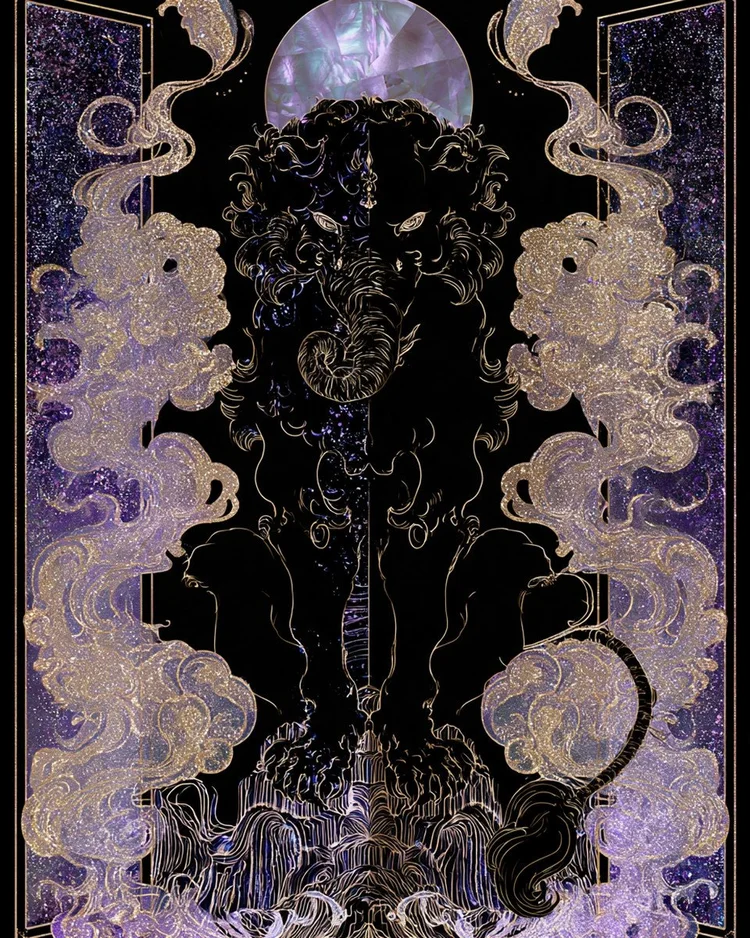
Her first form, a Chinese animal with an elephant's trunk, a rhinoceros's eyes, an ox's tail and a tiger's paws, that fed on copper and iron. Hunted for a pelt that kept sickness from the bed. The character she still wears is his.
Bai Juyithe poet at the screen
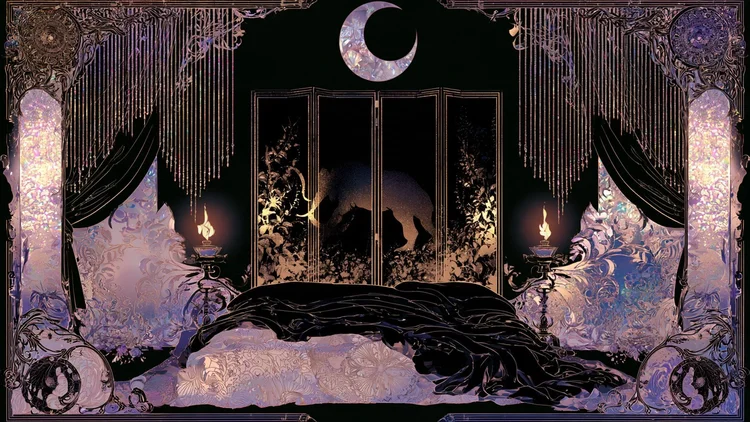
A poet of the Tang court in the ninth century who had a mo painted on a folding screen beside his bed, and wrote that the image turned away evil and pestilence as well as the beast. The oldest room she was ever in.
The Baku獏the eater of dreams
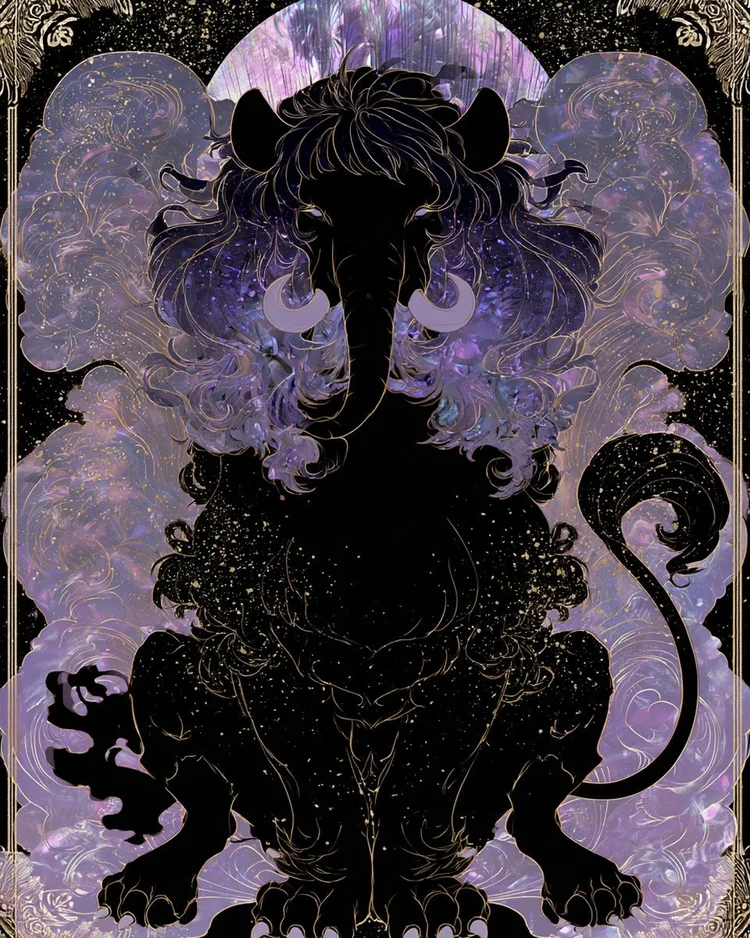
What the mo became on the far side of the sea, familiar in Japan by the fourteenth and fifteenth centuries. The dream-eating was added there. Called three times into the pillow, she comes and swallows the nightmare so that it can never come true.
The Invocationthree times, into the pillow
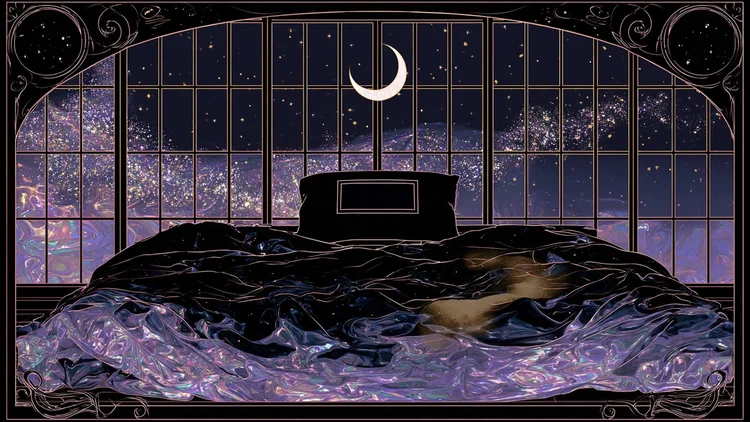
獏さん、私の夢を食べてください. Baku-san, come eat my dream. Said three times into the dark on waking from a nightmare. Some tellings shorten it to two words. Baku, devour.
Baku-makura獏枕the pillow
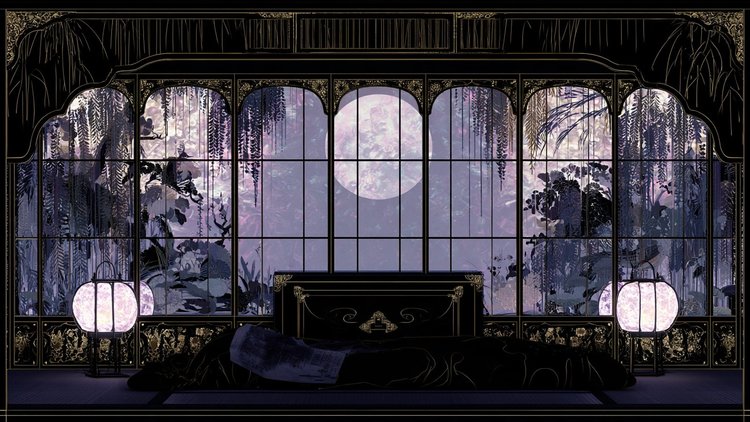
An Edo period pillow carved in her shape, or a plain one with her character brushed on the cloth, so that she was already present beside the sleeper when she was needed.
The Takarabune宝船the treasure ship
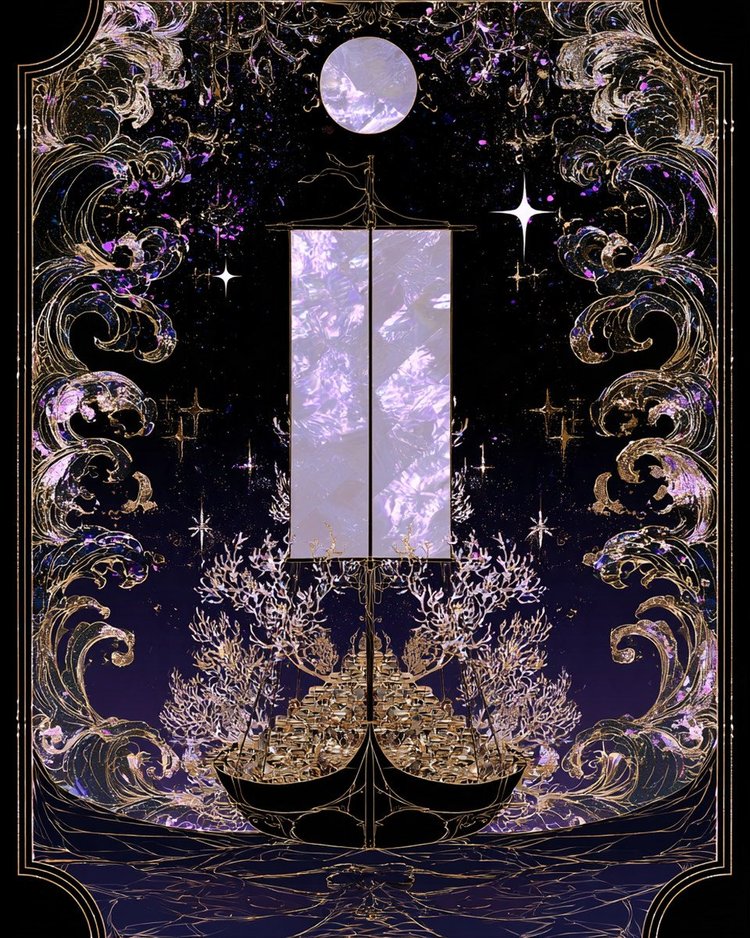
The ship of the Seven Lucky Gods, printed on paper and slipped beneath the pillow on New Year's night to bring a lucky first dream. Her name was written on the sail so that a soured dream would be eaten before it could count.
Hatsuyume初夢the first dream of the year
The first dream after the New Year, read as an omen for everything that would follow. The reason the treasure ship went under the pillow, and the reason she stood on its sail.
Kibana木鼻the carvings on the beam
The carved beam-ends of temple and shrine roofs, where her face was cut beside lions and elephants to keep the threshold. She sits there still at Nikko and at a hundred smaller shrines.
Toriyama Sekienthe cataloguer of demons
The Edo painter and printmaker who set her among his illustrated hundred demons in 1779, fixing the trunk and tusks and tiger paws in the shape most people still picture.
Lafcadio Hearnthe foreigner who called her
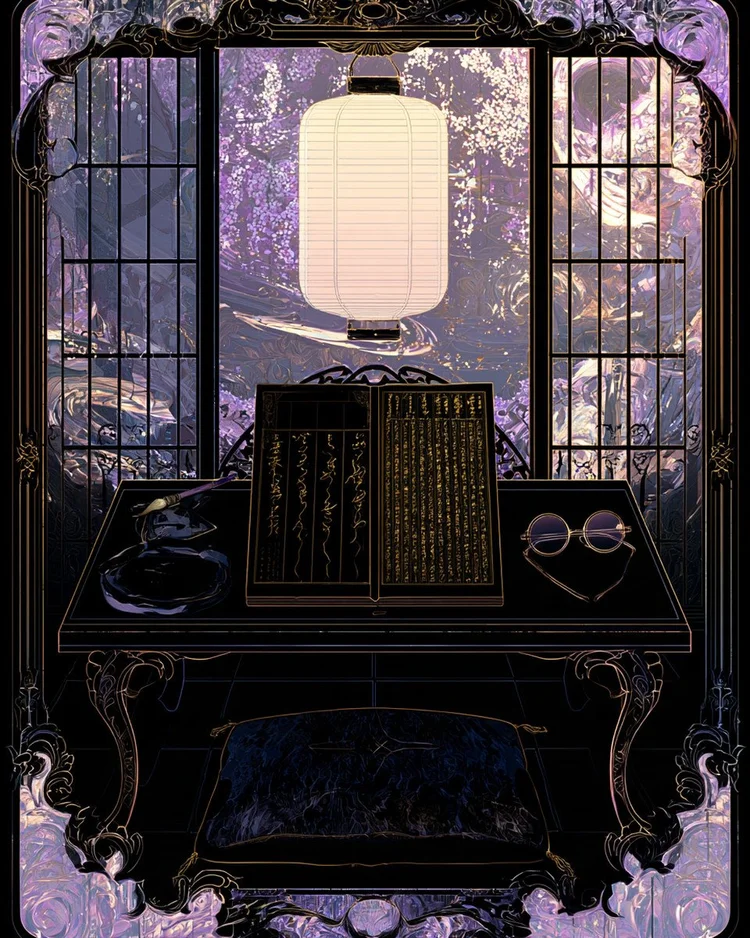
The writer who took a Japanese name and spent his last years recording what the old country still believed. His piece The Eater of Dreams carried her west, with the story that she was assembled from the pieces left over after every other animal was made, and a baku who looked at a dream and declined to eat it.
The Tapirthe animal that took her name
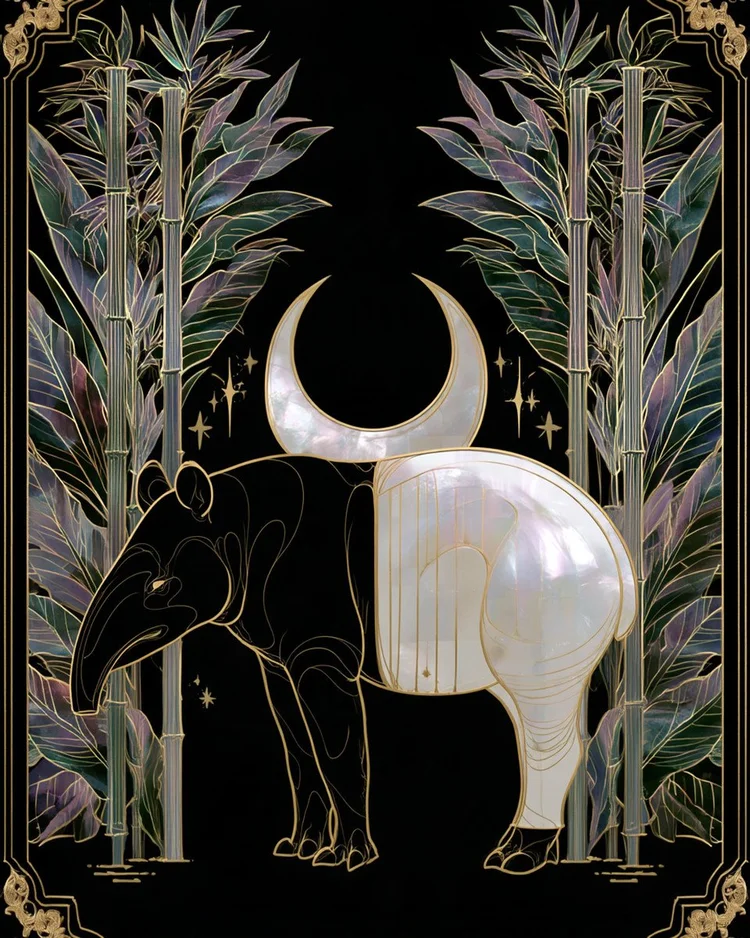
The Malayan tapir, given her name when it reached Japan because of its trunk-like nose. Baku is now the Japanese word for the living animal, and the two have slowly grown one face.
The Dream Eaterthe baku as this house drew her
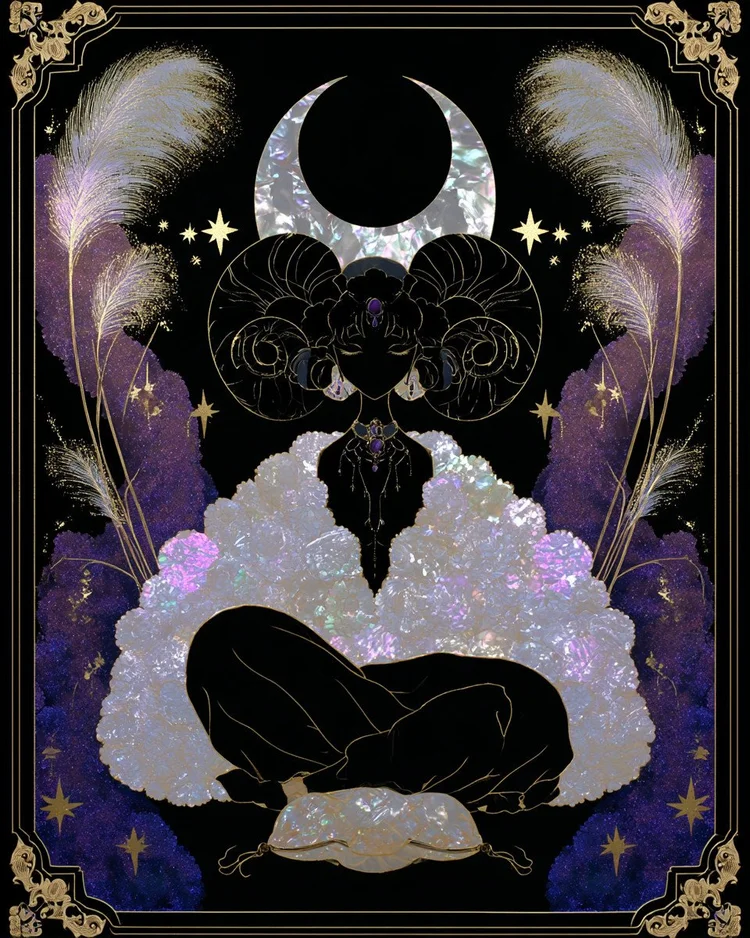
A woman with the curled horns of a ram and a body of fleece and smoke. The pelt on the bed become the body itself. She comes at the hour after midnight, takes the nightmare whole, and decides what she eats.