Jungle Potion: The Nectar of Mohini
Jungle Potion
The Nectar of Mohini
A perfume for the enchantress who poured immortality for the worthy, and sealed what remained in the green.
- Perfumer
- Jake Smoak
- Concentration
- Extrait
- Character
- Animalic Green Floral Chypre
- Year
- 2025
Jungle Potion was composed to feel like a living jungle at the hour it turns holy. Thick with humidity, heavy with bloom, faintly dangerous the way real wilderness always is, and lit from within by something older than the forest.
The figure at the center of it is Mohini, the enchantress, the one form the god Vishnu took that the world had never seen him wear. Most people outside India have never heard her name. That is a shame, because her story is one of the great stories: the churning of the ocean, the theft of immortality, and the light before which no disguise survives.
A word of respect before I begin. Mohini is a living presence in Hindu tradition, honored in temple and festival and dance to this day. Vishnu is worshipped by hundreds of millions of people. I come to this story as a guest, and I have tried to tell it the way it deserves to be told: fully, faithfully, and with gratitude for being allowed to carry a little of it.
Nothing hidden can stay hidden in front of her.
My Vision Behind the Perfume
The idea arrived before the materials did. I wanted a jungle you could walk into, and I wanted the jungle to be sacred rather than merely lush. There are a thousand green perfumes that smell like a greenhouse. I wanted one that smelled like a temple the maps had lost, with the vines pulling the stones apart and something still burning on the altar.
That meant three things had to be true at once. The green had to be alive, with an animal still moving in it. The bloom had to be narcotic and night-blooming, the flowers of garlands and offerings rather than the flowers of a florist. And the base had to be an altar: smoke, moss, root, and resin, the holy floor the whole thing stands on.
Then I found her story, and understood what the perfume was. It is her nectar. The overflow of the amrita, sealed into a vessel you can hold in one hand.
The Churning of the Ocean
Long ago, the gods had grown weak. The devas, the shining ones, had lost their strength to a curse, and the asuras, their rivals and cousins, pressed their advantage. So Vishnu, the preserver of all things, proposed a truce and a labor. The two hosts would churn the great Ocean of Milk together, and from its depths would rise the amrita, the nectar of immortality. Whoever drank it would never die.
They uprooted Mount Mandara for a churning rod. They took Vasuki, the king of serpents, and wound him around the mountain for a rope, the gods pulling at his tail and the demons at his head. When the mountain began to sink, Vishnu became a vast tortoise and bore it on his back. And for an age, the two armies churned the sea.
The ocean did not give up its treasures easily. The first thing to rise was Halahala, a poison so black it would have ended the world. Only the god Shiva could bear it. He drank the poison and held it in his throat, and his throat turned blue forever, and the world was saved.
After the poison came wonders. A wish-granting cow. A white elephant with seven trunks. A seven-headed horse. A jewel that sits still on Vishnu's chest. A tree of paradise. The moon itself. And Lakshmi, goddess of fortune, rising from the foam to choose Vishnu as her own.
Then, last of all, the physician of the gods rose from the water carrying a single vessel of gold, and in it was the amrita.
The demons seized it before the gods could reach it. Deathlessness came within a breath of falling into the wrong hands.
Mohini
The One Before Whom No Mask HoldsHer name comes from moha, the Sanskrit word for delusion, enchantment, the spell that clouds the mind. Mohini is the enchantress: the only form Vishnu has ever taken as a woman, and one of the strangest and most beautiful figures in all of Hindu story.
She is first spoken of in the Mahabharata, and her story is told in full in the Bhagavata Purana, one of the great scriptures of Vishnu's devotees. When the demons ran off with the amrita, Vishnu did what no weapon could do. He became a woman so beautiful that every eye in both armies turned toward her and forgot what it had been reaching for. Blue as the deep of the churned sea, blue as the god held within her, she walked into the demons' camp and asked only that she be allowed to pour.
They handed her the pot. That was their undoing and the world's deliverance. Mohini seated the gods in one line and the demons in another, and she poured the nectar for the gods alone, and the demons, spellbound, watched her do it and did not object.
One of them saw through her. A demon named Rahu slipped into the line of the gods wearing a god's stolen face, and he drank. But the sun and the moon were watching, and they cried out, and Mohini's light fell across him. Vishnu's discus took the demon's head from his shoulders in the same instant the nectar touched his throat. The head had already tasted immortality and could not die. It lives still, the old ones say, and in its hunger for revenge it swallows the sun and the moon whenever it can catch them. That is an eclipse. That is why the disguise never works twice.
This is the oldest thing that is true of her, older even than her beauty. She is the one before whom no mask holds.
There are other stories. When a demon named Bhasmasura won a boon that let him turn anyone to ash by touching their head, and then turned to use it on Shiva himself, it was Mohini who stopped him. She did not fight. She danced, and asked him to dance with her, and mirrored his every movement until, in the joy of it, he placed his own hand on his own head. In the south of India, Shiva and Mohini are together the parents of Ayyappa, the god of the great mountain pilgrimage at Sabarimala. The classical dance of Kerala, Mohiniyattam, is named for her: the dance of the enchantress. There is a day in her honor in the spring, Mohini Ekadashi, when her devotees fast and remember the pouring.
What I find most moving about her is the paradox at her center. She is illusion made flesh, the spell itself, and she uses that spell in the service of truth. She deludes the deluded. She enchants those who would steal. And she sees, with perfect clarity, exactly who is standing in front of her. She pours for the worthy and passes the false ones by, and she has never once changed that rule.
The Temple in the Green
Here the house takes up the story where the old texts set it down.
When the pouring was done and the deathless had drunk their fill, Mohini did not empty the vessel. She carried what remained into the deep green, to a temple the maps had long since lost, and there she sealed it. Wherever a single drop escaped her hands, the jungle rose to meet it, green and undying, blooming up out of the nectar's overflow. The serpents of the churning followed her and coiled at her feet, and the lotus that had risen beside the amrita opened once more at her knee.
That is the jungle in the bottle. It is her overflow. Every vine in it grew from a drop of immortality, every white flower opened in her light, and the altar at the bottom of it is the place she sealed the vessel and turned away. To wear it is to stand for a moment inside her pouring, and to be seen exactly as you are.
The First Breath of the Green
Lime, Grapefruit, GingerJungle Potion opens the way a machete opens the canopy.
Lime is the first cut: sharp, wet, and green, the cleanest citrus in perfumery and the one that smells most like a leaf torn in half. Beside it comes grapefruit, cold and pink and bitter at the edge, keeping the sweetness honest. And under both of them, ginger. Ginger is a root of the Indian earth, a rhizome dug and distilled, and its oil is warm and peppery and faintly lemon-bright. It is the humidity given a pulse, the breath of a warm forest floor rising to meet the citrus light.
Together they are the first light striking through wet leaves. Nothing has bloomed yet. The temple is still hidden. You have only just stepped in.
Galbanum
The Torn Green VineThen the green itself, raw and alive.
Galbanum is a resin that weeps from a wild fennel of the Persian highlands, gathered by hand from the cut stems. It is one of the oldest aromatics in the world, named in the Book of Exodus as an ingredient of the sacred incense of the tabernacle, and it smells like nothing else: snapped stems, bruised sap, a green so intense it is almost bitter, with a resinous shadow beneath. It is the smell of a living plant breaking.
In the perfume it is the torn vine, the wet green nerve of the jungle. Galbanum is what keeps the opening from being merely citrus. It makes the green sting.
Skunk
The Beast in the UndergrowthAnd here is where I refused to make it only pretty.
Low beneath the citrus and the green there is a feral tincture, and I will tell you plainly what it is: it is skunk. The scent gland of the animal, gathered and tinctured and tamed over long months by hand. At full strength it is exactly what you would expect, a thing no house in the world will touch. In extreme dilution it transforms. The harshness falls away and what remains is warm, mineral, faintly sweet, the smell of fur and earth and something breathing in the leaves.
I used it because a jungle without an animal in it is a painting. Take that note away and the whole composition collapses into a pleasant green perfume. Leave it in, and it becomes a place you can walk into, with something alive still moving in the undergrowth. That was always the goal. A world, held in a bottle, with the beast still living in it.
Gardenia and Tuberose
The Bloom She KeptNow the temple flowers open.
Both of these are what perfumers call narcotic white flowers, and both of them belong to India as much as to anywhere. Tuberose is called rajnigandha there, the night-fragrant one, and it is the flower of garlands, of weddings, of the offerings laid at temple thresholds after dark. Its absolute is among the most expensive florals in the world, thousands of blooms yielding a few grams of something carnal and heady and impossible to ignore. It smells like a flower that refuses to be forgotten.
Gardenia is rarer still. The living flower is one of the most beautiful scents in nature, creamy and cool and rich, and it is famously reluctant to give itself up to extraction. Most of what is sold under the name is built from other things. The true absolute is scarce and costly and worth every trouble, and it is the real flower that is in this bottle.
In the story, gardenia is the night bloom that rose beside the nectar, sister to her lotus. On the altar it is not an ornament laid beside the vessel. It is the thing that lights the stone. Tuberose is the heat beneath it, drugging and full. Together they are the bloom she kept, the flowers that opened wherever her light fell.
Violet Leaf and Blue Yarrow
Her BlueTwo cool notes hold the heart open.
Violet leaf is the leaf of the flower rather than the bloom, and its absolute smells of dew and cucumber and freshly torn green, cool and wet to the touch. It is the moisture on the petals, the jungle's breath on the flowers before the sun reaches them.
Blue yarrow is the stranger of the two. Yarrow is a humble herb, but when its flowers are distilled the oil comes out a deep, startling blue, run through with a compound that forms only in the heat of the still. The oil is rare, herbal, and sky-clear, with a sweetness at the edge. I chose it for its color as much as its scent. It is Mohini's own blue, the deep of the churned sea made visible, the god held within her.
Frankincense
The Temple SmokeThe clearing becomes a holy place.
Frankincense is the resin of the Boswellia tree, gathered as tears from cuts in the bark and burned as incense across the ancient world. It has been carried into temples for thousands of years, and it still is: in India it is burned every day, and a cousin of the tree grows wild in the dry forests of the subcontinent. Its scent is lemony, resinous, faintly peppery, and it does something no other material does. It changes the air in a room. It turns a space into a sanctuary.
In the perfume it is the smoke rising through the flowers, the sign that the temple is near and the altar is lit.
The Altar
Jade Wood, Guaiac, Tree Moss, Vetiver, Peru BalsamThe base of Jungle Potion is the altar itself, and I will tell you exactly what it is made of.
First, the honest word. The jade wood here is an accord I composed myself, to carry a cool green stone down through the woods. There is no tree by that name that I can put in a bottle, so I built the idea of one: mineral, chilled, faintly green, the altar stone. I name it as mine. Everything else on this altar is the real and costly thing.
Guaiac wood is a slow-growing hardwood of the South American Chaco, and its oil smells of rosy smoke and tea steeped over embers, sweet and slow. It is the smoke curling up off the offering.
Tree moss is a lichen, gathered from the bark of conifers, cousin to the oakmoss at the heart of every classic chypre. It smells of damp earth and centuries of green pressed into stone. It is now so restricted in modern perfumery that most houses have quietly walked away from it. I have not. It is the temple floor.
Haitian vetiver is the deep root that holds the whole world steady. The grass itself came from India, where it is called khus and woven into screens that cool the summer air, and its finest oil is now distilled in Haiti from roots dug by hand and by slow, stubborn labor. Smoke, wet earth, and a thread of grapefruit shadow that reaches all the way back up to the opening.
Peru balsam is a warm resin from the bark of a Central American tree, vanilla and cinnamon in its shadow, and it is the last thing you smell. It seals the light inside.
The Labor of the Materials
Nearly everything in this bottle comes from something alive, and nearly all of it is scarce.
Tuberose and gardenia are gathered by hand in a window of weeks, and the true gardenia absolute is one of the rarest florals a perfumer can buy. Galbanum is cut from wild plants in a single region of the world. Blue yarrow gives its color only in the still, and the oil is never the same twice. Frankincense is bled from wild trees, tear by tear. Tree moss is a lichen, slow to grow and slower to replace, and the amount a perfumer may use shrinks with each revision of the rules. Vetiver is a root dug from the ground and carried on shoulders. And the feral tincture at the bottom of it all takes months of patience to tame, and cannot be hurried by a single day.
None of this can be rushed. None of it can be faked without saying so. I was fortunate to have what I had for this batch, and I do not take it for granted.
- Top
- Lime · Grapefruit · Ginger · Galbanum · Skunk tincture
- Heart
- Gardenia · Tuberose · Violet leaf · Blue yarrow · Frankincense
- Base
- Jade wood accord · Guaiac wood · Tree moss · Haitian vetiver · Peru balsam
What Jungle Potion Smells Like
Jungle Potion opens green and bright and wet. Lime and grapefruit strike first, the ginger warms them almost at once, and then the galbanum arrives and the green turns sharp and alive. Beneath it, from the very first minute, there is something feral moving. You may not be able to name it. You will know the green is breathing.
Then the flowers open, and they open big. The gardenia arrives like an explosion, creamy and cool and rich, and the tuberose comes up beneath it with its carnal heat. Wearers have described this hour as warming and cooling at the same time, and that is exactly right: the white flowers glow, the violet leaf and blue yarrow keep them wet and cool, and the frankincense begins to smoke through the bloom. This is the temple clearing at the holy hour.
The drydown is the altar. The flowers soften and the chypre earth rises to meet them: tree moss and vetiver, smoky guaiac, the cool stone of the jade accord, and last of all the warm balsam sealing everything in. It ends deep, green, and quiet, the smoke settling over the sealed vessel.
The Meaning of Jungle Potion
Mohini poured for the worthy and passed the false ones by. When a stolen face stood in front of her, her light reached it, and the disguise did not survive.
That is what I hope this perfume does. I mean it as a light, never as a weapon or a judgment. To wear it is to stand for a moment inside her pouring, and to let the senses wake as though for the first time. The dull day turns bright and living. And whatever false thing was hiding, on you or around you, finds that her light has already reached it.
She pours still, the old ones say, for anyone ready to be seen exactly as they are. That has always been her one condition, and it has never once changed.
No shadow can hide in the Light.
Come near, if you are ready to be seen by it.
Mohinithe enchantress
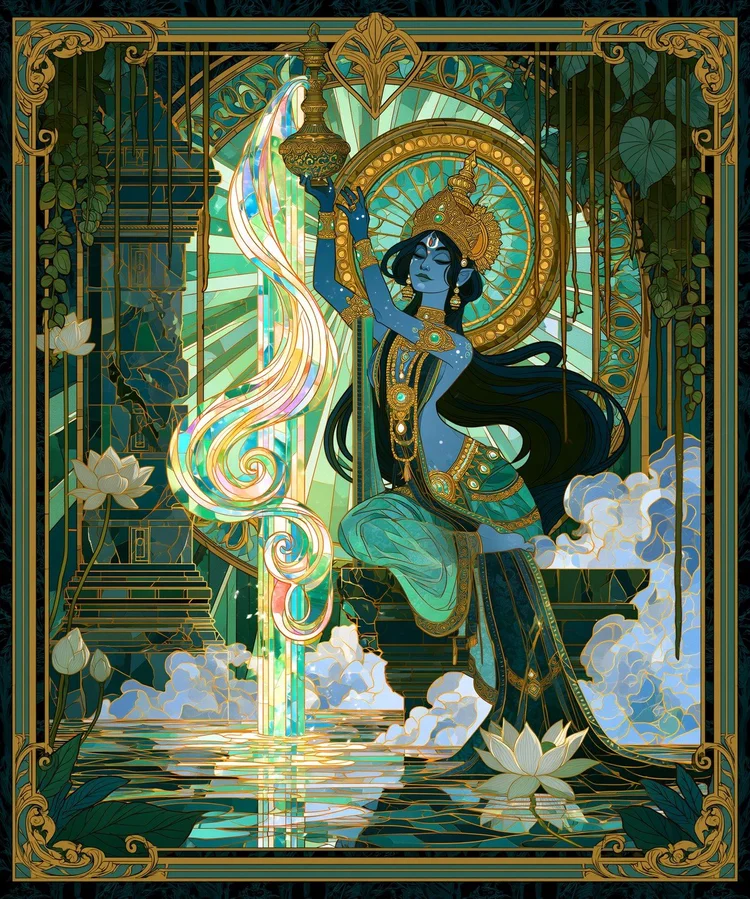
Vishnu's only female form, and the figure this perfume is named for. Her name comes from moha, delusion. She poured the nectar for the worthy and passed the false ones by, and no stolen face survived her gaze.
Vishnuthe preserver
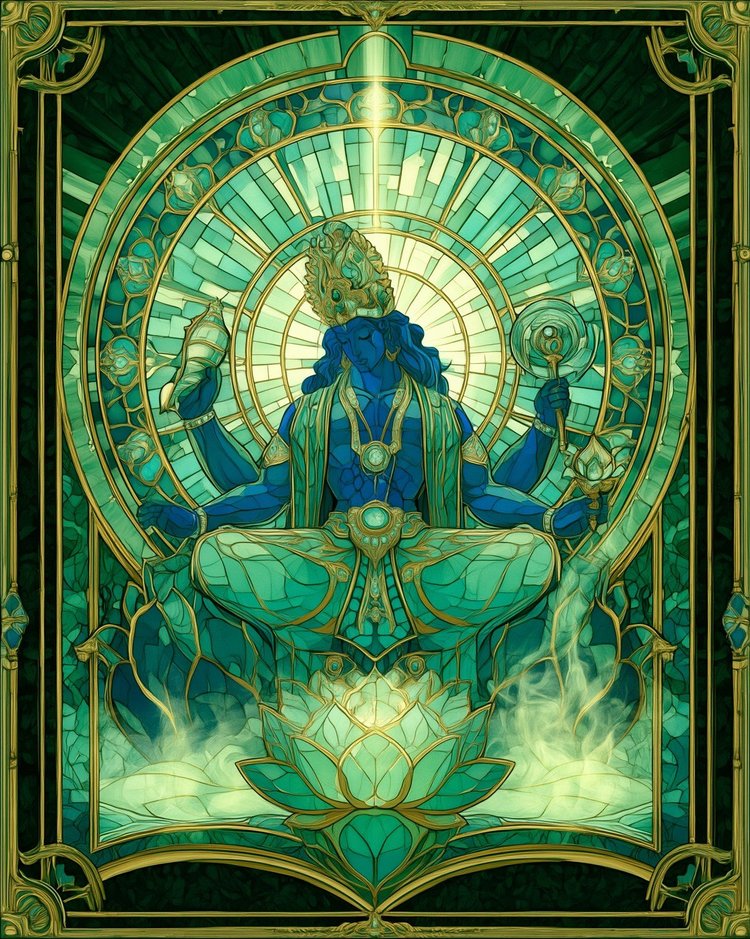
One of the three great gods, blue-skinned and four-armed, who keeps the world in balance. He proposed the churning of the ocean, and when the nectar was stolen he became Mohini to win it back.
The Devasthe gods
The shining ones, weakened by a curse. They churned the ocean alongside their rivals to win the nectar that would restore them.
The Asurasthe demons
Cousins and rivals of the gods. They pulled the serpent's head at the churning, and seized the golden vessel the moment it rose from the sea.
Mount Mandarathe churning rod
The mountain the two hosts uprooted and set in the ocean as the staff of the churn. When it began to sink, Vishnu took the form of a vast tortoise and bore it up on his back.
Vasukithe churning rope
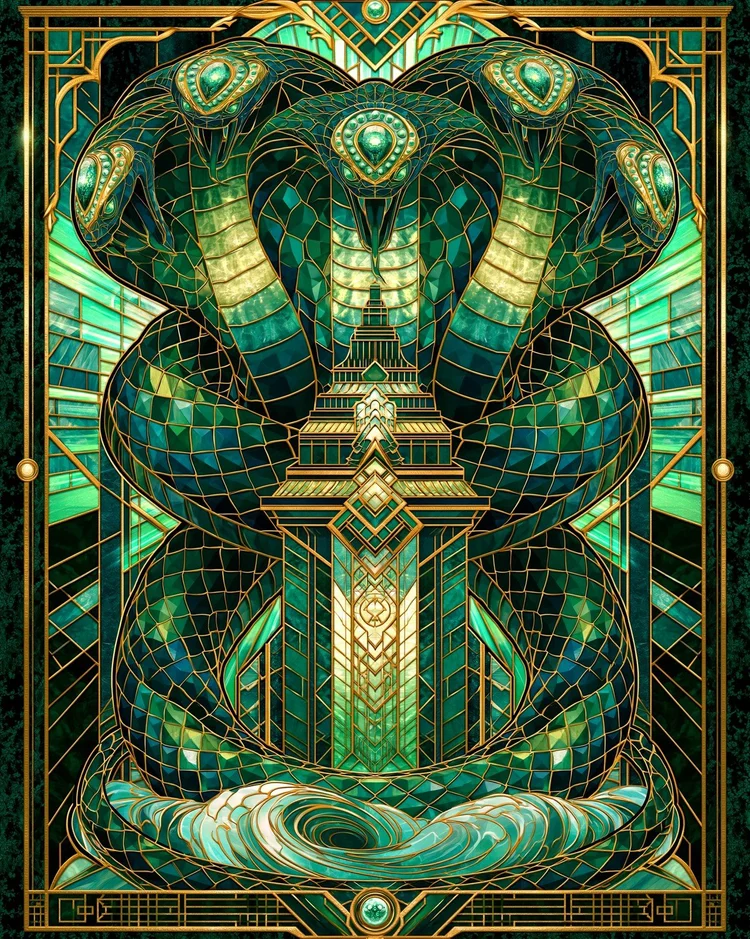
The king of serpents, wound around the mountain so the gods and demons could turn it between them, pulling from either end for an age.
Halahalathe poison
The black poison that rose first from the churned sea, before any treasure, and would have ended the world had it not been caught.
Shivathe blue-throated

The destroyer and transformer, who drank the poison to save the world and held it in his throat, which turned blue and has stayed blue ever since.
Lakshmigoddess of fortune
One of the wonders the ocean gave up. She rose from the foam and chose Vishnu for her own.
Amritathe nectar
The nectar of immortality, last of all the ocean's gifts, carried up in a single vessel of gold. Whoever drinks it will never die. What Mohini did not pour, she sealed and carried into the green.
Rahuthe stolen face

The demon who slipped into the line of the gods wearing a god's face and drank. Beheaded in the same instant, his head had already tasted immortality, and it swallows the sun and moon still. That is an eclipse.
Bhasmasurathe ash demon
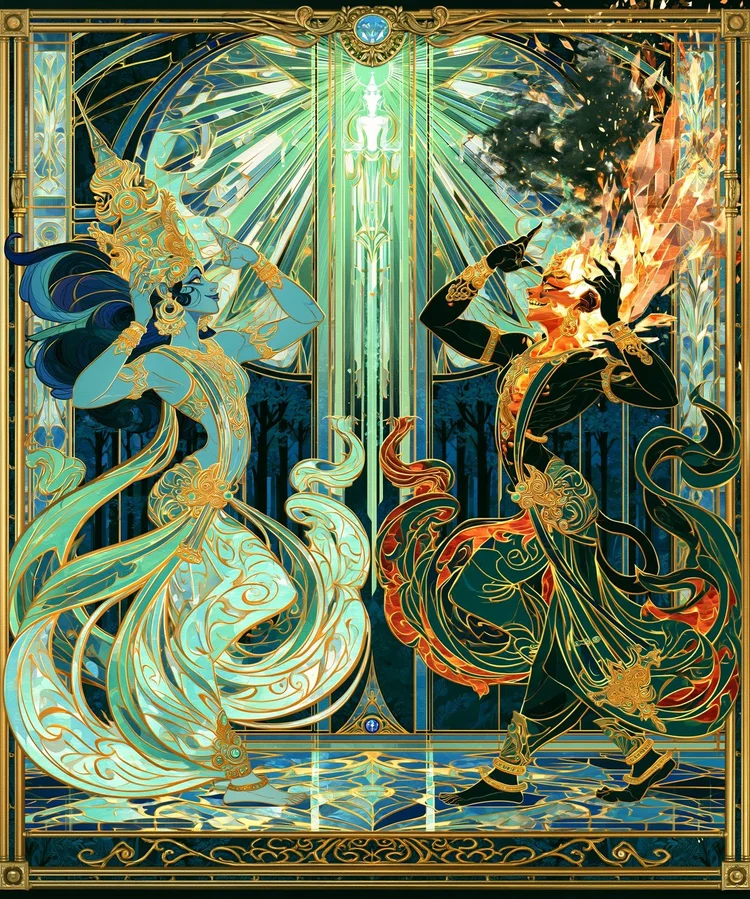
A demon whose touch could turn anyone to ash, and who turned to use it on Shiva. Mohini did not fight him. She danced, and he mirrored her, until he laid his own hand on his own head.