Provenance Materia Amber
MATERIA · THE STAG COLLECTION
Amber
The warm note of perfume, from the rockrose hills of Crete and Andalusia to the balsam forests of El Salvador and the vanilla vines of Madagascar
On 22 July 1700 the French botanist Joseph Pitton de Tournefort rode into Melidoni, a village in the hills of Crete some 22 miles from Rethymno, and was told that July was the harvest of ladanum. On the dry hillocks above the village, men were working through the rockrose with whips of two rows of leather straps, and the work had to be done, he wrote, “in the sultry time of the Day, and in the deadest Calm.” The sticky gum of the leaves clung to the straps. The men scraped it off with knives and shaped it into cakes, and a diligent gatherer made three pounds two ounces a day and sold it on the spot for a crown. Tournefort paid a crown and a half for a whip of his own1. Three centuries later, in the villages of Mylopotamos a short ride away, the rockrose is still swept in the summer heat with a bow hung with strips23. The dark gum those men gathered is the oldest root of the scent perfumers call amber.
Explore this folio
- IWhat it smells like
- IIIn the house
- IIIThree things called amber
- IVThe stone that burns
- VThe rockrose
- VIBeards, whips and sickles
- VIIThe frankincense of Jawa
- VIIIStorax of the Levant
- IXThe Balsam Coast
- XThe black flower
- XIThe sarrapia
- XIIThe molecules of warmth
- XIIIAmbre
- XIVRare and precious
- XVFor the perfumer


IWhat it smells like
The house amber reads like resin warmed in the palm. On the skin it moves through four stages.
- Opening
Dark honey and soft leather from the rockrose gum, with a dry edge of old wood and a faint breath of incense.
- First hour
Benzoin and vanilla come up through it, sweet and lightly powdered, and opoponax adds a honeyed, faintly spiced balsam.
- Heart
The four settle into one golden note, resin and vanilla over the low animal warmth that labdanum keeps at its centre.
- Long drydown
Balsam and powder close to the skin, sweet and slightly smoky, for many hours.
IIIn the house
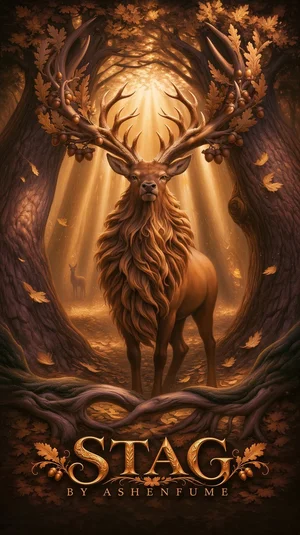
The house builds its amber on labdanum absolute, the purified gum of the rockrose. In Stag it becomes the Labdanum Amber, the house's own accord, composed in the studio around the absolute with opoponax, benzoin and vanilla warmed into it until the four read as one golden note. It sits in the base of the forest chypre beside the Deer Musk Pod Accord, oakmoss and Indonesian sandalwood, and keeps the musk glowing after the pines have faded. Labdanum also carries the heart of Badlands Remastered, beside oakmoss beneath the Utah juniper, and the base of Red Hare. Tonka bean rounds the drydown of Dream Eater. On the bench beside them sit benzoin, the Central American balsams, styrax and vanilla, the old palette of amber that the house draws on bottle by bottle.
 Found in
Stag
The Labdanum Amber in the base of the house forest chypre.
View the fragrance

IIIThree things called amber
The word amber has named three different things, one after another. It began in Arabic. ʿAnbar named a waxy, fragrant substance of the sperm whale, found cast up on the shore, and the word came into Medieval Latin as ambra and into English in the fourteenth century1516. Arabic speakers commonly said the -nb- as -mb-, which gave Europe its amb-16.
Then the word moved. From the late thirteenth century in Anglo-Latin, and from about 1400 in English, amber also meant the yellow fossil resin of the Baltic shore. For a while the two were told apart by colour, white or yellow amber for the stone and grey amber for the sea material. As the sea material fell out of use, the stone kept the name1617. Why the word jumped is uncertain. Both substances wash up on beaches, and that may be the whole of the link16.
Older languages had their own names for the stone. The Greeks called it ēlektron, a word that also named a pale alloy of gold and silver18. Arabic uses an entirely separate word, kahrabāʾ, borrowed from the Persian kāhrubā, the straw attractor, because rubbed amber picks up chaff. The eleventh-century scholar al-Biruni noted that it does so only when rubbed and warmed, and the same word now means electricity in Arabic1918. In 1600 the English physician William Gilbert coined the Latin electricus, like amber, for the same effect16. German calls it Bernstein, from the Middle Low German bernen, to burn: the burn-stone20.
The third amber is the one in a bottle of perfume. In the trade it names a warm accord built from resins, balsams and vanilla, and a careful 1996 review in Perfumer & Flavorist put its foundation plainly: “Labdanum forms the base of amber compounds.” Its formulas add vanillin, benzoin, coumarin and Peru balsam4. The French classification of the Société Française des Parfumeurs counts ambré among its seven families21, and in July 2021 the fragrance classifier Michael Edwards renamed the Oriental branch of his Fragrance Wheel Amber, so that Soft Oriental became Soft Amber and Woody Oriental became Woody Amber2223. The accord borrows the name of a stone, and its materials come from the rockrose, the storax tree, the balsam forests of Central America and the orchid of the vanilla bean.
IVThe stone that burns
Fossil amber has a scent of its own, and the ancients knew it. The Romans called it sucinum, from sucus, sap, because they believed it came from trees. Pliny the Elder offered two proofs: rubbed, it gives off a smell of pine, and lit, it burns like a pine torch, with a resinous smoke2425. Around 98 CE Tacitus wrote that the Aestii, on the Baltic shore, gathered it in the shallows and on the beach. Set alight, he reported, it burns like a torch with an oily, odorous flame, then softens like pitch, and the Aestii were amazed to be paid for it26.

Rome paid well. Under Nero, the manager of the emperor's gladiatorial shows sent a knight about 600 Roman miles north from Carnuntum, on the Danube, to the amber coast. He brought back so much that the nets around the arena, the weapons and the biers were studded with it, a different display each day, and the largest lump weighed thirteen Roman pounds. A small amber figure of a person, Pliny complained, could sell for more than a healthy living slave24. The stone travelled south by river routes along the Oder, the Elbe, the Vistula and the Rhine, and the Adriatic town of Aquileia became a centre of amber carving between the first and third centuries2725.
Baltic amber is about 44 million years old and holds up to about eight percent succinic acid, which gives the stone its mineral name, succinite28. In 1546 the German scholar Georgius Agricola separated that acid from distilled amber29. Early modern pharmacies distilled the stone dry and drew four products from it: oil of amber, crystals of salt of amber, a tincture and a balsam left in the still30. Burnt amber served as a fumigant, its smoke thought to ease childbirth and calm epilepsy2830.
In 1312 the Teutonic Knights took the Baltic amber trade as a monopoly and forbade people to gather it from the beaches. The amber guild of Danzig formed in 1477, and that of Königsberg in 164131. The perfume called amber shares a name and a colour with the stone, the honey gold of resin held to the light.

VThe rockrose

Labdanum comes from two shrubs of the rockrose family, the Cistaceae. The gum rockrose, Cistus ladanifer, which Linnaeus named in 1753, grows wild in Spain, Portugal, southern France, Morocco and Algeria5. Its flowers are white, sometimes with a crimson spot at the foot of each petal, and in Morocco botanists separate a plain white form from a spotted one33. The Cretan rockrose, Cistus creticus, named in 1762, has pink flowers and belongs to the central and eastern Mediterranean, from Crete and Cyprus to Türkiye and the Levant6.
The gum is a sticky oleoresin made by the young leaves and stems32. On the Cretan rockrose it is secreted by glandular hairs on the leaves, and chemists have counted more than three hundred compounds in it34. In Spain the gum rockrose is the jara pringosa, the sticky rockrose, and its scrub, the jaral, runs through the Sierra Morena and the Andévalo of Huelva, thinning out toward Almería35. Rockrose of all kinds covers more than three million hectares of the Iberian Peninsula36. It flowers from March to May and ripens its seed in late summer32, and in Extremadura its pollen is the most important crop of the region's beekeepers14.
What the gum does for the shrub
The rockrose makes its gum to survive a hard place. A study of four wild populations in Badajoz, measured over two years, found that the diterpenes of the leaf gum peak in winter, at about 20.9 milligrams per gram of dry leaf, and fall to about 8.6 in summer. In controlled trials cold alone, with water kept plentiful, raised the three main diterpenes by 64 to 115 percent, and the researchers concluded that temperature decides how much the plant makes37. The flavonoids in the same gum run the other way. They peak in summer, when they act as a screen against ultraviolet light, and they are thought to deter grazing animals37.
The gum also works on the ground. Autumn and winter rains wash the diterpenes into the soil, where they hold back the germination and growth of other plants, and in winter even the rockrose's own seedlings37. Fire does the rest. Heated for fifteen minutes at 90°C, every seed of the gum rockrose germinated, against about thirty percent of seeds left untreated. A single capsule holds 500 to 1,000 seeds, the plant matures in three or four years, and the young shrubs come up in the open ground that fire leaves behind3832. Stands of rockrose that grow this way tend to hold their ground for years and keep few other species39. The perfumer's labdanum is that chemistry of cold, sun, fire and crowding, scraped from the leaf.
VIBeards, whips and sickles
The first writer to describe labdanum placed it in Arabia. Herodotus, in the fifth century BCE, listed ledanon with frankincense, myrrh, cassia and cinnamon among the spices of the Arabians, and wrote that it gathers in the beards of he-goats like gum in timber. It is used in many perfumes, he said, and the Arabians burn it as incense more than anything else4041. Pliny repeated the goat story five centuries later and added a second method, strings wound through the shrub to roll up the sticky leaves. The best ladanum, he wrote, came from Cyprus and sold for 40 asses a pound, and it was cut with myrtle berries and with dirt from the fleeces of other animals42. Dioscorides recorded it as a remedy for coughs and earache43.
Labdanum may be one of the gifts carried into Egypt in the Book of Genesis. The Ishmaelite caravan that bought Joseph came down from Gilead with gum, balm and lōṭ, and Jacob later sent lōṭ to Egypt with balm, honey, pistachios and almonds. The Jewish Publication Society's translation of 2023 renders the word as ladanum in both verses4445. In 1929 the Egyptologist Percy Newberry went further and suggested that the false beard of the pharaohs might once have represented a goat's beard laden with labdanum. It remains one scholar's speculation46.

Crete kept the craft alive. The French naturalist Pierre Belon saw labdanum gathered there under the hot sun in 1548, and the English traveller Bernard Randolph wrote in 1687 of a drug the Venetians called oldani, bought on Crete and shipped to Venice43. When Tournefort reached Melidoni in 1700, he found the whip in use, and he noted that the gatherers kneaded fine black sand into it to make it heavier1. Through the Middle Ages labdanum served as medicine and perfume from Byzantium to the Low Countries, and archaeologists have found it in fifteenth- and sixteenth-century cesspits in northern Belgium. It is still a traditional ingredient of the holy chrism of the Orthodox Church43.
Sises
Today the old harvest survives in one or two villages of northern Crete34. In Sises and Aloides, in the Mylopotamos district of Rethymno, gatherers use the ergastiri, a stick about a metre long with a wooden bow, hung with strips 50 to 60 centimetres long. The strips were once leather, and now they are plastic, which gives up the gum more cleanly. The lightest tool weighs about three kilograms. Work starts in late May and runs from early morning into the afternoon heat. At home, in the afternoon or evening, the gum is scraped from the strips with a blade called the xystri. One tool can gather up to a kilogram and a half a day, and a swept shrub recovers in about two days. In 2014 the gum sold for more than a hundred euros a kilogram23.
In 1983 the researcher Kostas Oikonomakis filmed the gatherers of Sises at work. The eldest, Georgios Tsikalas, known as Benakis, had learned the craft at twelve, and he worked beside Giorgis Mavrakis, who kept the village café. They took bread, salted cheese and a flask of water into the hills, and they said the resin left them warm and sweating all day3. On 14 August 2026 the cultural association of Sises held its fourth Labdanum Festival47.
The jaral of Huelva
In Spain the rockrose is gathered with a sickle. In summer, workers in the Andévalo of Huelva cut the top 50 to 70 centimetres of the young stems by hand, tie them into bundles of 15 to 20 kilograms and haul them out by trailer. The villages of the harvest include Rosal de la Frontera, Cabezas Rubias, El Cerro de Andévalo, Paymogo, Puebla de Guzmán, Calañas and Santa Bárbara de Casa, and Andalusia cuts roughly 1,500 to 2,000 tonnes of plant a year. Cut shrubs regrow strongly the next year3536.
The bundles go into a hot solution of sodium carbonate for ten to fifteen minutes, which loosens the gum from the leaves. Once the bath cools, sulfuric acid is added and the gum separates from the water35. Laboratory replicas of this Andalusian method recover about six to seven percent of the fresh plant as gum. The older method of Zamora, plain boiling water, gives about twenty-five times less3948. Across the industry, about 300 to 350 tonnes of raw gum are drawn each year from 6,000 to 7,000 tonnes of hand-cut shrub39.

VIIThe frankincense of Jawa
Benzoin carries its route in its name. English took the word from Middle French benjoin, through Catalan, from the Arabic lubān jāwī, the frankincense of Jawa49. Jawa, to the medieval Arab sailors, was Sumatra. Ibn Battuta, sailing for China in the 1340s, wrote that his ship headed for the island of Jawa, from which the incense called jawi takes its name50. In the fourteenth century the port kingdom of Samudra-Pasai, on the north coast of Sumatra, shipped pepper, camphor and benzoin from its hinterland51. The Greeks and Romans seem to have had no knowledge of it. By the fifteenth century it was a royal gift. According to the pharmacist and historian John Uri Lloyd, Caterina Cornaro, Queen of Cyprus, received fifteen pounds of it from Egypt in 1476, and in English the name wore down to benjamin52.
Two kinds reach the perfumer. Siam benzoin comes from Styrax tonkinensis in Laos, and Sumatra benzoin from S. benzoin and S. paralleloneurus, which the trade does not separate7. Both are wound resins. A styrax tree makes none until its stem is cut, when the wood forms new resin ducts around the injury, and each fresh cut makes new ducts again53. The Batak farmers of North Sumatra know three trees: haminjon toba, the best, which grows above about a thousand metres, haminjon durame, lower down and of lower quality, and a third that may be a natural cross between them54.
The kemenyan gardens
In Batak country the tapping season opens with a ritual. At the marhottas, farmers set an offering of flour and pork beside a healthy young tree, pray cross-legged to Debata Mulajadi Nabolon through the ancestors, share a meal, and then begin to tap, singing a song twice for each cut. The tapper is to keep a clean heart and clean speech, and Batak lore holds that the tree was once a king's daughter, Boru Raja55. The farmers tap from June to September and gather the resin about three months later, and a well-kept tree can yield for nearly sixty years56. Each tree is cleared of weeds, its trunk cleaned with a knife and notched with a small chisel, and the hardened resin is scraped into a basket, the high notches reached with a rope57. The first flow, from deep in the cut, is white and the best. Later flows run darker and come away with bark5357.
The gardens lie deep in the forest. From the villages of Pandumaan and Sipituhuta, in Humbang Hasundutan, the tappers walk about five hours into the tombak haminjon, the benzoin forest, and stay one to two weeks in single huts, cooking rice and grilling fish. In 2017 Haposan Sinambela and Arnold Lumban Batu described trees that once gave about a kilogram each and, after nearby clearing, about a quarter of that. The customary forest covers 5,172 hectares and has been kept, the villagers say, for seventeen generations58. In Simardangiang, in North Tapanuli, Endi Panjaitan came home to look after his late father's garden. He climbs the trees and cuts the resin free, sleeps in a wooden hut three metres square, and brings in 20 to 40 kilograms a week. In 2023 the best grade, kemenyan toba, sold at 350,000 rupiah a kilogram59.
The fallows of Laos
Siam benzoin grows in the hills of northern Laos, in Luang Prabang, Phongsaly, Houaphan and Oudomxay. There the styrax tree, yan, comes up by itself in the fallow after a crop of upland rice, and farmers sow extra seed before they burn the field. A tree is first cut at about seven years, when its trunk is 12 to 14 centimetres thick. Villagers cut at the end of the rains and gather the dried tears in the cool, dry months, and the tapped trees are felled and burned when the field is cleared again60. Tappers climb as high as ten metres with a bamboo pole and a rope ladder, notching in three lines up the trunk61. In the Khamu village of Ban Sang La Dtai, the best family gathered ten and a half kilograms in 199760.
A study of 2016 counted 201 producing villages in fifteen districts and an average of 48 tonnes a year62. The tears are sorted by hand, because they are too brittle for machines, and after cleaning only about a tenth of a lot makes the top grade6364. The finished resin comes as white-yellow to reddish flattened grains, like almonds, with a strong smell of vanilla65. It travels from Luang Prabang to Vientiane, by truck to Bangkok, and by sea to Marseille63.

VIIIStorax of the Levant
Storax is the oldest name in the amber palette after labdanum, and for most of history it named two materials at once. One was the resin of Styrax officinalis, a shrub of the eastern Mediterranean. The other was the liquid storax of the Oriental sweetgum, Liquidambar orientalis66. Herodotus wrote that the Arabians burned storax to smoke away the winged snakes that guarded the frankincense trees40. In 301 CE Diocletian's edict on prices capped storax from Cilicia at 500 denarii a pound, and among Constantine's gifts to the church of St Peter in Rome were 150 pounds of storax66. Liquid storax was made from June to October, sold through the winter and delivered by spring, carried in leather bags66.
The sweetgum is a relict. It belongs to the Altingiaceae and once grew across Europe in the Pleistocene6768. Today it lives wild only from Rhodes and the eastern Aegean islands to southwestern Türkiye, along riverbanks and in wet alluvial ground, chiefly around Marmaris, Fethiye, Köyceğiz, Dalaman and Ula in the province of Muğla869. It grows 30 to 35 metres tall and lives two to three centuries69. Its forests in Muğla shrank from 6,312 hectares in 1949 to about 1,400 in 2016, cut for the farmland on their rich soils and worn down by over-tapping, grazing and fire, and the tree is listed as Endangered on the global Red List696867.

Kavakarası
The work runs to a calendar. In March, strips of bark 10 centimetres wide and 50 long are taken from two thirds of the trunk. About a month later the wood is cut a few millimetres deep with a spoon-shaped knife, and from mid-July to the end of October the oil is scraped from the wounds every fifteen days69. In July 2023, near Kavakarası, workers were stripping the resin-soaked bark from the sweetgums every week or ten days, as Oktay Aydemir explained, and carrying it in sacks to the production centre in the village. There it was soaked for about ten minutes in boiling water over a wood fire and pressed, and the dark oil sank below the water in the vats. Cüneyt Taşdemir, who ran the operation, put the price at 5,000 to 5,500 lira a kilogram. It was the first season after six years with no production at all7071.
The pressed bark is kept too. Dried, it becomes buhur, burned as incense69. In 2026 the Beyobası forest unit set a target of a tonne of oil and three tonnes of incense, and a closed heating system replaced the open fires under the kettles72. The scale has fallen far. Muğla made about 200 tonnes of sweetgum oil in 1947, 60 in 1970 and amounts measured in kilograms by the 2000s69. In Honduras, Pech tappers in Olancho work the American sweetgum, Liquidambar styraciflua. They cut slanting wounds called huacas, usually at the full moon at the start of the rains, and return every four to six weeks73.
IXThe Balsam Coast
Peru balsam has never come from Peru. It is the balsam of a tall Central American tree, Myroxylon balsamum of the pea family, in the form long called var. pereirae, which botanists now fold into the species75. The tree grows 25 to 30 metres tall and, according to the Salvadoran national standard, grows wild only on the Costa del Bálsamo, the Balsam Coast of El Salvador, at about 300 to 1,000 metres76. The name records a shipping route. Spanish traders gathered the produce of the coast at the Peruvian port of Callao for shipment to Europe, and the balsam took the name of its port7778. In 1935 El Salvador decreed that every container sent abroad must carry the words BALSAMO DE EL SALVADOR in large letters, because buyers overseas believed it came from somewhere else79.
The balsam was a currency long before Europe saw it. It was paid as tribute to the chiefs of Cuscatlan in decorated earthen jars. In Seville the physician Nicolás Monardes described the medicines of the Indies in his books of 1565, 1571 and 15748081. Pope Pius V allowed the bishops of the Indies to use the balsam of Guatemala in the holy chrism in place of the balsam of Egypt82. In 1939 El Salvador named the balsam a national tree. Its Nahuat name, ushit, can also mean ointment, and it grows through the Cordillera del Bálsamo in Jayaque, Talnique, Tepecoyo, Comasagua, Chiltiupán, Teotepeque, Santa Isabel Ishuatán, San Julián and Cuisnahuat83.
The balsameros of Atiluya
The tree gives nothing until it is hurt. The old pharmacopoeias called the balsam a pathological product: the bark is beaten or scorched before it flows7784. Between 2005 and 2006 the ethnographer Zachary Revene worked with the balsameros of Atiluya, in Santa Isabel Ishuatán, Sonsonate, for El Salvador's national culture council. The men work 15 to 20 metres up. The honderos climb on about fifty metres of natural-fibre rope, and the tableros sit on a board held by a knot called the honda falsa. Revene photographed don Tulio, a tablero, heating the bark, and don Ángel laying cloths on the wound. One man of 72 had climbed as a hondero since he was fifteen and meant to switch to the board and work lower on the tree85.
The balsameros have a word for each step. In the calienta, a torch of wooden splints about a metre long, the tizón, is held to the bark, with a tin sheet against the wind. In the pega, cloths called pañales are laid on the wound for about fifteen to twenty days to soak up the balsam. Then the cloths come off, the burned bark is scraped with blades made from old machetes, and the cloths go back for a second and a third round. At the end, cloths and bark are boiled and twisted in a wooden press, the torcedera, and the heavy balsam settles under the water. The Atiluya area has 22 torcederas85. At a farm in San Julián, the windows cut in the bark are 5 centimetres wide and 25 to 90 long, the embers stay on for one or two days, and the cloths are boiled for fifteen to twenty minutes, since longer boiling darkens the balsam. Twisting the bundles takes strength and a second man78.
The work belongs to the dry months, from late November to May, and in the rains the balsameros grow food8576. A tree is first tapped at about twenty to thirty years and gives 2.5 to 3.5 kilograms of balsam a year, more in hot, dry weather and most at about sixty years of age978. Many balsameros work as sharecroppers, keeping half of the balsam from trees on another man's land85. In 1997 El Salvador exported 381 tonnes, its largest year between 1994 and 2002, about 95 percent of it to the United States, Germany, France and Britain86.
Tolu
The second balsam comes from the same species further south. Monardes described Indians near Cartagena cutting the bark of the tree and fixing shells of black wax to catch the flow, in a district “called Tolu, from which it takes its name.” In 1581 the botanist Clusius received a sample from Hugh Morgan, druggist to Queen Elizabeth87. Tolu tappers cut a shallow V into the bark and two wider Vs above it, and the balsam runs into gourds fixed to the trunk. A tree is worked for two or three years and then rested988. Fresh Tolu is a soft brownish-yellow solid that hardens until it turns brittle9. In 1841 the chemist Henri Sainte-Claire Deville distilled a hydrocarbon from it, and the solvent toluene still carries the balsam's name8990. In the Colombian department of Sucre the tree is now classed as Near Threatened91.

XThe black flower
Vanilla is the fruit of an orchid, Vanilla planifolia, a climbing vine of the wet tropics whose wild range runs from southern Mexico to northern Brazil92. The Nahuatl name, tlilxochitl, is read by Nahuatl speakers today as the black flower. The first European drawing of it is in the Badianus manuscript of 1552, an Aztec herbal, which calls the pods vainillas, small pods93. The Totonac of Papantla, in Veracruz, are held to be the first to grow and cure it, and they paid cured pods in tribute to the Aztecs94. The oldest reports of its use come from the Maya, who flavoured cacao with it95. Tahitian vanilla, V. × tahitensis, is a hybrid of V. planifolia with another species, probably made by people. Its discoverers propose that the cross happened in Maya forest gardens, and the vine later crossed the Pacific9697.
An orchid without its bee
The flower is hard to pollinate, and in the wild it is seldom pollinated at all. Each blossom lasts a single day. It begins to open around one in the morning, shows its lip most fully around ten, and closes by early afternoon. In a study in Yucatán, published in 2024, researchers watched 76 flowers for 63 hours and recorded no visit that pollinated a flower. Male orchid bees swarmed to scent lures nearby and all but ignored the blossoms, and a colony of the stingless bee Melipona beecheii set beside the vines never came near. Left open, 4.9 percent of flowers set fruit. Pollinated by hand, 70.4 percent did74. The long-told story that stingless bees are vanilla's pollinator traces back to an account of 1884 that mixed up several bees and several vanillas98.
The orchid keeps its scent locked away. The green pod stores vanillin as a scentless sugar compound, glucovanillin, in tissue kept apart from the enzyme that frees it, and only the breaking of the cells in curing brings the two together99. Green beans from Hainan held 10.67 percent glucovanillin and 0.03 percent vanillin. Cured, they held 0.17 percent glucovanillin and 2.97 percent vanillin100.

Edmond's thumb
The first recorded hand pollination of vanilla was made by the Belgian botanist Charles Morren in Liège on 16 February 1836. His vine gave 54 pods98. The method that changed the crop came from a boy. Edmond, born enslaved in 1829 on the Bellevue plantation at Sainte-Suzanne on the island of Bourbon, now Réunion, worked out in 1841, at about twelve, how to lift the flap inside the flower and press the pollen onto the stigma101. The method was published in 1843, describing a toothpick or a pin98. Réunion exported no vanilla in 1841 and over three tonnes in 185898. Freed in 1848, Edmond took the surname Albius. He received no reward for his discovery, and he died in the public hospital at Sainte-Suzanne in 1880101102.
The vines of SAVA
Most of the world's finest vanilla now grows in northeast Madagascar, in the region named for its four towns, Sambava, Antalaha, Vohémar and Andapa103. Estimates of Madagascar's share range from about four fifths of the trade to half of the world's premium beans, and somewhere between 70,000 and 100,000 farmers grow it104103. Pollination runs from October to December, every flower by hand, in the morning while it is open10310. In 2017 a farmer named Jacky, who lived with his family in a treehouse in a cleared patch of forest, told Al Jazeera that he slept beside his flowers to guard them and pollinated them with a tool he cut from a branch, like a toothpick. Velomora showed the reporter the wooden tool, studded with small nails, that his family once used to prick each bean with its own mark104.
The beans ripen over many months. They are picked one by one as the tip yellows, and curing must begin within a week10. In the Bourbon method of Madagascar, Réunion and the Comoros, the beans are killed in hot water for a few minutes, sweated for a day or two in blanket-lined boxes, laid in the sun from noon to three and sweated again, day after day, for up to two weeks, then dried slowly in the shade and conditioned in closed boxes for two months or more. Between four and a half and six kilograms of green beans make one kilogram of cured10.

XIThe sarrapia
Tonka is the seed of Dipteryx odorata, a great forest tree of the pea family with purple flowers. Its almond-shaped seeds are three to four centimetres long, dark brown and wrinkled outside and pale within11105. In Venezuela it is sarrapia, and the best groves are in the lower basin of the Caura, in Bolívar. Gatherers pick the fallen fruit from the forest floor from late January to April and crack the hard shell with a stone, and it takes 350 to 400 fruits to make a kilogram of seed106. Soaked in rum or alcohol, the beans grow a frost of coumarin crystals on the skin105. Venezuela's sarrapia trade peaked in 1942, at 784 tonnes106.
Coumarin makes up one to three percent of the bean, and up to about four percent in samples measured in 2025107. Coumarins can serve plants as a defence against grazing insects. In feeding trials with the main coumarin of another shrub, Daphne laureola, one caterpillar avoided it, a second preferred it, and a third refused it only in its food108. In a related tonka tree on Barro Colorado Island, in Panama, fruit bats carry whole fruits to their roosts hundreds of metres away, and agoutis bury the seeds more than fifty metres from the parent109. In 1820 the chemist Vogel drew a crystalline substance from tonka beans and took it at first for benzoic acid. The French pharmacist Guibourt later named it coumarin110.
XIIThe molecules of warmth
Each material brings its own few molecules to the accord, and they overlap. The balsams and benzoin share a family of esters built from benzoic and cinnamic acid. Peru balsam is about half to two thirds benzyl esters, chiefly benzyl benzoate with benzyl cinnamate849. Benzyl benzoate smells faint, sweet, oily and balsamic. Benzyl cinnamate is sweet and floral with a hint of cherry and a powdery balsam, and it lasts more than ten days on a blotter111112. Siam benzoin runs to benzoic acid and coniferyl benzoate, Sumatra benzoin to cinnamic acid and its esters, and both carry a trace of vanillin, most easily found in the Siam765. Grade A Sumatra benzoin holds about 21 percent of one cinnamate alone, p-coumaryl cinnamate113. Styrax adds cinnamyl cinnamate and the sweet, faintly plastic note of styrene114115.
Labdanum supplies the depth. Its absolute is about four fifths diterpenoid39, and in the oil distilled from it, chemists in 1998 identified 186 compounds among more than 300. Among them were ledene and viridiflorol, 2,2,6-trimethylcyclohexanone, and 1.4 percent of ambroxide, a molecule with a dry, woody amber odour that perfumers otherwise build in the laboratory12116. Vanilla brings vanillin, with smoky guaiacol, spicy eugenol and a strawberry-like ester, ethyl cinnamate, behind it, and Tahitian beans add the anise and cherry of anisyl alcohol and anisaldehyde117. Tonka brings coumarin, which smells of sweet hay with a creamy, nutty edge118110.
XIIIAmbre
Chemistry gave the accord its modern shape. In 1858 Théodore Gobley isolated vanillin from vanilla pods119. In 1868 William Henry Perkin made coumarin from coal-tar chemicals120121, and in 1874 Ferdinand Tiemann and Wilhelm Haarmann made vanillin from coniferin, a compound in the sap of young conifer wood. A vanillin factory opened at Holzminden the next year122123. Synthetic coumarin first went on sale in a perfume in Fougère Royale, in 1882121, and Jicky, in 1889, was among the first perfumes built with synthetic materials124. Around 1905 Ambre Antique appeared, a perfume the trade press now calls the first of the amber family125. In 1925 Shalimar was launched at the Paris exhibition of decorative arts, and a well-worn story says it began when its perfumer poured ethyl vanillin into a bottle of Jicky126.
The east kept older ambers. In Kannauj and Old Delhi, the attar makers distil their winter perfumes in copper stills over wood fires into receivers of sandalwood oil. Shamama, the oldest of them, is distilled from many herbs and spices for about fifteen days, and it is sold beside hina and mushk-e-amber. In the mixed perfumes of Arabia shamama goes by the name shamamatul amber127128129.

XIVRare and precious
Every material in the accord is gathered by hand, most of it by people who live in the forest or the hills it comes from. A kilogram of natural vanillin takes about 500 kilograms of pods and the hand pollination of some 40,000 flowers, and vanillin from the bean costs about 1,200 to more than 4,000 dollars a kilogram119. Black Madagascar vanilla reached a record 635 dollars a kilogram in 2018, when police and village guards caught more than a thousand vanilla thieves in a year130. The price then fell. Green vanilla that fetched about 36 euros a kilogram at the farm gate in 2018 fetched about 2.2 in 2023103.
The trees ask patience. A Peru balsam tree is first tapped at twenty years or more and gives a few kilograms a year9. A Lao styrax gives about half a kilogram a year, a Sumatran a tenth of a kilogram to a whole one, depending on the tree60131. The sweetgum oil of Muğla, which once ran to hundreds of tonnes, now comes in tonnes, from forests that have lost more than three quarters of their area since 194969. The rockrose is the exception, a shrub of fire and broken ground that regrows the year after it is cut35.
Some of the materials are strong on the skin. Peru balsam is a long-standing marker in dermatology clinics for fragrance allergy132. The fragrance industry's own standards allow Peru balsam and styrax only as purified extracts and distillates, capped by type of product133134. Perfumers working with these materials should read the current texts, which change with each amendment.
XVFor the perfumer
The forms, yields, chemistry, standards and trade behind the amber materials, for quick reference at the bench.
Labdanum: from shrub to absolute
| Step or form | Figure | Source |
|---|---|---|
| Andalusian method (sodium carbonate, then acid) | 5.79 to 7.44% gum on fresh plant | 3948 |
| Zamorean method (boiling water) | 0.23%, about 25 times less | 39 |
| Gum to absolute (methanol, chilled to minus 20°C) | About 70 to 73% | 3948 |
| Absolute fractions | About 80% diterpenoid, 10.6% flavonoid | 39 |
| Cistus leaf oil, hydrodistilled | 0.19 to 0.42 mL per 100 g dried plant | 32 |
| World raw gum | About 300 to 350 t a year from 6,000 to 7,000 t of shrub | 39 |
| Andalusian cut | About 1,500 to 2,000 t of plant a year, 90% to gum and oil | 35 |
| Cretan ergastiri | Up to 1.5 kg a day | 2 |
| Cretan whip, 1700 | 3 lb 2 oz a day, a crown on the spot | 1 |
Season and chemistry. Leaf-gum diterpenes peak in winter (20.93 mg/g dry leaf) and fall in summer (8.57). The main ones are 6-acetoxy-7-oxo-8-labden-15-oic acid, 7-oxo-8-labden-15-oic acid and oxocativic acid. Flavonoids run 0.6 to 3.4% of leaf dry weight and peak in summer37, 14 to 28% of the gum in summer-cut plants and 6 to 16% in winter48. Labdanolic acid is a major compound that UV detectors miss48.
| Constituent | Share | Note |
|---|---|---|
| Ledene | 9.3% | 186 compounds identified, about 95% of the oil12 |
| Viridiflorol | 4.3% | 12 |
| Cubeban-11-ol | 4.1% | 12 |
| Ambroxide | 1.4% | Dry amber, woody, paper, musk12116 |
| 2,2,6-Trimethylcyclohexanone | 1.3% | 135 |
| Dihydrocinnamic acid | 6.5% | 135 |
| Labd-7-enoic acid | 6.3% | 135 |
| Oxidised aromadendranes, C15 to C20 | 23% | 12 |
Cistus leaf oil by region. Extremadura: viridiflorol 19.9%, ledol 9.6%, α-pinene 4.5%. Guadalajara: α-pinene 48.2%. Zamora and Huelva: α-pinene 19.3 to 42.5%32. Oulmès, Morocco: viridiflorol 17.6%, trans-pinocarveol 11.0%, bornyl acetate 9.4%33. The house reads the high-pinene oils as resinous and piney, the viridiflorol and bornyl acetate oils as woodier and more ambered.
Crete. Cretan ladano holds ent-manoyl oxide isomers and sclareol among its labdane diterpenes136, and sclareol carries most of its antistaphylococcal activity137. Odour descriptors: absolute amber, woody, old wood, sweet, musty. Oil woody, amber, incense, balsamic, spicy138.
Benzoin: Siam and Sumatra
| Siam | Sumatra | |
|---|---|---|
| Tree | Styrax tonkinensis, Laos7 | S. benzoin and S. paralleloneurus7 |
| Acids | Benzoic acid 15 to 45%, coniferyl benzoate 15 to 60%, no cinnamic acid65 | Cinnamic acid and its esters7, p-coumaryl cinnamate about 21% in grade A113 |
| Vanillin | Minor, easiest to detect657 | Minor7 |
| Form | Hard, cream to pale orange tears, milky inside7 | Almonds, and blocks of tears in reddish resin139 |
| Ethanol-insoluble cap (BP 1980) | 5%139 | 20%139 |
| Odour | Sweet, vanilla, balsamic, woody, powdery140 | Sweet, spicy, vanilla, balsam, resinous140 |
Forms. Benzoin gives a negligible oil on distillation. Perfumery uses tinctures, resinoids and absolutes139. Tincture of benzoin is 10% in alcohol53.
Yields. Laos: tapping from about 7 years, 0.4 to 0.6 kg a tree, 160 to 240 kg a hectare60. Older estimates give 1 to 3 kg139. Sumatra: 0.1 to 0.5 kg a tree, a good tree about 1 kg131. Farm households harvest 48 to 98 kg a year57. After cleaning, a Lao lot is about 10% grade A, 10% B and 35 to 40% each C and D63.
Adulteration. Sumatran blocks are often built with damar, and Indian samples have been cut with pine rosin. The British Pharmacopoeia tests Sumatra benzoin for damar139. Sumatra benzoin has been sold as Siam with added vanilla64. Liquid chromatography separates the two origins141.
Styrax
Calendar, Muğla. March: strips 10 by 50 cm off two thirds of the trunk. May: wood cut 3 to 4 mm with a spoon knife. Mid-July to October: scraped every 15 days. Scrapings boiled in hair bags about 30 minutes and pressed. Oil keeps 25 to 30% water. Residue burned as buhur69.
Chemistry. Turkish styrax: cinnamyl cinnamate 21.5%, 3-phenylpropyl cinnamate 7.5%, cinnamic acid 4.0%, cinnamyl alcohol 2.0%. The balsam is about 60% triterpene acids (storesin). A 2021 distilled oil gave (E)-ethyl cinnamate 27.5 to 30.6%, torreyol 11 to 12%, cinnamyl alcohol 7.2 to 7.9%114. Styrene varies from under 1% to over 80% by form and study69114. American styrax is darker and cleaner, its odour masked by a styrene note142.
Forms. Steam-distilled oil, resinoids and absolutes. Crude balsam is often saponified before distillation to free cinnamyl alcohol142. Pyrolysed oils must be rectified to low levels of polycyclic aromatics134.
Peru and Tolu balsams
| Standard | Cinnamein (benzyl esters) | Other |
|---|---|---|
| British Pharmaceutical Codex, 1911 | 56 to 66% | About 28% resin84 |
| US Dispensatory, 1918 | About 60%, British standard at least 57% | Acid number 56 to 84, specific gravity 1.130 to 1.16077 |
| British Pharmacopoeia, 1990s | 45 to 70% esters | Saponification value 230 to 2559 |
| Salvadoran norm, 2008 | At least 40% | Density 1.150 to 1.170 g/mL, acid value 56 to 8476 |
Composition. Benzyl benzoate dominates, with benzoic acid, cinnamic acid, benzyl cinnamate and 3,4-dimethoxycinnamaldehyde. Nerolidol is small, and vanillin and coniferyl benzoate are minor. Aged balsam shows more free acid, a sign of slow ester hydrolysis13.
Tolu. Resin about 80%, free cinnamic acid 12 to 15%, about 7.5% benzyl benzoate with a little benzyl cinnamate, vanillin 0.05%. Fresh Tolu gives 1.5 to 3.0% volatile oil88.
Forms. Peru balsam steam-distils poorly. Usable oil comes by vacuum distillation or solvent, and true Peru balsam oil is semi-solid at room temperature, so a runny oil probably holds a diluent9. Ethanol extraction of the bark gave 36% against 18.7% by the traditional process86.
Adulteration, 1918. Castor oil, copaiba, Canada turpentine, Tolu dissolved in alcohol, and a synthetic sold as Perugen. Genuine balsam turns violet to cornflower blue with sulphuric acid77. In 1995 Tolu on offer could be wholly synthetic9.
Vanilla
| Stage | Practice | Source |
|---|---|---|
| Killing | Hot water a few minutes. Most vanillin at 65°C for 1 minute in trials | 1099 |
| Sweating | 36 to 48 hours in blanket-lined boxes from 48 to 50°C | 10 |
| Sun drying | Noon to 3 pm, to about 50°C, alternated with sweating 12 to 14 days (grade I) | 10 |
| Slow drying | About 35°C and 70% humidity, 20 to 35 days | 10 |
| Conditioning | About two months in waxed-paper boxes, three recommended | 10 |
| Ratio | 4.5 to 6 kg green to 1 kg cured | 10 |
Vanillin. About 2% of the cured bean, ranging from 1 to 3% by origin and study. Market maximums by origin: Bourbon 2.9%, Indonesia 2.7%, Mexico 1.8%, Tahiti 1.5%1011999. More than 200 compounds in all119.
Odorants by origin. Vanillin leads in Madagascar, Comoro and Tahiti beans (6,201, 8,053 and 1,501 µg/g). Guaiacol (burnt) is highest in Comoro beans. Tahitian beans hold 1,175 µg/g anisyl alcohol against 8 in Madagascar beans117.
Grades and authenticity. Brown beans 18 to 22% moisture, black 25 to 35%. Length grades from 15 cm and over10. Bean vanillin runs about −22.2 to −14.6‰ δ13C, petrochemical vanillin −36.2 to −24.9‰, lignin vanillin −28.7 to −26.5‰. Site-specific NMR catches blends that bulk isotopes miss143. Beans picked green in the 2017 to 2018 boom fell from 1.8% to 1% vanillin130.
Tonka and coumarin
Coumarin 20.4 to 43.4 mg/g in six tonka samples (2025)107. First isolated by Vogel, 1820. Synthesised by Perkin, 1868110120. About 1,850 t used worldwide in 1995, 1,700 t in fragrance110. In the United States any food with added coumarin, or tonka, has been adulterated since 1954144.
Standards in force (dated)
| Material | Rule | Source |
|---|---|---|
| Peru balsam | Crude prohibited. Extracts and distillates restricted, 0.41% in fine fragrance (Amendment 49, 2020) | 133 |
| Styrax | Crude prohibited. Resinoids, absolutes and oils restricted, 0.69% in fine fragrance (Amendment 49, 2020) | 134 |
| Coumarin | Restricted, 1.5% in fine fragrance (Amendment 49, 2020) | 145 |
| Benzoin, labdanum | No standard of their own in the 51st Amendment index | 146 |
| European labelling | Peru balsam oil and extract, and vanillin, added to the declarable allergens (Regulation 2023/1545, new products from 31 July 2026) | 147 |
| Patch testing | Peru balsam sensitises 4 to 8% of patients routinely tested | 132 |
These standards change with each amendment. Check the current texts before formulating.
Trade and price
| Year | Figure | Source |
|---|---|---|
| 1st century | Best ladanum 40 asses a pound | 42 |
| 301 | Cilician storax capped at 500 denarii a pound | 66 |
| 1942 | Venezuelan sarrapia exports 784 t | 106 |
| 1947 | Turkish sweetgum oil about 200 t | 69 |
| 1995 | Peru balsam 13.50 dollars a kg (London), Tolu 15 (New York), Turkish styrax about 11.75 | 9142 |
| 1996 | Siam benzoin, Marseille: grade A 16 dollars a kg, D 8 to 9 | 63 |
| 1997 | El Salvador exports 381 t of Peru balsam | 86 |
| 2006 to 2015 | Laos, 48 t of benzoin a year on average | 62 |
| 2014 | Cretan labdanum over 100 euros a kg | 2 |
| 2018 | Madagascar vanilla record 635 dollars a kg | 130 |
| 2020 to 2023 | Madagascar minimum export price, 250 dollars a kg, lifted May 2023 | 148 |
| 2023 | Green vanilla 2.2 euros a kg at the farm gate | 103 |
| 2023 | Kemenyan toba 350,000 rupiah a kg | 59 |
| 2026 | Turkish sweetgum oil 7,500 to 15,000 lira a kg | 149 |
Amber through the centuries
- 44 million years ago
The resin of Baltic amber forms in the forests of the Eocene28.
- 5th century BCE
Herodotus describes ledanon combed from goats' beards in Arabia41.
- 1st century
Pliny records amber's pine smell and the price of ladanum2442.
- 301
Diocletian's edict caps the price of storax66.
- 14th century
Ibn Battuta names Sumatra as the home of jawi incense50.
- 1552
The Badianus manuscript draws the black flower93.
- 1574
Monardes describes the balsam of Tolu87.
- 1700
Tournefort watches the ladanum whips at Melidoni1.
- 1841
Edmond Albius hand-pollinates vanilla on Réunion101.
- 1868
Perkin makes coumarin120.
- 1874
Tiemann and Haarmann make vanillin122.
- About 1905
Ambre Antique appears, later called by the trade press the first amber125.
- 1935
El Salvador decrees BALSAMO DE EL SALVADOR on every export container79.
- 2021
The Oriental family of the Fragrance Wheel is renamed Amber22.
Found in
Stag
The Labdanum Amber in the base of the house forest chypre.
The Stag collectionMore from the November forest
 ✦ Folio No. 7
Deer Musk
The musk that the Labdanum Amber keeps glowing in the base of Stag.
Read the folio
 ✦ Folio No. 28
Siberian Fir
The soft fir of the dark taiga, one of the three conifers that open Stag.
Read the folio
 ✦ In Stag
Oakmoss
The lichen of the oak, set against labdanum in every chypre.
Folio to come
✦ ✦ ✦
Sources & image credits149 references
- Joseph Pitton de Tournefort, A Voyage into the Levant, vol. 1, Letter II (London: D. Browne et al., 1718), trans. John Ozell.↑
- Athina Petrakaki (ed.), “Σίσες και Αλόϊδες: Παγκόσμια αποκλειστικότητα στη συλλογή του αλάδανου”, Rethemnos News (15 January 2014).↑
- Kostas D. Oikonomakis, “Οι αλαδανάρηδες του Μυλοπόταμου”, first published in ΕΘΙΑΓΕ (NAGREF) magazine no. 34 (Oct-Dec 2008), republished by dasarxeio.com (18 May 2014).↑
- Danute Pajaujis Anonis, “Amber Notes in Perfumery: Amber Perfumes, Compounds and Specialties”, Perfumer & Flavorist 21 (January/February 1996).↑
- Plants of the World Online, Cistus ladanifer L., Royal Botanic Gardens, Kew (accessed 20 November 2026).↑
- Plants of the World Online, Cistus creticus L., Royal Botanic Gardens, Kew (accessed 20 November 2026).↑
- Kashio M., Johnson D.V. (eds), Chapter 2, Description of gum benzoin, in Monograph on benzoin, RAP Publication 2001/21, FAO, Bangkok (2001).↑
- Plants of the World Online, Liquidambar orientalis Mill., Royal Botanic Gardens, Kew (accessed 20 November 2026).↑
- Coppen J.J.W., Peru and Tolu balsams, in Gums, resins and latexes of plant origin, FAO Non-Wood Forest Products 6, Rome (1995), as reproduced by Pl@ntUse.↑
- De La Cruz Medina J., Rodríguez Jiménes G.C., García H.S., Vanilla: post-harvest operations, FAO Post-Harvest Compendium, Food and Agriculture Organization of the United Nations (2009).↑
- Plants of the World Online, Royal Botanic Gardens Kew, Dipteryx odorata (Aubl.) Forsyth f.↑
- Weyerstahl P., Marschall H., Weirauch M., Thefeld K., Surburg H., Constituents of commercial labdanum oil, Flavour and Fragrance Journal 13(5), 295-318 (1998).↑
- Riesmeier M., Mattonai M., Wong S.S., Veall M.-A., Betts J., Johnston M., Ribechini E., Devièse T., Molecular profiling of Peru balsam reveals active ingredients responsible for its pharmaceutical properties, Natural Product Research (online 21 April 2020), doi:10.1080/14786419.2020.1753056.↑
- Instituto de Investigación de la Dehesa, Aprovechamiento múltiple de jarales, Oportunidades económicas de la dehesa, ficha 1, Universidad de Extremadura (n.d.).↑
- Merriam-Webster Dictionary, “amber” (accessed 2026).↑
- Online Etymology Dictionary, “amber”, ed. Douglas Harper (accessed 2026).↑
- Victor Mair, “Amber in the east”, Language Log, University of Pennsylvania (12 January 2026).↑
- Faya Causey, “Ancient Names for Amber”, in Ancient Carved Ambers in the J. Paul Getty Museum (Los Angeles: J. Paul Getty Museum, 2012, online ed. 2019).↑
- John M. Munro, “Amber Forever”, Saudi Aramco World 32, no. 6 (November/December 1981): 32-36.↑
- Digitales Wörterbuch der deutschen Sprache, “Bernstein”, etymology after W. Pfeifer, Etymologisches Wörterbuch des Deutschen.↑
- Slate.fr, “7 familles” (on the Société Française des Parfumeurs classification).↑
- Jeb Gleason-Allured, “Goodbye Oriental, Hello Ambery”, Global Cosmetic Industry (22 June 2021).↑
- British Society of Perfumers, “Fragrances of the World changes Oriental category to Amber” (19 June 2021).↑
- Pliny the Elder, Naturalis Historia 37.11-12 (sections 30-51), Latin text, The Latin Library.↑
- Mark Cartwright, “Amber in Antiquity”, World History Encyclopedia (11 September 2017).↑
- Tacitus, Germania 45, trans. A. S. Kline (2015).↑
- Faya Causey, “The Ancient Transport of Amber”, in Ancient Carved Ambers in the J. Paul Getty Museum (Getty, 2012, online ed. 2019).↑
- Christopher J. Duffin, “Historical Survey of the Internal Use of Unprocessed Amber”, Acta medico-historica Adriatica 13, no. 1 (2015): 41-74.↑
- Museum of Fine Arts, Boston, CAMEO: Conservation and Art Materials Encyclopedia Online, “Succinic acid”.↑
- Christopher J. Duffin, “Amber: A versatile component of the early modern materia medica”, Hektoen International (20 August 2026).↑
- Russell Shor, “The History and Reconstruction of the Amber Room”, Gems & Gemology 54, no. 2 (Winter 2018): 378-393.↑
- Pérez-Izquierdo C., Jordán Bueso M.J., Rodríguez-Molina M.C., Pulido F., Spatial variation in yield, chemical composition, and phytotoxic activity of Cistus ladanifer essential oils, Chemistry & Biodiversity 20, e202300995 (2023).↑
- Mechchate H. (entry), Essential oil from Cistus ladanifer L., Encyclopedia, adapted from Plants 10(10), 2068 (2021).↑
- Batsaki Y., Plant of the month: Cretan rockrose, JSTOR Daily (23 February 2022).↑
- Red de Información Ambiental de Andalucía, Cistus ladanifer L., jara pringosa, ethnobotanical species sheet, 65-75 (n.d.).↑
- European CAP Network, ESjara: rockrose essential oil development for the bioeconomy of rural areas, EIP-AGRI Operational Group (2023-2025).↑
- Alías J.C., Sosa T., Valares C., Escudero J.C., Chaves N., Seasonal variation of Cistus ladanifer L. diterpenes, Plants 1, 6-15 (2012).↑
- Dias L.S., Pereira I.P., Dias A.S., Seed germination in Cistus ladanifer: heat shock, physical dormancy, soil temperatures and significance to natural regeneration, Plants 8(3), 63 (2019).↑
- Frazão D.F., Martins-Gomes C., Sosa Díaz T., Delgado F., Gonçalves J.C., Silva A.M., Labdanum resin from Cistus ladanifer L. as a source of compounds with anti-diabetic, neuroprotective and anti-proliferative activity, Molecules 29(10), 2222 (2024).↑
- Herodotus, Histories 3.107, trans. A. D. Godley, Loeb Classical Library (1920), Greek text at perseus-grc2 3.107.1.↑
- Herodotus, Histories 3.111-113, trans. A. D. Godley, Loeb Classical Library (Harvard University Press, 1920).↑
- Pliny the Elder, Natural History 12.37, “Ladanum and stobolon”, trans. John Bostock and H. T. Riley (London, 1855).↑
- Yota Batsaki, “Plant of the Month: Cretan Rockrose”, JSTOR Daily (23 February 2022).↑
- Genesis 37:25 and 43:11, The JPS Tanakh: Gender-Sensitive Edition (Jewish Publication Society, 2023), via Sefaria.↑
- Genesis 37:25 and 43:11, New Revised Standard Version Updated Edition (2021), BibleGateway.↑
- Wikipedia, “Labdanum”, used as a map to P. E. Newberry, “The Shepherd’s Crook and the So-Called Flail or Scourge of Osiris”, Journal of Egyptian Archaeology 15 (1929): 84-94.↑
- Politika Kritis, “Ρέθυμνο: 4η Γιορτή Αλαδάνου στις Σίσες Μυλοποτάμου” (18 July 2026).↑
- Frazão D.F., Martins-Gomes C., Delgado F., Silva A.M. et al., labdanum resin from Cistus ladanifer L. evaluated as a skin care cosmetic ingredient, MDPI open-access journal (2022), via ProQuest.↑
- Merriam-Webster Dictionary, “benzoin” (accessed 2026).↑
- Ibn Battuta, Rihla, books 9-11, “From the Maldives to Bengal and China, 1344-1346”, English web edition (translator not named on page).↑
- Aglaia Iankovskaia, At the Edge of the World of Islam: Maritime Southeast Asia in the Eyes of Ibn Battuta, MA thesis, Central European University (Budapest, 2017).↑
- John Uri Lloyd, “Benzoinum”, in History of the Vegetable Drugs of the Pharmacopeia of the United States (1911).↑
- He Q., Sun Y., Chen X., Feng J., Liu Y., Benzoin resin: an overview on its production process, phytochemistry, traditional use and quality control, Plants 12(10), 1976 (2023).↑
- Purwanto Y., Walujo E.B., Munawaroh E., The ethnobotany of benzoin (Styrax spp.), Journal of Tropical Ethnobiology 2(1), 18-34 (2005).↑
- Saturi S., Marhottas, ritual sadap kemenyan dari Tanah Batak, Mongabay Indonesia (23 October 2016).↑
- Katz E., García Fernández C., Goloubinoff M., Sumatra benzoin (Styrax spp.), in Shanley P. et al. (eds), Tapping the Green Market, Earthscan, London (2002), abstract via CGSpace.↑
- Purba B.H., Budiani E.S., Mardhiansyah M., Kontribusi hutan rakyat kemenyan (Styrax spp.) terhadap pendapatan rumah tangga petani, Universitas Riau, fieldwork October to November 2016 (n.d.).↑
- Aubrey Kandelila Fanani, “Pandumaan-Sipituhuta yang setia dengan hutan kemenyan”, ANTARA News (1 March 2017), in Indonesian.↑
- Lumbanbatu B.N., Merawat kebun, menjaga hutan kemenyan Desa Simardangiang, Mongabay Indonesia (3 April 2023).↑
- Kashio M., Johnson D.V. (eds), Chapter 3, Traditional benzoin production within its village context, in Monograph on benzoin, RAP Publication 2001/21, FAO, Bangkok (2001).↑
- Kashio M., Johnson D.V. (eds), Chapter 5, Tapping methods and improvement, in Monograph on benzoin, RAP Publication 2001/21, FAO, Bangkok (2001).↑
- Benzoin production benefits local farmers, Vientiane Times (5 April 2016), as reprinted by Vietstock.↑
- Kashio M., Johnson D.V. (eds), Chapter 8, Marketing, in Monograph on benzoin, RAP Publication 2001/21, FAO, Bangkok (2001).↑
- Kashio M., Johnson D.V. (eds), Chapter 9, The future: problems and prospects for benzoin in Lao PDR, in Monograph on benzoin, RAP Publication 2001/21, FAO, Bangkok (2001).↑
- Joint FAO/WHO Expert Committee on Food Additives, Benzoe tonkinensis, specification prepared at the 79th JECFA, FAO JECFA Monographs 16 (2014).↑
- Koray Durak, “The Story of Storax in the Byzantine World: A Fragrant Resin of International Fame from Southern Anatolia”, Adalya 25 (2022): 179-202.↑
- Wikipedia, Liquidambar orientalis, after Kavak S., Wilson B., IUCN Red List assessment e.T62556A42326468 (2018) (accessed 20 November 2026).↑
- EUFORGEN, Liquidambar orientalis, European Forest Genetic Resources Programme, after Alan M., Kaya Z., Technical guidelines for genetic conservation and use (2003).↑
- Arslan M.B., Şahin H.T., Unutulan bir orman ürünü kaynağı: Anadolu sığla ağacı (Liquidambar orientalis Miller), Bartın Orman Fakültesi Dergisi 18(1), 103-117 (2016).↑
- İhlas Haber Ajansı, Dünyada sadece Amerika kıtası ve Muğla’da yetişiyor: sığla yağının kilosu 5 bin lira, Cumhuriyet (17 July 2023).↑
- Haber Merkezi, Türkiye’de sadece Muğla’da üretiliyor, Posta (17 July 2023).↑
- Anadolu Ajansı, Binlerce yıllık ağaçlardan elde ediliyor: sığla yağı ve buhuru üretimi başladı, Ekonomist (23 June 2026).↑
- Miranda Gómez R.A., Mejoramiento en el sistema de filtrado para el bálsamo del Liquidambar styraciflua, graduation project, Escuela Agrícola Panamericana Zamorano, Honduras (2016).↑
- Quezada-Euán J.J.G., Guerrero-Herrera R.O., González-Ramírez R.M., MacFarlane D.W., Frequency and behavior of Melipona stingless bees and orchid bees in relation to floral characteristics of vanilla in the Yucatán region of Mexico, PLOS ONE 19(7), e0306808 (2024).↑
- Plants of the World Online, Royal Botanic Gardens Kew, Myroxylon balsamum var. pereirae (Royle) Harms, listed as a synonym of Myroxylon balsamum.↑
- Ministerio de Economía de El Salvador, Acuerdo No. 354, Norma Salvadoreña Recomendada NSR 71.52.01:07, Calidad del Bálsamo de El Salvador, especificaciones, Diario Oficial 379 (5 May 2008), via FAOLEX.↑
- J. P. Remington, H. C. Wood et al., “Balsam of Peru”, The Dispensatory of the United States of America, 20th ed. (1918).↑
- Victor Hugo, “Fotos: La extracción del oro negro salvadoreño”, Diario El Salvador (13 May 2021).↑
- Legislative Decree No. 162 of 14 December 1935 on the use of the phrase Bálsamo de El Salvador as an appellation of origin, Diario Oficial 281 (20 December 1935), via WIPO Lex.↑
- University of Notre Dame, Hesburgh Libraries Special Collections, “Nicolás Monardes, Segunda parte del libro de las cosas que se traen de nuestras Indias Occidentales (Seville, 1571)”, Durand Collection exhibit.↑
- José L. Fresquet, “Nicolás Monardes (ca. 1493-1588)”, Universitat de València.↑
- John Uri Lloyd, “Balsamum Peruvianum”, in History of the Vegetable Drugs of the Pharmacopeia of the United States (1911).↑
- Ministerio de Cultura de El Salvador, “El MUHNES exhibe el bálsamo como Pieza del Mes” (2 September 2022).↑
- British Pharmaceutical Codex, Balsamum peruvianum (1911), via Henriette’s Herbal.↑
- Revene Z., Los balsameros de Atiluya, Sonsonate, El Salvador, El Salvador Investiga, CONCULTURA, San Salvador (fieldwork 2005 to 2006).↑
- Rivera J.R.A., Evaluación de procesos de purificación de resina del Bálsamo del Perú (Myroxylon balsamum) por medio de métodos físicos, undergraduate thesis, Escuela Agrícola Panamericana Zamorano, Honduras (December 2003).↑
- John Uri Lloyd, “Balsamum Tolutanum”, in History of the Vegetable Drugs of the Pharmacopeia of the United States (Cincinnati: Lloyd Library, 1911).↑
- British Pharmaceutical Codex, Balsamum tolutanum (1911), via Henriette’s Herbal.↑
- Toluene, Wikipedia, history section, citing Sainte-Claire Deville H.É. (1841), Berzelius J.J. (1843) and Cahours A. (1850).↑
- Clegg B., Toluene, Chemistry in its Element, Chemistry World, Royal Society of Chemistry.↑
- Payares-Díaz I.R., Mario-Contreras O.A., Medrano-Vélez M.A., Millán-Romero E., Germinación y desarrollo de plántulas de Myroxylon balsamum (L.) Harms en el departamento de Sucre, Colombia Forestal 17(2), 193-201 (2014).↑
- Plants of the World Online, Royal Botanic Gardens Kew, Vanilla planifolia Andrews.↑
- Luis Diego Gómez P., “Vanilla planifolia, the first Mesoamerican orchid illustrated, and notes on the de la Cruz-Badiano Codex”, Lankesteriana 8, no. 3 (2008): 81-88.↑
- Tomás Rodríguez López, “La vainilla (Vanilla planifolia): perfume y sabor de México que conquistó al mundo. I: Historia”, Desde el Herbario CICY 8 (2016): 89-92.↑
- Lubinsky P., Bory S., Hernández Hernández J., Kim S.-C., Gómez-Pompa A., Origins and dispersal of cultivated vanilla (Vanilla planifolia Jacks. [Orchidaceae]), Economic Botany 62, 127-138 (2008).↑
- Lubinsky P., Cameron K.M., Molina M.C., Wong M., Lepers-Andrzejewski S., Gómez-Pompa A., Kim S.-C., Neotropical roots of a Polynesian spice: the hybrid origin of Tahitian vanilla, Vanilla tahitensis (Orchidaceae), American Journal of Botany 95(8), 1040-1047 (2008).↑
- ScienceDaily, Tahitian vanilla originated in Maya forests, from University of California, Riverside (August 2008).↑
- Karremans A.P., A historical review of the artificial pollination of Vanilla planifolia: the importance of collaborative research in a changing world, Plants 13(22), 3203 (2024), doi:10.3390/plants13223203.↑
- Antonio-Gutiérrez O., Pacheco-Reyes I., Lagunez-Rivera L., Solano R., Cañizares-Macías M.P., Vilarem G., Effect of microwave and ultrasound during the killing stage of the curing process of vanilla (Vanilla planifolia Andrews) pods, Foods 12(3), 469 (2023).↑
- Cai Y., Gu F., Hong Y., Chen Y., Xu F., An K., Metabolite transformation and enzyme activities of Hainan vanilla beans during curing to improve flavor formation, Molecules 24(15), 2781 (2019).↑
- Leanne Melbourne, “Edmond Albius: the boy who revolutionised the vanilla industry”, The Linnean Society of London (16 October 2019).↑
- Smithsonian Magazine, “The Bittersweet Beginnings of Vanilla Can Be Traced Back to the Far-Flung Isle of Réunion” (June 2025 issue).↑
- Hänke H., 2024 Living Income Reference Price update for vanilla sourced from Madagascar, Fairtrade International (2024).↑
- Lind P.L., The bitter taste of Madagascar vanilla, Al Jazeera (19 February 2017), with Danwatch.↑
- Axtell B.L., Fairman R.M., Minor Oil Crops, part II, 2.9 Tonka bean, Food and Agriculture Organization of the United Nations (1992).↑
- Fundación Empresas Polar, Sarrapia, Diccionario de Historia de Venezuela.↑
- Toma A.C., Stegmüller S., Richling E., Coumarin contents of tonka (Dipteryx odorata) products, European Food Research and Technology 251, 513-517 (2025).↑
- Alonso C. et al., study of the feeding response of three moth larvae to coumarins in Daphne laureola, Entomologia Experimentalis et Applicata 132, 76-83 (2009).↑
- Bonaccorso F.J., Glanz W.E., Sandford C.M., Feeding assemblages of mammals at fruiting Dipteryx panamensis trees in Panama, Revista de Biología Tropical 28(1), 61-72 (1980).↑
- Clark G.S., An aroma chemical profile: coumarin, Perfumer & Flavorist 20 (November/December 1995).↑
- The Good Scents Company, Benzyl benzoate.↑
- The Good Scents Company, Benzyl cinnamate, citing Mosciano G., Perfumer & Flavorist 17(1), 41 (1992).↑
- Heng M.Y., Syafni N., Ramseyer J., Thuerig B., Tamm L., Hamburger M., Potterat O., Qualitative and quantitative secondary metabolite profiles in a large set of Sumatra benzoin samples, Journal of Agricultural and Food Chemistry 71, 10590-10597 (2023).↑
- Aşkun T., Kürkçüoğlu M., Güner P., Anti-mycobacterial activity and chemical composition of essential oils and phenolic extracts of the balsam of Liquidambar orientalis Mill. (Altingiaceae), Turkish Journal of Botany 45, 800-808 (2021).↑
- The Good Scents Company, Styrene (CAS 100-42-5), organoleptic data, Luebke W. (1981).↑
- The Good Scents Company, Ambrox (CAS 65588-69-4), organoleptic data, Luebke W. (1985).↑
- Shigeto A., Hachisuka S., Kumazawa K., Characterization of potent odorants in three different cultivars (Madagascar, Comoro and Tahiti) of vanilla bean by aroma extract dilution analysis, Food Science and Technology Research 22(6), 811-816 (2016).↑
- The Good Scents Company, Vanilla odour type: materials and descriptors (accessed 20 November 2026).↑
- Gallage N.J., Møller B.L., Vanillin: bioconversion and bioengineering of the most popular plant flavor and its de novo biosynthesis in the vanilla orchid, Molecular Plant 8(1), 40-57 (2015).↑
- W. H. Perkin, “On the artificial production of coumarin and formation of its homologues”, Journal of the Chemical Society 21 (1868): 53.↑
- Joe Schwarcz, “The Beginnings of Chemical Synthesis”, McGill University Office for Science and Society (22 October 2024).↑
- Tiemann F., Haarmann W., Ueber das Coniferin und seine Umwandlung in das aromatische Princip der Vanille, Berichte der deutschen chemischen Gesellschaft 7(1), 608-623 (1874).↑
- Vera Koester, “Wilhelm Haarmann (1847-1931)”, ChemistryViews (Wiley-VCH / ChemPubSoc Europe).↑
- Wikipedia, “Jicky”, used as a map to L. Turin and T. Sanchez, Perfumes: The A-Z Guide (Penguin, 2008).↑
- Hannah Tan, “Coty celebrates 120th anniversary with olfactory exhibition in Paris”, The Moodie Davitt Report (14 October 2024).↑
- Wikipedia, “Shalimar (perfume)”, used as a map to G. Pellen, France-Amérique (12 January 2017).↑
- Krishanraj Iyengar, “Revival of oldest winter scent”, The Tribune, India (7 January 2024).↑
- Rachna Sachasinh, “This ancient city is the perfume capital of India”, National Geographic (17 December 2020).↑
- Amrita Chattopadhyay, “Technologies of Perfumery in India: Overview and the Case of Kannauj”, Sahapedia.↑
- Reuters, via The World (PRX), Madagascar: a deadly battle over the country’s vanilla crop (26 July 2018).↑
- Kashio M., Johnson D.V. (eds), Chapter 6, Markets and end-uses of benzoin, in Monograph on benzoin, RAP Publication 2001/21, FAO, Bangkok (2001).↑
- de Groot A.C., Myroxylon pereirae resin (balsam of Peru): a critical review of the literature, Contact Dermatitis 80(6), 335-353 (2019), doi:10.1111/cod.13263.↑
- International Fragrance Association, IFRA Standard: Peru balsam, Amendment 49 (2020).↑
- International Fragrance Association, IFRA Standard: Styrax, Amendment 49 (2020).↑
- The Good Scents Company, cistus oil GC analysis, reproducing Weyerstahl P. et al., Flavour and Fragrance Journal 13, 295-318 (1998).↑
- Pentafragkas D., Comparative phytochemical study of Cistus creticus, undergraduate thesis, Department of Chemistry, University of Crete, Heraklion (2019).↑
- Demetzos C., Stahl B., Anastassaki T., Gazouli M., Tzouvelekis L.S., Rallis M., Chemical analysis and antimicrobial activity of the resin Ladano, of its essential oil and of the isolated compounds (1999), record via Pergamos, National and Kapodistrian University of Athens.↑
- The Good Scents Company, Labdanum odor type: materials and descriptors (accessed 20 November 2026).↑
- Coppen J.J.W., Benzoin, in Gums, resins and latexes of plant origin, FAO Non-Wood Forest Products 6, Rome (1995), as reproduced by Pl@ntUse.↑
- The Good Scents Company, Balsamic odor type: materials and descriptors (accessed 20 November 2026).↑
- Burger P., Casale A., Kerdudo A., Michel T., Laville R., Chagnaud F., Fernandez X., New insights in the chemical composition of benzoin balsams, Food Chemistry 210, 613-622 (2016).↑
- Coppen J.J.W., Styrax, in Gums, resins and latexes of plant origin, FAO Non-Wood Forest Products 6, Rome (1995), as reproduced by Pl@ntUse.↑
- Pironti C., Ricciardi M., Motta O., Camin F., Bontempo L., Proto A., Application of 13C quantitative NMR spectroscopy to isotopic analyses for vanillin authentication, Foods 10(11), 2635 (2021).↑
- United States Code of Federal Regulations, 21 CFR 189.130, Coumarin, after 19 FR 1239 (5 March 1954).↑
- International Fragrance Association, IFRA Standard: coumarin, 49th Amendment (2020), hosted copy.↑
- International Fragrance Association, IFRA Standards, 51st Amendment, index of standards (2023).↑
- SGS, EU expands the list of fragrance allergens in cosmetic products (October 2023), on Commission Regulation (EU) 2023/1545.↑
- Zicha J., Madagascar lifts minimum export price on vanilla, Mintec (31 May 2023).↑
- İhlas Haber Ajansı, Kilosu 15 bin TL: dünyada 3 bölgede var, köylüler çalışıyor, Mynet Finans (23 June 2026).↑
Photographs
Rockrose in La Siberia: GFreihalter, CC BY-SA 3.0. Ladanum at the German Pharmacy Museum: Zinnmann, CC BY 4.0. Rockrose in Monfragüe: Fernando Losada Rodríguez, CC BY-SA 4.0. Burning amber: Rhetos, CC0. Amber fisher near Gdańsk: Michal Kosior, public domain. Gum rockrose: Haggeswood, CC BY 4.0. Ladanum whip, 1718: Joseph Pitton de Tournefort, public domain. Rockrose near Aracena: Basotxerri, CC BY-SA 4.0. Siam benzoin and Peru balsam: Maša Sinreih and Valentina Vivod, CC BY-SA 3.0. Sweetgum tapping at Kavakarası: Kjf webmaster, CC BY-SA 3.0. Costa del Bálsamo: Daniel Chávez Castro, CC BY 3.0. Hand pollination of vanilla in Java: Thilly Weissenborn, Lux Fotostudio, Tropenmuseum, CC BY-SA 3.0. Vanilla drying in Madagascar: Roger Lesueur, Bibliothèque nationale de France, public domain. Musk deer: Sangyam adventurer, CC BY-SA 4.0. Siberian fir: Aleksandr Zykov, CC BY-SA 2.0. Oakmoss at Myrstigen: W.carter, CC0. All via Wikimedia Commons. Stag key art: Ashenfume. Plates marked Illustration are renders made by Ashenfume to illustrate the text.
Join the discussionHave you swept rockrose in the Cretan heat, climbed a balsam tree or cured a vanilla bean? Add what you know, or ask a question.