Provenance Materia Deer Musk
MATERIA · THE STAG COLLECTION
Deer Musk
The scent at the navel of a small tusked deer, from the musk roads of Tibet to the mountain farms of the Qinling
In the autumn of 2021, in the Lupra and Khampa forests of Mustang, high in the Nepal Himalaya, soldiers of the Nepal Army walked the slopes for ten days beside rangers of the Annapurna Conservation Area Project and local people of Barhagaun-Muktinath. They pulled 171 snares from the deer trails. In the wire lay five alpine musk deer, dead, two of them males whose glands had already been cut away. A sixth, a female, was still alive, and Rishi Baral's team freed her and let her go into the forest. More than two thousand kilometres to the northeast, in the Qinling Mountains of Shaanxi, keepers on the musk deer farms hold a male still, slip a small spoon into his gland, turn it gently, draw out the dark grains and let him go. Between these two scenes lies one of the oldest, rarest and most costly materials perfumery has ever known. This is deer musk.
Explore this folio
- IWhat it smells like
- IIIn the house
- IIIA deer without antlers
- IVThe November rut
- VThe scent that shoots
- VIThe musk roads
- VIIThe pods of Tonquin
- VIIIThe musk lands
- IXThe making of musk
- XThe hunt
- XIThe spoon
- XIIFrom grain to tincture
- XIIIThe ring of fifteen
- XIVThe emptying forests
- XVRare and precious
- XVIFor the perfumer


IWhat it smells like
The house accord reads like a pod opened in the hand. On the skin it moves through four stages.
- Opening
Dried hide and a little hay, warm and close, with the faint animal edge of the raw grain.
- First hour
The musk rises, sweet and powdery, a soft warmth that seems to come from the skin itself.
- Heart
Powder at the centre and leather at the edges, the closeness of an animal's coat after a day in the cold.
- Long drydown
A low, glowing musk that holds for days, the way the old pods kept their scent for a century.
IIIn the house
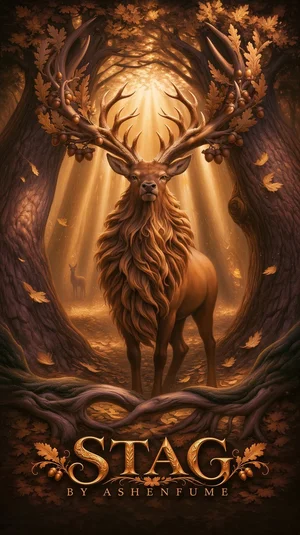
The house works with its own Deer Musk Pod Accord, composed at Ashenfume from the chemistry of the true material, the musk and the pod together. At its heart is the warm, left-handed form of muscone, the same molecule that makes the real grain what it is. Around it sits the pod itself, dried leather and hide and a little hay, the closeness of an animal's coat. The accord is the base of Stag, the house forest chypre. Stag opens cold, on Scots pine, Siberian fir and black spruce, with galbanum and mandarin. Orange blossom and hay come through the heart. Then the animal comes forward and holds the centre of the wear, with oakmoss at his feet, Indonesian sandalwood and muhuhu beside him, and a labdanum amber that keeps the musk glowing after the pines have faded. In the house's telling, this is the animal Bran and Sceolán found in the bracken and would not harm.
 Found in
Stag
The Deer Musk Pod Accord in the base of the house forest chypre.
View the fragrance

IIIA deer without antlers

The musk deer is a deer in name only. It belongs to a family of its own, the Moschidae, with a single living genus, Moschus, and seven species1. The Siberian musk deer, Moschus moschiferus, ranges through the forests of eastern Siberia and Sakhalin, northern China, Korea and northern Mongolia, and Linnaeus named it in 1758 from the Altai9. The forest musk deer, M. berezovskii, the alpine musk deer, M. chrysogaster, the black musk deer, M. fuscus, the Himalayan musk deer, M. leucogaster, the Kashmir musk deer, M. cupreus, and the Anhui musk deer, M. anhuiensis, divide the mountains of Asia between them110. China holds more kinds than any other country and is the centre of their world10.
They are small and secretive animals. An adult stands 50 to 70 centimetres at the shoulder and weighs 7 to 17 kilograms. Its hind legs are longer than its forelegs, it carries no antlers, and the males grow long, curved upper canines that hang below the jaw like small sabres. Musk deer live alone, feed at dusk and in the night, and mark their ground with a gland at the tail and with shared latrines2. The alpine musk deer lives between 3,000 and 5,000 metres, from the eastern Himalaya to the Tibetan highlands, Sichuan and Gansu11. The black musk deer keeps to the tree line, at 2,600 to 4,200 metres, in rhododendron and conifer forest12. The Anhui musk deer, which weighs about eight kilograms, lives only in the Dabie Mountains of western Anhui, and its females usually bear twins13.
Their lineage is old. The oldest fossils of Moschus come from the Late Miocene beds of Lufeng in Yunnan2. Musk deer were long filed with the true deer, until molecular studies moved them closer to the cattle and antelopes, and in 2010 a study of the Miocene musk deer Hispanomeryx, from fossil sites near Zaragoza in Spain, found that their bones tell the same story. The Moschidae are the sister group of the Bovidae142.
The musk itself is made in a single organ that only adult males carry. The musk gland is a flattened, rounded sac between the navel and the genitals153. Dried and cut from the animal it becomes the musk pod, a hairy pouch three to seven centimetres across and two to four centimetres thick5. The Tonquin pods of the old London trade weighed 25 to 35 grams, and about half of that weight was musk16. A Siberian gland, dried, is 85 to 90 percent musk17.
IVThe November rut
A musk deer lives on what the season gives. The Siberian musk deer eats more than 130 kinds of plant, and in winter the lichens that hang from the trees and grow on the ground make up about 70 percent of what it eats, by weight. Lynx, wolverine and the yellow-throated marten hunt it18. Its senses are sharp. The Himalayan musk deer gives a double hiss when alarmed, and it can scream when wounded19.
It speaks most through scent. A male marks his ground by rubbing the gland at his tail against the vegetation19, and researchers on the musk deer farm at Xinglongshan, in Gansu, record the same habit as tail-pasting20. The musk gland is for another purpose. Musk is a pheromone, a scent for talking to other deer, and in the breeding season the males use it to draw the females4. In the Himalayan musk deer the male's musk sac is the key to drawing a mate, its strong smell calling the females out of hiding19.

The rut at the edge of winter
The rut falls at the edge of winter. Musk deer mate between November and January, depending on the place and the height of the mountain21. On the alpine musk deer farm at Xinglongshan in Gansu, most mating comes in late November20. The musk is ready in time. It is secreted in early summer and ripens inside the gland through the autumn4.
In the rut the males grow restless and competitive and eat little. They hold ground that takes in the ranges of several females, and they fight one another with their long canines19. Their musk travels even in the snow. In the mating season the musk a male passes in his urine is so concentrated that it marks the snow with dark pink and red spots21.
VThe scent that shoots

The word musk has travelled far. English took it in the fourteenth century through Old French, Latin and late Greek from the Persian mušk22. The classic story carries it further back, to the Sanskrit muṣka, testicle, for the look of the pod22. The Finnish Indologist Klaus Karttunen argues that Greek and Latin borrowed the word from Persian, and he lists the Sanskrit names of the animal, kastūrīmṛga and mṛganābhi, the deer's navel, and of the musk, kastūrikā and mṛgamada, the deer's intoxicant23. Arabic calls it misk24, and Tibetan gla rtsi25.
The Chinese word is 麝香, shèxiāng, the musk deer's fragrance. The great physician Li Shizhen, in the sixteenth century, read the character 麝 as 射, to shoot, set over 鹿, deer, because the animal shoots its scent across great distances26. The earliest Chinese mention of musk is in the Erya, a dictionary compiled between the third and first centuries BCE, and the earliest medical use is in the Shennong bencao jing, the Divine Farmer's materia medica of the Han dynasty26. It places musk in its highest grade, among the animal drugs, and calls it pungent and warm. Musk drives off foul air, kills ghosts and spirit things, and treats malaria, poisoning, epilepsy and convulsions. The text adds a field note: the musk deer is like a small deer, and its navel holds the fragrance27. In the early fourth century the alchemist Ge Hong counted musk among a couple of dozen essential drugs and prescribed musk pellets against snakes for travellers in the mountains26.
Tibetan medicine prized it too. Musk is one of the four ingredients of the Seru-4 pills, and the pleasant smell of musk rising from a patient was read as a sign that poison was surfacing from the body25. In India the musk deer appears in Sanskrit literature rather often from the early first millennium CE. Indians used musk to perfume the body and clothing, to flavour drinks and in medicines23.
VIThe musk roads
The first musk in the written record of trade is a parcel of thirty-two pods. In 313 CE, in a letter found near Dunhuang and now known as Sogdian Ancient Letter No. 2, a merchant reported that a colleague named Wan-razmak had sent to Dunhuang thirty-two vesicles of musk belonging to one Takut, for delivery onward28. Musk, as the historian Daniel Waugh notes, came from Tibet28. By the fourth and fifth centuries the Graeco-Roman world knew it23.
In the sixth century the Greek merchant Cosmas Indicopleustes described the animal in his Christian Topography. The small animal, he wrote, is the Moschus, called in the native tongue Kastouri. Those who hunt it pierce it with arrows, tie up the blood collected at the navel and cut it away, for this is the part with the pleasant fragrance known as musk29. In Babylon the rabbis of the Talmud debated which blessing to say over it, and ruled that over musk one blesses the One who creates varieties of spices, because musk comes from a living creature30.
The great age of the trade began in the eighth century, when the expanding Abbasid empire came into contact with Tibet. The historians Anna Akasoy and Ronit Yoeli-Tlalim have named the routes that joined them the musk routes3132. Much of the Himalayan musk passed through India on its way west32, and Tibetan musk travelled in quantity along the roads of Khurasan to Iraq. Writers of the ninth and tenth centuries, among them Ibn Māsawayh, al-Jāḥiẓ, Ibn Khurradādhbih and Abū Zayd al-Sīrāfī, described its grades, its production, and its use in scented oils, in the incense called nadd and in the rich perfume called ghāliya33.
The ninth-century historian al-Yaʿqūbī ranked the musks of the world by their homelands. The finest and most costly was Tibetan, and after it came Sogdian musk, which the merchants of Khurasan bought from Tibet, then Chinese musk, the best of it shipped from Canton, then Indian musk, which was Tibetan musk carried down into India, and a long tail of lesser kinds down to the musk of al-Multan in Sind. Another fragment graded musk by colour. The best was the colour of an apple, with a smell like the apples of Lebanon34. The philosopher al-Kindī wrote a whole book on the chemistry of perfume and distillation, edited and translated into German by Karl Garbers in 194835.
Musk carries a special meaning in Islam36. The Qur'an describes the drink of the righteous in paradise as a sealed wine whose seal is musk24. The Prophet compared a good companion to a seller of musk, who may give you some, sell you some, or at least leave you with its scent37, and he called musk the most fragrant of scents38. The scholar Anya King, in her history of musk in the medieval Islamic world, traces how it came from the medicine chest, where it was thought to correct the air and improve health, into daily life. Small amounts were ground to a paste for the perfumes men wore, or ground with aromatic wood for incense, and because it was so costly it was often stretched or imitated3639.
VIIThe pods of Tonquin

Marco Polo met the animal in the kingdom of Erguiul, on the borders of China. There is a wild beast there, he wrote, like a gazelle, and at its navel, between the flesh and the skin, the hunters find something like an impostume full of blood. They cut it out with its skin, and the blood inside is the musk that makes the powerful perfume40.
Europe bought it by the bag. The French traveller Jean-Baptiste Tavernier bought 1,673 musk bags at Patna, holding about 452 ounces of musk, and his contemporary Jean Chardin warned that no drug was so easily adulterated or more apt to be so. In 1853 Scientific American reckoned that one part of musk could scent three thousand parts of odourless powder41. In 1856 England imported more than five thousand ounces, which the Encyclopaedia Britannica reckoned at about five thousand animals for England alone. It sold at three pounds to three pounds ten shillings an ounce and came packed in catty-boxes of twenty to twenty-five pods42.
The pods reached London from Shanghai in caddies. There they were probed with a thin-bladed knife, graded and opened, and the grains were dried in the air to lose the ammonia note of the raw secretion16. The best grade, Tonquin, took its name from Tonkin in northern Vietnam, though the American pharmacists of 1898 knew it came mostly from Yunnan by way of Shanghai43. The round Yunnan pods called pig-faced musk were nearly as good. Cabardine musk, from Russia and Siberia, was flatter, yellower and lesser16. A Philadelphia perfumery manual of 1877 put it plainly. The best musk came from Tonquin, few people liked it pure, and everyone valued it blended with other odours44.
A musk that cost more than gold invited every kind of fraud. In 1860 the Britannica noted that dried blood and grain tin were much used, and that Chinese counterfeit pods could be caught only by very careful and experienced examination42. Emptied pods were refilled with earth, rasped wood, scraps of leather, and sometimes lead, flesh or paper43. Whole fake bags were stitched from animal membranes and stuffed with dried blood and earth45. One Shanghai report of 1889 put the share of adulterated musk at about half, and the American Journal of Pharmacy that same year put it at eighty percent43. Two decades later the trade was still finding stone, shot, dried blood and resin inside the pods16. In Russia at the turn of the millennium, musk was being stretched with dried blood, liver, spleen and tree bark17, and a Korean study of 2021 adds red ants to the list46.
VIIIThe musk lands
Each mountain range gave the trade its own musk, and the graders of the eighteenth and nineteenth centuries could tell them apart. In 1892 a pod from Assam was worth about two thirds of a Chinese Tonquin pod, a Russian pod about a quarter, and the Bokharian musk of Central Asia least of all45. Today most of the world's legal musk comes from farms in China, and the wild musk lands are the hunting grounds of poachers.
Tibet. This was the musk of the Sogdian letters and the Abbasid court, carried west through Khurasan and south through India2831. It was ranked first of all musks by al-Yaʿqūbī, whose graders prized musk the colour of an apple, scented like the apples of Lebanon34.
Yunnan and Tonkin. Tonquin was the benchmark grade of the London trade, pods of 25 to 35 grams that were half musk, shipped by way of Shanghai1643. Its grains were crumbly, slightly unctuous and dark red-brown, the musk every other kind was judged against43.
Sichuan and the Qinling. Sichuan produced 862 kilograms of musk in 1980. Today the farms of Shaanxi and Sichuan hold most of China's twenty thousand captive deer474849. Farmed musk comes out as granular, purplish black, oily grains with a strong, distinctive aroma and a faintly spicy, bitter, salty taste5.
Siberia and the Far East. Russia has a single musk deer, the Siberian, found in Khabarovsk, Primorye, Yakutia, Amur, the Altai and Sakhalin. Russia is the one country that regularly sets export quotas for raw musk1750. The graders of the 1890s found its musk ammoniacal, sharp and rather urinous4345.
The Himalaya. This is the country of the alpine, Himalayan and black musk deer of the high forests, the home of Kedarnath Wildlife Sanctuary, founded in 1972 for the musk deer5152. The old trade knew Assam pods by their longer, whiter, coarser hair, and Nepal musk as grain sold through Calcutta16.
Mongolia and the Altai. Mongolia counted 44,000 musk deer in 1985. Hunting has been closed there since 1953, and the Altai calls musk Siberian gold475053. The Altai pods shrank from 24 grams to 17 between 1997 and 2001, a sign of heavy hunting17.
The numbers behind those names have changed beyond recognition. In the 1950s musk from Sichuan made up four fifths of China's domestic trade54. In Russia the official census counted 150,400 Siberian musk deer in 1998 and 126,580 in 2002, while field surveys suggested about 140,000 in the Far East alone17. In 2002 Khabarovsk counted 18,150, Primorye 17,000, Yakutia 15,000, Amur 4,150, the Altai Republic 2,500 and Sakhalin 1,40017. In Yakutia, in the 1940s, a single Evenk reindeer-herding family took twenty musk deer in one summer near the mouth of the Mundurucchu River55.
IXThe making of musk
A male musk deer begins to secrete at about a year and a half. Full production comes at two and a half, stays high until about eight and a half, and on a farm can run until he is twenty57. Each year the work runs to a calendar set by his hormones. On a breeding base in Fengxian, in Shaanxi, testosterone in the droppings of six-year-old males peaked in June, higher than in any other month4. The gland makes its musk from May to July, and the musk then matures inside it from August to the following April4. During the secretion season the inside of the gland runs at about 40°C15.
The musk changes as it ripens. In June it is a pale, milky, wet cream with a strong, foul smell. By August it is a reddish-brown paste. From October it is a brown to blackish solid, an oily powder of grains41558. The muscone that carries its scent rises steadily from June to December and then falls away4. The chemist Heinrich Walbaum, who first isolated that molecule in 1906, found the freshly collected secretion unpleasant and penetrating, with an odour that almost hides the musk inside it59.

Bacteria live in the gland and change with it. In one study the count of bacterial types fell from 593 in the liquid musk to 214 in the solid15. Corynebacterium dominates throughout, and in mated males during the strongest secretion it made up nearly 64 percent of the community. The researchers suspect these bacteria help build muscone, a theory still to be proven60. A 2025 study found that the musk deer and the North American muskrat, two unrelated animals, share the same key precursor for their musks, cyclopentadecanone, and the same dominant gland bacterium61. Mating takes its toll. Males kept from the females produced 21.16 grams of mature musk in a season, and males that mated produced 7.1260. In a single herd, the largest pod held 31.5 grams and the smallest under half a gram62.
XThe hunt
For most of history, every gram of musk cost a life. Wild musk is taken mainly from winter to early spring, when the musk is mature. The gland is cut out whole and dried in the air, and it reaches the market as the hairy whole pod5. In Russia the hunter cuts the gland away with its skin, pins out its edges and lets it dry for about three weeks17. The legal season there runs from 1 September to 15 February17.

The hunters work with wire. In the Russian taiga, metal cable and even telephone wire is looped across the musk deer's tracks, and fences are built holding hundreds of loops17. In Uttarakhand poachers set fires to block the deer's escape and drive them into wire snares51. In Bhutan's Jigme Dorji National Park, rangers removed 400 snares in 84 days of patrol between October and December 2016, most of them nylon leg snares set behind brush barricades along the deer's winter routes63. A snare takes whatever walks into it. For every male with a usable pod, three to five musk deer die, females and young among them1751. In a sample of 57 snared deer from the Sikhote-Alin, 51 percent were female17.
Around the turn of the millennium, at least four of every five musk deer killed in Russia were taken illegally. Some 400 to 450 kilograms of raw musk was traded off the books each year, the musk of 17,000 to 20,000 males, about five times the legal trade17. Hunters were paid two to three dollars a gram, and the price in South Korea, the largest buyer, was at least four times that1747.
XIThe spoon
China began farming musk deer in 1958, stocking the first communal farms with animals caught in the nearby mountains4910. The method that changed the trade came out of the same decade. Researchers in Chongqing worked out how to take musk from a living deer. A sterilised spoon-shaped tool is slipped into the opening of the pod, turned gently and drawn out with the musk on it64. On the farms the male is held still while a keeper scoops the musk, dries it on coarse paper, weighs it and seals it in an airtight bottle57. At the Pien Tze Huang breeding centre in Fengxian, researchers clamped the base of the gland, scooped the musk with a curette and released the deer, and each collection took under half an hour15. Restraint much past thirty minutes can kill a musk deer, so the keepers work fast64.
A Nepali team described the procedure on an eighteen-month-old male alpine musk deer. Three people held him on his side. A sterilised silver scoop, grooved at each end and coated with antibiotic cream, went into the gland six times with a gentle rolling motion, and the whole job took fifteen minutes65. On the Chinese farms the musk is taken twice a year, around October and March, from males of three years and older, and each harvest gives ten to fifteen grams5764. The keepers also spend about five minutes a day with every deer57.
Yields vary with the herd. At Xinglongshan, in Gansu, captive alpine musk deer averaged 7.9 grams a year from 1997 to 2009, with a range from nothing at all to 34.2 grams66. Adult forest musk deer in Shaanxi averaged 17.6 grams, and more in March than in September67. In Fujian in late 2023, males gave 5.8 to 25.1 grams each68. Across China in 2017, more than 20,000 captive musk deer produced about 150 kilograms of musk, and Shaanxi's 14,000 deer produced 100 of those kilograms, about fifteen grams a male48. Musk is called soft gold in Shaanxi, and it goes into nearly three hundred traditional medicines48.
The farms are a mountain business. In Hanyuan County, in Sichuan's Ya'an, a 1,200-mu park at 1,700 metres in the Jiuxiang state forest keeps its deer in wooden cabins among pine, mulberry and elm, with wooden ladders for them to climb. The farmer Yang Guojing, who is 48, has brought survival to about ninety percent. The work, she says, needs very fine management. A pair of fawns sells for nearly 70,000 yuan69. In Fengxian alone, more than 150 farms held 3,712 deer70. The Chinese herd has grown 5.6 times since the 1990s10, and it holds the genetic marks of its narrow beginnings, with inbreeding coefficients of 0.34 to 0.56 in the herds studied49.
XIIFrom grain to tincture
Inside the pod lies the grain musk, the shèxiāng rén, or musk kernel5. In wild pods it includes glossy purplish-black lumps the Chinese trade calls dāngménzǐ. Farmed musk comes out granular, in short strands or lumps, purplish black or dark brown and oily5. In 1960 the perfumery chemist Steffen Arctander set the standard for a good pod at 60 to 75 percent grains by weight6.
Perfumers have worked with deer musk almost entirely as a tincture. The method is a slow maceration. Arctander's standard was three percent musk in 90 percent alcohol, often with a little alkali added, left to age for at least six months before filtering. Perfume houses kept their own stock tinctures at five, ten or twenty percent, and the pharmacists made theirs at one part in five or one in ten6. The American pharmacopoeia of 1918 gave a recipe: grind five grams of musk with 45 millilitres of water and leave it for a day, add 45 millilitres of alcohol and macerate six days, shaking now and then, then filter and make up to 100 millilitres71.
The chemistry explains the patience. Strong alcohol dissolves only a tenth or so of the musk, and water a half to three quarters1672. A dilute alkali brings out the smell markedly, and camphor destroys it4543. The tincture comes out pale brown to dark amber, and it develops the true smell of musk only after it has aged6.
A musk absolute can be made too. The grains are extracted with petroleum ether to give a resinoid, and the resinoid is washed with alcohol, which leaves most of the fats behind. What remains is a dark brown, very viscous liquid with an intense musk odour. Most perfumers of Arctander's day still preferred the tincture, because with it the risk of overdosing was so slight6.
XIIIThe ring of fifteen
In 1906 the chemist Heinrich Walbaum isolated the scent of musk from Tonkin pods. He described an oil with a strong and very pleasant smell of musk, identified it as a ketone and named it muscone59. Twenty years later, in 1926, the chemist Leopold Ruzicka showed what it was: 3-methylcyclopentadecanone, a ring of fifteen carbon atoms with a single methyl branch, C16H30O598. At the time chemists believed rings that large could hardly exist. Ruzicka found such rings in muscone and in civetone, the musk of the civet, and in 1939 he shared the Nobel Prize in Chemistry73.
Muscone is a small part of the whole, between half a percent and two percent of the grains, held in a waxy matrix of fats and steroids774. The deer makes it in a single hand, the left-handed (R) form, and the human nose reads it through one dedicated receptor that answers to that form more strongly than to its mirror image875. The figures, for the bench, close this folio.
The great change came from chemistry. In 1888 Albert Baur, working on explosives related to TNT, found that some nitrated benzenes smelled of musk, and the nitro musks were born7677. The macrocyclic, polycyclic and alicyclic musks followed through the twentieth century77. In 1960 Arctander named two macrocyclic musks as the usual stand-ins for the rounding effect of deer musk in a formula6. The human musk receptor offers one reason why. OR5AN1 responds to the macrocyclic ketones like muscone and to the nitro musks, and only barely to the lactones and the newer families75. That may be one reason accords led by a macrocyclic ketone read closest to the deer.
XIVThe emptying forests
The wild musk deer have paid for the trade. China held two to more than three million musk deer in the 1950s4778. A national survey in 2003 found populations at two to three percent of those levels79, and the decline since the 1950s now stands at more than 97 percent10. The forest musk deer alone fell from over a million in the 1960s to between 100,000 and 200,000 in 199280. The Anhui musk deer numbers perhaps 700 to 800 in a range under 5,000 square kilometres, and a 1993 survey of the Mazongling reserve found only six to eight81. Mongolia's musk deer have declined by about 83 percent since the 1970s82. In Kedarnath, where 600 to 1,000 musk deer lived two or three decades earlier, the divisional forest officer put the number at fewer than a hundred in 201651.

Six of the seven species are listed as Endangered on the global Red List, and the Siberian musk deer as Vulnerable541152121310. The international convention on wildlife trade places the musk deer of Afghanistan, Bhutan, India, Myanmar, Nepal and Pakistan on its strictest list, and all other populations under controlled trade83. The European Union has closed its market to commercial musk imports since 199950. China raised every species to first-class national protection on 21 February 200384. Nepal can jail a poacher of a protected animal for five to fifteen years85. In its Dhorpatan Hunting Reserve, nineteen suspected poachers were arrested in five months of 2023, three of them in the Barse block with two muskets and 102 sets of traps86. In South Korea the musk deer's range shrank sharply from the 1950s to 1999, driven by capture for money and by high forest roads that opened the ridges to poachers87.
The seizures keep coming. In February 2018 Nepal's Central Investigation Bureau arrested a man in Bara with eleven musk pods weighing 500 grams, which the bureau called its biggest seizure of musk pods88. In February 2026 customs officers in the Russian Far East found 300 dried musk glands, 4.7 kilograms in all, disguised as food and bound by sea for East Asia, valued at 12.3 million roubles89. In October 2022, in Fengxian County, a villager set three homemade rope snares on a mountainside and carried down a live forest musk deer. It lost its left forefoot to the snare and now lives at the Fengxian rescue station90.
There are signs of return too. In northern Vietnam, where fewer than fifty forest musk deer survive, a camera trap in Cao Bang caught one in 2021, the first record in more than two decades91. In Afghanistan's Nuristan, a Wildlife Conservation Society team made five sightings of the Kashmir musk deer, the first since a Danish survey of 194892. And in December 2023 a wild yearling female walked into a school in Nanchuan, near Chongqing64.
XVRare and precious
Deer musk has always been sold by the gram. In Europe it once cost five times its weight in gold3. In 1960 musk absolute sold at fifty to eighty shillings a gram, among the most expensive of all perfume materials6. Today the international black market pays about 45,000 dollars a kilogram51. In the Altai, where poachers have multiplied since the fall of the Soviet Union, musk sells for an average of 200 dollars a gram53. In China farmed musk sold for about 400 yuan a gram in 201848, natural musk climbed from 300,000 to 400,000 yuan a kilogram during the pandemic93, and by 2024 wild musk passed a million yuan a kilogram94.
Behind each kilogram stands a herd. A wild male carries about 23 to 25 grams of musk1756, so a kilogram of wild musk takes some forty males. Because snares kill three to five deer for every male with a usable pod, that kilogram can cost 120 to 200 animals1751. A farm spares the animal and asks for time. At seven to eighteen grams a year6667, a kilogram of farmed musk takes 55 to 140 years of a male's working life, gathered a spoonful at a time. China's farms produce something near 150 to 200 kilograms a year4864, against a demand the Chongqing researchers put at about six tonnes64.
XVIFor the perfumer
The secretion, the forms, the chemistry, the grades and the trade behind deer musk, for quick reference at the bench.
Raw material & yields
| Basis | Figure | Source |
|---|---|---|
| Wild pod | About 23 to 25 g of musk | 1756 |
| Tonquin pod, 1911 | 25 to 35 g, about half of it musk | 16 |
| Dried Siberian gland | 85 to 90% musk | 17 |
| Good pod, 1960 | Grains 60 to 75% of weight | 6 |
| Farm harvest | 10 to 15 g, twice a year, males 3 and older | 64 |
| Xinglongshan, 1997 to 2009 | 7.9 g a year (0 to 34.2) | 66 |
| Shaanxi adults | 17.6 g a year | 67 |
| Fujian, late 2023 | 5.8 to 25.1 g | 68 |
| Unmated and mated males | 21.16 g and 7.12 g a season | 60 |
| China, 2017 | About 150 kg from more than 20,000 captive deer | 48 |
The calendar. Secretion May to July, maturation August to April4. Milky cream in June, reddish-brown paste by August, a brown to blackish solid from October41558. Muscone climbs from June to December4.
Labour in a kilogram. Some forty wild males, and with snare losses 120 to 200 animals. On a farm, 55 to 140 years of a male's working life17516667.
Forms & tincture
| Standard | Strength and method | Source |
|---|---|---|
| Arctander, 1960 | 3% in 90% ethanol, often with a little alkali, aged at least six months, then filtered | 6 |
| Perfume house stocks | 5, 10 or 20% | 6 |
| Pharmacy | 1 in 5 or 1 in 10 | 6 |
| British Pharmaceutical Codex, 1911 | 1 in 20 | 16 |
| Sayre, 1917 | 5% | 72 |
| US Dispensatory, 1918 | 5 g ground in 45 mL water a day, 45 mL alcohol six days, made to 100 mL | 71 |
Solubility. Strong alcohol takes up about a tenth of the musk, water a half to three quarters1672. Dilute alkali lifts the odour, camphor kills it4543.
Absolute. Grains extracted with petroleum ether to a resinoid, then washed with alcohol to leave the fats. Dark brown, very viscous, intense6.
Molecular composition
| Constituent | Share | Note |
|---|---|---|
| (R)-Muscone | 0.5 to 2% of grains7, 2.0% minimum in dried musk5, 1.66% mean in Fujian farm musk68 | Musky, animal, powdery, rich and powerful, about 336 hours on a strip95 |
| Waxes | 38%, Siberian musk | 74 |
| Steroids | 38%, Siberian musk | Cholesterol, androsterone, etiocholanolone, androstanediols747 |
| Free fatty acids and phenols | 10%, Siberian musk | 74 |
| Muscopyridine | About 0.04% | A pyridine bridged by a carbon ring, an odorant of musk9697 |
| Normuscone | Present | Muscone without its methyl branch98 |
| Urea-bearing androstanes | Present | Two, known from musk98 |
| Property | Value |
|---|---|
| Name | 3-Methylcyclopentadecanone, CAS 541-91-38 |
| Formula, mass | C16H30O, 238.41 |
| Natural form | (R), laevorotatory, [α]D minus 13° |
| Boiling point | 328°C |
| Isolated | 1906, Walbaum, from Tonkin musk59 |
| Structure | 1926, Ruzicka598 |
| Human receptor | OR5AN1, about three times more responsive to the (R) form9975 |
| Specific anosmia | About 6% of people100 |
Maturation. Four macrocyclic ketones and six androgens build up as the musk ripens58. The gland bacteria, led by Corynebacterium, may take part in making muscone, still a hypothesis60. Musk deer and muskrat share cyclopentadecanone as a key precursor61.
Steroids at work. Musk-pod medicines have caused positive doping tests101. Prasterone and androsterone mark medicines made with the artificial musk102.
Grades & authenticity
| Grade | As the trade knew it | Source |
|---|---|---|
| Tonquin | The best. Crumbly, slightly unctuous dark red-brown grains, mostly from Yunnan via Shanghai | 1643 |
| Yunnan, pig-faced | Round pods, nearly as good | 16 |
| Assam | Longer, whiter, coarser hair. About two thirds of Tonquin's value in 1892 | 1645 |
| Nepal | Sold as grain through Calcutta | 16 |
| Cabardine, Russian | Flatter, yellower, rather urinous. About a quarter of Tonquin's value | 164543 |
| Bokharian | Lowest in value in 1892 | 45 |
| Check | What it shows |
|---|---|
| Probe needle | Kernel swells above the groove5 |
| Palm | Rolls to a ball that crumbles clean5 |
| Flame | Crackles, melts and foams with a strong aroma, white or grey-white ash5 |
| Ash colour | Reddish ash means blood43 |
| X-ray | Lead inside an unopened pod, from 189843 |
| Loss on drying, ash | 35.0% and 6.5% at most today5, 15% and 8% in 191116 |
| Laboratory | Microscopy, steroid GC, a musk-protein antibody test, DNA barcoding3 |
| Carbon isotopes of the steroids | Wild from farmed103 |
Look and feel. Good musk had a recognisable look and feel. The Tonquin grade came as irregular, crumbly, slightly unctuous grains of dark reddish brown, and pharmacists rejected musk that was weak-smelling, black, pale, damp or gritty43. True musk burns to a greyish-white ash, and blood to a reddish one, and by 1898 X-rays could find lead inside an unopened pod43. The Chinese pharmacopoeia keeps the old trade tests. A probing needle drawn out of the pod should bring the kernel swelling up above its groove, a pinch rolled in the palm should form a ball that crumbles without sticking, and musk on a flame should crackle, melt and foam with a strong aroma and leave a white or grey-white ash5. The modern laboratory adds microscopy, steroid profiles by gas chromatography, an antibody test for a musk protein and DNA barcoding3. The carbon isotopes in its steroids can even tell wild musk from farmed103.
On the blotter
Raw deer musk smells animal, slightly of amine, sweet and extremely persistent6. Fresh from the gland it is foul and penetrating5958, and once dried and aired it loses its ammonia edge16. The old pharmacists called it peculiar, penetrating and persistent, and some people got headaches or fainted from it43. Its staying power was legendary. Pods a century old still smelled strongly, and musk that had scented a room for thirty years showed no measurable loss of weight42.
The tincture is slower. It is pale brown to dark amber, and with ageing it develops the full, typical smell of musk6. The absolute is intense and true to type6. Pure muscone, the heart of it, is musky, animal and powdery, rich and powerful95. Farmed musk can vary. The normal kind is black-brown with a faint fragrance, and two off-types appear on the farms, a white musk that is acrid and nearly free of muscone and a soft, muddy black musk with an unpleasant smell104.
Perfumers used it at the edge of perception. Arctander advised a dose just above the threshold, where the animal note itself goes unnoticed and the musk gives lift and life to orientals, heavy florals, aldehydic perfumes, lily of the valley, rose and violet6. The 1877 manual said the same in its own words. Few liked musk pure, and everyone valued it in a blend44.
Substitutes
The artificial musk of Chinese medicine. Chinese medicine found its own answer. In 1975, with national demand above fifteen tonnes a year, the Chinese Academy of Medical Sciences began building an artificial musk, starting from a single kilogram of the natural material94. Led by Yu Dequan, the work produced a formula of four key components that won approval as a first-class new medicine in 1993 to 199410594. By 1995 China's medicines were using 4,000 to 5,000 kilograms of musk a year106. Of 433 patent medicines that once used musk, 431 now use the artificial one105, and the inspectors can tell them apart, because prasterone and androsterone turn up in every medicine made with the artificial musk102. Only four may still use natural musk, among them the Angong Niuhuang pill and Pien Tze Huang3.
Trade & price
| Year | Price | Source |
|---|---|---|
| 1856 | 3 pounds to 3 pounds 10 shillings an ounce, London | 42 |
| 1960 | Absolute at 50 to 80 shillings a gram | 6 |
| About 2000 | Russian hunters paid 2 to 3 dollars a gram | 17 |
| 2016 | About 45,000 dollars a kilogram, black market | 51 |
| 2018 | Farmed musk about 400 yuan a gram, China | 48 |
| 2019 | About 200 dollars a gram, Altai | 53 |
| 2020 to 2022 | Natural musk 300,000 to 400,000 yuan a kilogram | 93 |
| 2024 | Wild musk above 1 million yuan a kilogram, artificial above 60,000 | 94 |
Musk through the centuries
- Late Miocene
The oldest known Moschus lives at Lufeng, in Yunnan2.
- Han dynasty
The Shennong bencao jing places musk in its highest grade of drugs2726.
- 313 CE
A Sogdian merchant records thirty-two pods of musk sent to Dunhuang28.
- 6th century
Cosmas Indicopleustes describes the Kastouri and its musk29.
- 8th century
The musk routes open between Tibet and the Abbasid world31.
- 13th century
Marco Polo describes the musk deer of Erguiul40.
- 1856
England imports more than five thousand ounces of musk42.
- 1888
- 1906
Heinrich Walbaum isolates muscone from Tonkin musk59.
- 1926
- 1958
- 1975
Chinese scientists begin work on an artificial musk for medicine94105.
- 2003
China gives every musk deer species its highest legal protection84.
Found in
Stag
The Deer Musk Pod Accord in the base of the house forest chypre.
The Stag collectionMore from the November forest
 ✦ Folio No. 28
Siberian Fir
The soft fir of the dark taiga, one of the three conifers that open Stag.
Read the folio
 ✦ In Stag
Galbanum
The bitter green gum of a giant fennel, running through the cold opening.
Folio to come
 ✦ In Stag
Orange Blossom
The flower of the bitter orange, honeyed in the heart beside the musk.
Folio to come
 ✦ In Stag
Oakmoss
The lichen of the oak, at the stag's feet in the base of the chypre.
Folio to come
 ✦ In Stag
Sandalwood
Indonesian sandalwood and muhuhu, creamy and quiet under the musk.
Folio to come
 ✦ In Stag
Labdanum
The dark resin of the rockrose, the amber that keeps the musk glowing.
Folio to come
✦ ✦ ✦
Sources & image credits106 references
- Mammal Diversity Database, Moschidae, American Society of Mammalogists (2026).↑
- Musk deer, Wikipedia, citing Qi G., Acta Anthropologica Sinica 4(1), 55-69 (1985), and Hassanin A. and Douzery E.J.P. (2003).↑
- Liu K., Xie L., Deng M., Zhang X., Luo J., Li X., Zoology, chemical composition, pharmacology, quality control and future perspective of musk (Moschus): a review, Chinese Medicine 16, 46 (2021).↑
- Fan M., Zhang M., Shi M. et al., Sex hormones play roles in determining musk composition during the early stages of musk secretion by musk deer (Moschus berezovskii), Endocrine Journal 65(11), 1111-1120 (2018).↑
- Chinese Pharmacopoeia Commission, Moschus (she xiang), Pharmacopoeia of the People’s Republic of China, vol. I (2020), via ShennongAlpha, Westlake University.↑
- Arctander S., Perfume and Flavor Materials of Natural Origin, Elizabeth, New Jersey (1960), entries for musk and tincture.↑
- German Sport University Cologne, Department of Biochemistry, Musk deer: secretions from the musk glands, Doping Glossary.↑
- Muscone, DrugFuture Chemical Index, after the Merck Index, with Ruzicka L., Helvetica Chimica Acta 9, 715 and 1008 (1926).↑
- Mammal Diversity Database, Moschus moschiferus Linnaeus, 1758, American Society of Mammalogists (2026).↑
- Jiang F., Zhang J., Song P., Xu B., Cai Z., Li X., Gao H., Gu H., Zhang T., Conservation status, decline factors, and strategies for globally endangered musk deer (Moschus spp.) in China, Wildlife Letters 4(1), 42-55 (2026).↑
- Alpine musk deer, Wikipedia, citing Tobgay S. et al. (2017) and Yang Q. et al. (2003).↑
- Biodiversity Center of Japan, Ministry of the Environment, Threatened mammal species database: Moschus fuscus.↑
- Anhui musk deer, Wikipedia, citing the IUCN Red List assessment by Wang Y. and Harris R. (2015).↑
- Sánchez I.M., Domingo M.S., Morales J., The genus Hispanomeryx (Mammalia, Ruminantia, Moschidae) and its bearing on musk deer phylogeny and systematics, Palaeontology 53(5), 1023-1047 (2010).↑
- Li Y., Zhang T., Qi L., Yang S., Xu S., Cha M., Zhang Z., Hu D., Liu S., Microbiota changes in the musk gland of male forest musk deer during musk maturation, Frontiers in Microbiology 9, 3048 (2018).↑
- Moschus, The British Pharmaceutical Codex (1911), via Henriette's Herbal.↑
- Homes V. (ed.), No Licence to Kill: the population and harvest of musk deer and trade in musk in the Russian Federation and Mongolia, TRAFFIC Europe (2004).↑
- Mulder J., Moschus moschiferus, Siberian musk deer, Animal Diversity Web, University of Michigan Museum of Zoology (1999).↑
- Plummer J., Moschus leucogaster, Himalayan musk deer, Animal Diversity Web, University of Michigan Museum of Zoology (2011).↑
- Meng X., Yang Q., Feng Z., Xu H., Perkins G.C., Zhao C., Hui C., Feng J., Zhou Y., Gender specific behavioural patterns of captive alpine musk deer (Moschus sifanicus), Belgian Journal of Zoology 138(1), 101-105 (2008).↑
- Musk deer (Moschinae), Grzimek’s Animal Life Encyclopedia, via Encyclopedia.com.↑
- Harper D., musk (n.), Online Etymology Dictionary (accessed 7 November 2026).↑
- Karttunen K., The musk deer and its musk in classical Indian literature, Kervan, University of Turin (2025).↑
- Qur’an 83:25-26, trans. Abul Ala Maududi, Quran.com.↑
- Czaja O., The administration of Tibetan precious pills: efficacy in historical and ritual contexts, Asian Medicine 10(1-2), 36-89 (2015).↑
- Romaskiewicz P.M., Musk (she xiang) in medieval China (22 September 2024).↑
- Shennong bencao jing, upper grade, animal section: musk, Chinese text.↑
- Sims-Williams N. (trans.), The Sogdian Ancient Letters, Letter 2, with an introduction by D.C. Waugh, Silk Road Seattle, University of Washington.↑
- Cosmas Indicopleustes, Christian Topography, Book XI, trans. J.W. McCrindle, Hakluyt Society (1897).↑
- Brown J., Berachot 43a, Talmudology (14 February 2020).↑
- Akasoy A. and Yoeli-Tlalim R., Along the musk routes: exchanges between Tibet and the Islamic world, Asian Medicine 3(2), 217-240 (2007).↑
- Akasoy A., Burnett C., Yoeli-Tlalim R. (eds), Islam and Tibet: Interactions along the Musk Routes, Ashgate (2011).↑
- Bessard F., review of Islam and Tibet: Interactions along the Musk Routes, Bulletin critique des Annales islamologiques 29, 68-71 (2014).↑
- Gordon M.S., Robinson C.F., Rowson E.K., Fishbein M. (eds), The Works of Ibn Wāḍiḥ al-Yaʿqūbī: An English Translation, vol. 1, fragments on perfume, 208-218.↑
- al-Kindī, Kitāb kīmiyāʾ al-ʿiṭr wa-t-taṣʿīdāt, ed. and trans. K. Garbers (1948), digital edition, Universitäts- und Landesbibliothek Sachsen-Anhalt.↑
- University of Southern Indiana, King explores the origins and trade of musk (2017), on King A., Scent from the Garden of Paradise: Musk and the Medieval Islamic World, Brill (2017).↑
- Sahih al-Bukhari 5534, Book of Hunting and Slaughtering, chapter on musk.↑
- Sahih Muslim 2252b.↑
- King A.H., Scent from the Garden of Paradise: Musk and the Medieval Islamic World, Islamic History and Civilization 140, Brill (2017).↑
- Polo M., The Travels of Marco Polo, Book I, chapter 57, Of the kingdom of Erguiul, trans. H. Yule, rev. H. Cordier, 3rd edition (1903), via Project Gutenberg.↑
- Musk, Scientific American 8(36), 288 (1853).↑
- Musk, Encyclopaedia Britannica, 8th edition (1860).↑
- Felter H.W. and Lloyd J.U., Moschus, King’s American Dispensatory (1898), via Henriette’s Herbal.↑
- Cristiani R.S., A Technical Treatise on Perfumery and Kindred Arts, chapter IV, Henry Carey Baird, Philadelphia (1877).↑
- Askinson G.W., Perfumes and Their Preparation, trans. I. Fuerst, Norman W. Henley, New York (1892).↑
- Cho C.W. et al., Adulterants of musk and the Korean musk trade, Korean Journal of Herbology 36(4), 41-50 (2021).↑
- Animals Committee of the Convention on International Trade in Endangered Species, Review of significant trade: Moschus spp., prepared by UNEP-WCMC with TRAFFIC and IUCN, document AC.16.7.4, Shepherdstown (December 2000).↑
- Musk deer breeding brings poverty relief, Xinhua, Xi’an (21 November 2018), via Xinhua Silk Road.↑
- Fan J., Zheng X., Wang H. et al., Analysis of genetic diversity and population structure in three forest musk deer captive populations with different origins, G3: Genes, Genomes, Genetics 9(4), 1037-1044 (2019).↑
- Conference of the Parties to the Convention on International Trade in Endangered Species, Conservation of and trade in musk deer, document 36, Santiago (2002).↑
- Chakrabarty A., Fading scent of musk deer, Down To Earth (14 September 2016).↑
- Biodiversity Center of Japan, Ministry of the Environment, Threatened mammal species database: Moschus leucogaster.↑
- Bargain H., Russian poachers are going after musk, the gold of Siberia, The Moscow Times (20 December 2019).↑
- Siberian musk deer, Wikipedia.↑
- Argunov A.V. and Safronov V.M., New data on the distribution of musk deer (Moschus moschiferus) in Yakutia, Izvestiya RAN, Biological Series 5, 549-554 (2022), in Russian.↑
- Ng D. and Burgess E.A., Against the Grain: trade in musk deer products in Singapore and Malaysia, TRAFFIC Southeast Asia (2004).↑
- Meng X., Gao H., Feng J., Meng Z., Ma Q., Wang J., Zhou Y., Quantified analyses of musk deer farming in China, Asian-Australasian Journal of Animal Sciences 24(10), 1473-1482 (2011).↑
- Jie H. et al., Elucidating metabolites and biosynthetic pathways during musk maturation: insights from forest musk deer, Frontiers in Pharmacology 16, 1503138 (2025).↑
- Avenas P., À propos de la muscone et de la muscarine, L’Actualité Chimique 507, Société Chimique de France (2025).↑
- Xu Z. et al., Chemical composition and microbiota changes across musk secretion stages of forest musk deer, Frontiers in Microbiology 15, 1322316 (2024).↑
- Sun Y.-S. et al., Convergent musk biosynthesis across host and microbiota in musk deer and muskrat, Zoological Research 46(3), 505-517 (2025).↑
- Li D. et al., The musk chemical composition and microbiota of Chinese forest musk deer males, Scientific Reports 6, 18975 (2016).↑
- Dendup P. et al., Snaring and musk deer in Jigme Dorji National Park, Bhutan, International Journal of Conservation Science 9(1), 193-198 (2018).↑
- Chen W., The ill-starred fate of the forest beauty, Chongqing Daily, page 5 (16 May 2024), in Chinese.↑
- Musk deer Moschus chrysogaster: musk extraction from live deer, Journal of the Bombay Natural History Society 86, via Biostor.↑
- Li H.L. et al., Musk yield of captive alpine musk deer at Xinglongshan, 1997 to 2009, Scientia Agricultura Sinica 45(3), 522-528 (2012).↑
- Wang Y., Musk yield and quality of captive forest musk deer in Shaanxi, Chinese Agricultural Science Bulletin 39(23), 94-101 (2023).↑
- Lu X. et al., Musk yield and muscone content of captive forest musk deer at Zherong, Fujian, Chinese Journal of Ecology 44(7), 2297-2303 (2025).↑
- Li T. and Huang G., Musk deer breeding in Hanyuan County, Ya’an, Chuanguan News, Sichuan Daily Group (21 April 2026), in Chinese.↑
- Wang Y. et al., Musk deer farming in Fengxian County, Shaanxi, Acta Ecologica Sinica 35(15), 4986-4992 (2015).↑
- Remington J.P., Wood H.C. et al., Tinctura Moschi, The Dispensatory of the United States of America, 20th edition (1918), via Henriette’s Herbal.↑
- Sayre L.E., Moschus, A Manual of Organic Materia Medica and Pharmacognosy (1917), via Henriette’s Herbal.↑
- Award ceremony speech, Nobel Prize in Chemistry 1939, NobelPrize.org.↑
- Sokolov V.E. et al., Musk deer (Moschus moschiferus): reinvestigation of main lipid components from preputial gland secretion, Journal of Chemical Ecology 13, 71-83 (1987).↑
- Sato-Akuhara N., Horio N., Kato-Namba A. et al., Ligand specificity and evolution of mammalian musk odor receptors, Journal of Neuroscience 36(16), 4482-4491 (2016).↑
- University of Bristol School of Chemistry, Real musks (2003).↑
- Synthetic musk, Wikipedia.↑
- Parry-Jones R., TRAFFIC examines musk deer farming in China, TRAFFIC East Asia.↑
- Yang N. et al., Forest musk deer conservation in China, Animals 15(18), 2701 (2025).↑
- Biodiversity Center of Japan, Ministry of the Environment, Threatened mammal species database: Moschus berezovskii.↑
- Biodiversity Center of Japan, Ministry of the Environment, Threatened mammal species database: Moschus anhuiensis.↑
- From the field: saving the Mongolian musk deer, UN News (21 November 2021).↑
- Convention on International Trade in Endangered Species, Appendices I, II and III, archived January 2009, University of North Texas web archive.↑
- State Forestry Administration of China, Order No. 7, amendment to the list of wild animals under state key protection (21 February 2003), in Chinese.↑
- Khadka G., Poaching and smuggling of musk deer on rise in Mustang forests, The Kathmandu Post (14 November 2021).↑
- Baral P., Dhorpatan struggling to check poaching, smuggling, The Kathmandu Post (25 November 2023).↑
- Lee W.-S. and Rhim S.-J., Distribution of musk deer in South Korea, Journal of Forestry Research 13(2), 135-136 (2002).↑
- Man held with possession of 11 musk pods, The Himalayan Times (3 February 2018).↑
- Federal Customs Service of Russia, Far Eastern customs seize 300 musk deer glands, press release, republished 9 February 2026.↑
- Zhang N. and Xue S., A forest musk deer snared in Fengxian, Shaanxi, The Paper (12 January 2024), in Chinese.↑
- Fauna and Flora, Rare musk deer caught on camera in Cao Bang province, Vietnam.↑
- Strange fanged deer persists in Afghanistan, Phys.org (October 2014), on Ostrowski S. et al., Oryx 50(2) (2016).↑
- Natural musk supply and the price of Pien Tze Huang, National Business Daily (8 May 2023), in Chinese.↑
- The race to save endangered TCM ingredients, CGTN (3 September 2024).↑
- The Good Scents Company, (R)-muscone (data page).↑
- Zviely M., Muscopyridines, Perfumer & Flavorist (2013).↑
- US National Library of Medicine, Muscopyridine, MeSH record C071830.↑
- Musk, Natural Products Database, Drugs.com.↑
- Shirasu M., Yoshikawa K., Takai Y. et al., Olfactory receptor and neural pathway responsible for highly selective sensing of musk odors, Neuron 81(1), 165-178 (2014).↑
- Block E. et al., Implausibility of the vibrational theory of olfaction, PNAS 112(21), E2766-E2774 (2015).↑
- Thevis M. et al., Musk pod preparations and positive doping tests, British Journal of Sports Medicine 47(2), 109 (2013).↑
- Ding M. et al., Steroid markers of natural and artificial musk in Chinese patent medicines, Chinese Medicine 17, 41 (2022).↑
- He Y. et al., Carbon isotope ratios of steroids to tell wild from farmed musk, Journal of Mass Spectrometry 53(11), 1078-1085 (2018), via AGRIS, FAO.↑
- Zhang T. et al., Study of compositions of musks in different types secreted by forest musk deer, PLOS ONE 16(3), e0245677 (2021).↑
- Tang W., Artificial musk and the National Science and Technology Progress Award, Wenhui Bao, Shanghai (13 January 2016), in Chinese.↑
- Artificial musk, Down To Earth (30 May 1995), via India Environment Portal.↑
Photographs
Musk deer in Sagarmatha National Park: Sangyam adventurer, CC BY-SA 4.0. Musk pod: 乌拉跨氪, CC BY-SA 3.0. Forest near Tengboche: Vyacheslav Argenberg, CC BY 4.0. Musk deer skull: Didier Descouens, CC BY-SA 4.0. Musk deer, 4 November 2016: Gurung pratap, CC BY-SA 4.0. Woodcut from the Hortus Sanitatis, Jacob Meydenbach: public domain. Harrison's Musk Cologne label, 1857: Library of Congress, public domain. Wall chart of the glands of the Siberian musk deer: Museo di Anatomia comparata Giovanni Battista Grassi, public domain. Siberian musk deer in the taiga: ErikAdamsson, CC0. Oak forest, Kedarnath Wildlife Sanctuary: PJeganathan, CC BY-SA 4.0. Siberian fir near Beloretsk: Aleksandr Zykov, CC BY-SA 2.0. Galbanum plate from Köhler's Medizinal-Pflanzen: public domain. Bitter orange blossom: Zeynel Cebeci, CC BY-SA 4.0. Oakmoss at Myrstigen: W.carter, CC0. Sandalwood: Jacopo188, CC BY-SA 3.0. Rockrose: Carsten Niehaus, CC BY-SA 3.0. All via Wikimedia Commons. Stag key art: Ashenfume.
Join the discussionHave you walked musk deer country, seen the rut in the snow or kept a tincture of the old grain? Add what you know, or ask a question.