Provenance Folio No. 1 Woods
Oud
The wood of the gods, from Assam to New Guinea
Across a great arc of Asia, from the wet hills of India to the islands of New Guinea, a handful of trees answer injury by filling their wounds with fragrant resin. That darkened wood has been burned for gods and kings for three thousand years and now sells for more than gold. This is the whole world of oud, region by region, and the three origins we carry in the house.
IA tree that heals in perfume
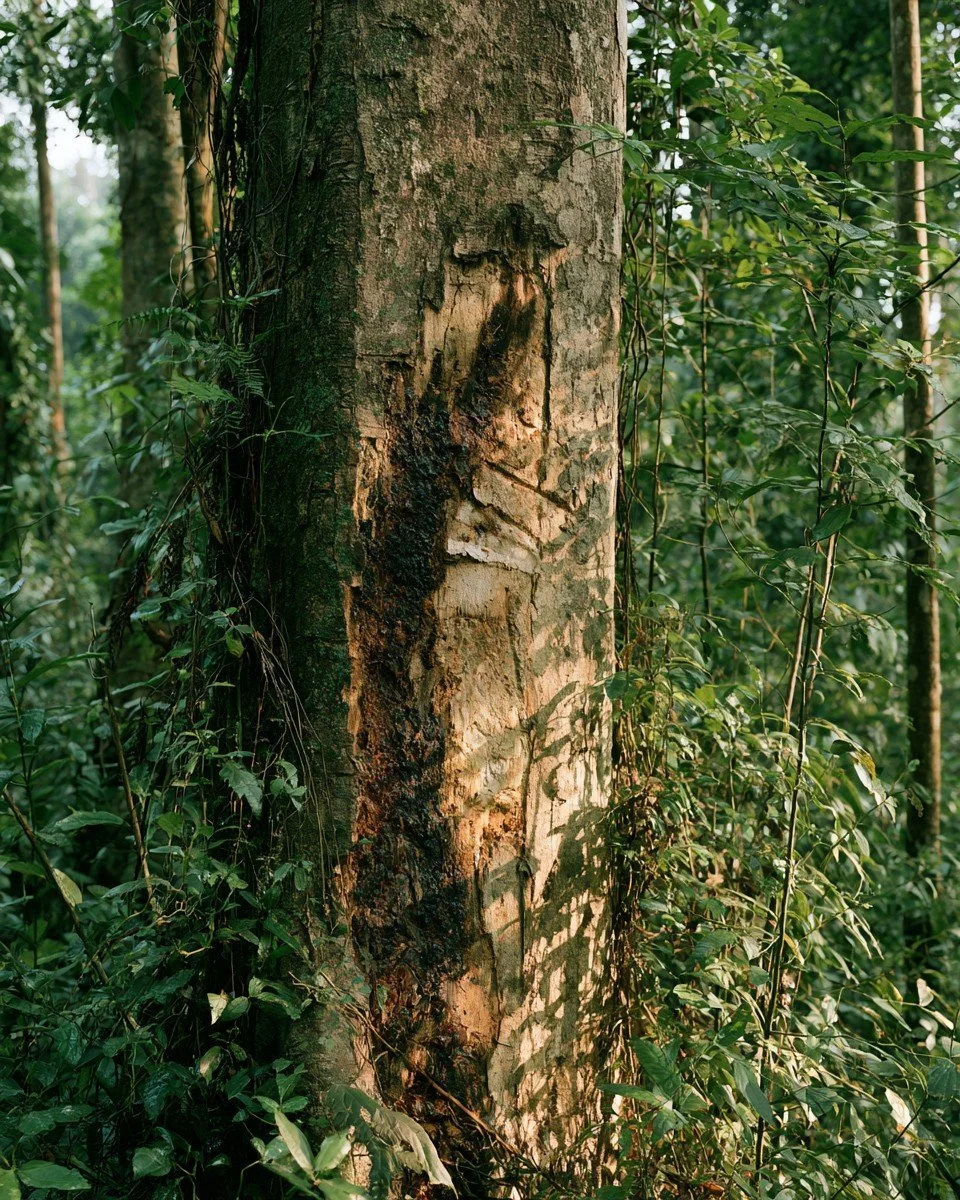
A healthy Aquilaria is a quiet tree. Its wood is pale and light and carries almost no scent. Everything changes with an injury. When the bark is torn open by a storm, a boring insect, or a blade, fungi move into the wound, and the tree answers by flooding the damaged wood with a dark, fragrant resin that holds the infection back56. Year by year the resin gathers until the timber turns dense and nearly black. That darkened wood is agarwood. Oud is the oil drawn from it.
The molecules that make oud smell like oud live almost entirely in that wounded tissue. Two families of compounds, the sesquiterpenes and a group called 2-(2-phenylethyl)chromones, build up in agarwood and are rarely found in the healthy tree at all7. The fragrance is the tree's record of a long fight.
Nature gives it up slowly. In natural forest only about seven to ten percent of trees ever carry the infection2, and the outside of the trunk keeps the secret. For generations the one certain test was to fell the tree and look, and countless healthy trees came down beside the infected ones6. That single fact explains much of what has happened to oud ever since.
IIThe trees

Oud is a family of trees. Four genera can make it: Aquilaria, Gyrinops, Aetoxylon, and Gonystylus1. Most of what reaches the market comes from eight species, seven of them Aquilaria and one a Gyrinops from Sri Lanka8.
Three names matter most to a perfumer. Aquilaria malaccensis, which older texts call A. agallocha, is the tree of India, Bangladesh, and Malaysia3. Aquilaria crassna is the tree of Cambodia, Laos, Thailand, and Vietnam4. Aquilaria sinensis is the tree of southern China and Hainan9. Out on the eastern islands, Gyrinops joins them10.
Species shapes a scent, but place shapes it more. The same tree grown in a different forest, wounded in a different way, and soaked for a different length of time gives an oil with a different voice. That is why oud is spoken of by origin.
IIIA map of oud
Follow the arc from west to east. The regions marked in gold are the three origins we hold in the house, and each has its own folio. Tap any marker to read its entry.
In the houseKnown origin
Swipe the map to explore
-
1Aquilaria malaccensis
Meghalaya & Sylhet
The southern edge of Meghalaya falls toward the plains of Sylhet into the wettest country on Earth11. Across the border in Bangladesh, the village union of Sujanagar has distilled agar-attar for centuries, and its attar became a Geographical Indication product in 202412.
Oud from this border carries a sweet, suede-like body over damp, earthy depth, close kin to the Indian style with a softer hand13.
Read the Meghalayan folio -
2Aquilaria malaccensis
Assam
The Brahmaputra valley is the old heart of Indian oud, and the town of Hojai is its distilling capital14. Northeast India was estimated in 2011 to hold nine to ten million cultivated Aquilaria on private land2.
This is the classic Hindi oud: barnyard and fermented on top, then sweet hay, deep resinous wood, sometimes ripe fruit or chocolate, and the longest, loudest wear of any origin13.
Folio in preparation -
3Aquilaria crassna
Cambodia
The Cambodian forests are crassna country, a species now critically endangered after decades of harvest4.
Cambodian oud is the fruit of the family, rich with berry jam and sometimes grape, syrupy and more robust than the island oils13.
Folio in preparation -
4Aquilaria crassna
Laos & Thailand
Thailand has become a major supplier to the Gulf. In Bangkok's oud houses fine oil is sold by the tola, about twelve grams, and the country's agarwood market is projected to reach two billion dollars by 202815.
Thai oud runs close to Cambodian with less fruit and a distinctive mineral note on top, quieter and zestier. Lao oils are known for shifting as they wear13.
-
5Aquilaria crassna
Vietnam
The mountain crassna of Khánh Hòa, Quảng Nam, and Quy Nhơn has long been ranked the finest agarwood of all. Vietnamese mandarins burned it in solemn rites, and the tree is cast among the Nine Urns of the imperial capital at Huế16.
Vietnam is also the homeland Japanese incense masters gave to kyara, the rarest grade there is17. In the chi-nan wood traders prize, two key chromones run 170 and 420 times higher than in ordinary agarwood18.
-
6Aquilaria sinensis
Hainan, China
China's name for agarwood, chénxiāng, means the incense that sinks, after the dense resinous pieces that drop in water. It first appears in Chinese texts in Buddhist sutras of the late second century, and by the late medieval period the wood of Hainan was ranked above the mainland's9.
Chinese oud leans toward the Indian or the Cambodian style depending on how it is distilled, lighter than Hindi oud and still rich13.
-
7Aquilaria malaccensis
Malaysia
Here the tree is karas and its wood is gaharu19. Malaysia and Indonesia were the leading exporters when international trade in agarwood first came under treaty controls in the 1990s20.
-
8Aquilaria, several species
Borneo & Indonesia
Borneo is shared by Malaysia, Indonesia, and Brunei, and its oils are distilled with a lighter hand.
Borneo oud is light, sweet, and syrupy with a touch of vanilla, the gentlest door into oud. Indonesian oils run jungly and fresh, with the clear smell of burning chips13.
-
9Gyrinops and Aquilaria
New Guinea
On the far eastern edge of the range, village harvesters cut into trunks to find the resin. Surveys there have identified new agarwood-producing species, and in some villages oud has raised incomes as much as tenfold10.
Papuan oud is green and leafy, wet jungle with floral hints close to violet13.
-
10Gyrinops walla
Sri Lanka
The island's own agarwood tree, walla patta, grows in the understory and in home gardens. Fewer than one in ten mature trees carries resin, and on one monitored plot every mature tree had been taken21.
IVThe cultures of oud
The Arab world. Oud is woven into hospitality across the Gulf. Chips are set over coals in a censer called the mabkhara, and when guests arrive the censer is passed among them so each can perfume themselves in the smoke22. The custom reaches back to the earliest days of Islam. Ibn Umar burned pure aloeswood, sometimes with camphor laid beside it, and said this was how the Prophet had perfumed himself23.
Japan. In the sixteenth century, under the shogun Ashikaga Yoshimasa, the nobles Sanjōnishi Sanetaka and Shino Sōshin organised his great collection of fragrant woods and founded kōdō, the way of incense17. They sorted agarwood into rikkoku gomi, six countries and five tastes, a system that still ranks kyara at the summit. Practitioners speak of listening to incense.

Japan's most famous piece of agarwood, the Ranjatai, is a log 156 centimetres long that has rested in the Shōsōin treasury at Tōdai-ji for more than a millennium. Labelled cuts mark pieces taken by Ashikaga Yoshimasa, Oda Nobunaga, and Emperor Meiji24. In 2025 the treasury announced it had identified the log's fragrance components and the age of its tree25.
China. Chénxiāng has been among the premier incense materials of East Asia for nearly two thousand years, burned in temples and courts and written into the old materia medica9.
India. The everyday word for incense across India, agarbatti, takes its name from agaru26. In the seventh-century Harshacharita, a king of Assam sends agarwood and its attar as a royal gift, and the Ain-i-Akbari of Akbar's court records how the attar was drawn12.
VFrom heartwood to oil
Once a tree is felled, the resinous wood is separated from the pale timber around it, largely by hand, and broken into chips. The chips soak in water before they are distilled. In one study a fourteen-day soak gave the best result, as the water slowly turned acidic and broke open the cell walls holding the oil27. A long, patient distillation follows.
The return is tiny. Commercial agarwood oils measured in one Malaysian study came out at roughly 0.14 to 0.20 percent of the weight of the wood28. A full kilogram of rare, resin-dark wood gives about one and a half to two grams of oil.
The soak is where regional style is born. In India and Bangladesh the chips sit for weeks, and a study of Assam oils found that several aromatic compounds, agarospirol among them, form during that fermentation itself29. The barnyard depth of Hindi oud is widely credited to this long soak, while the island oils of Borneo are distilled with far less of it13.
VIThe chemistry of a wound
Agarwood is one of the most chemically crowded materials in nature. A single review in 2018 described more than one hundred and fifty compounds newly isolated from agarwood and Aquilaria in the eight years before it31. Two families carry the character7.
The sesquiterpenes are the woody, balsamic voice of the oil, with names like agarospirol, jinkoh-eremol, and α-agarofuran. The 2-(2-phenylethyl)chromones are heavier and deeper, and their levels help separate ordinary wood from the legendary grades18. In the laboratory, members of this family show antioxidant, anti-inflammatory, and neuroprotective activity32. Warmed agarwood also releases benzylacetone, a small, sweet, faintly floral molecule that drifts through incense smoke33.
VIIWhat it does to the body
In a 2008 study at Kyoto University, mice that breathed agarwood oil vapour grew calmer and moved less, a standard sign of sedation. The researchers traced the effect to benzylacetone in one oil and to α-gurjunene and calarene in another34. Benzylacetone alone reduced the animals' activity, and a later paper tied the finding directly to the Japanese practice of listening to incense33. In 2017 a study of agarwood essential oil found sedative and sleep-promoting effects in mice that faded when the brain's GABA-A receptors were blocked35. These are the same receptors many sleep medicines work through.
This is early, animal research, and oud on skin is a pleasure first. It is still striking that cultures from Japan to Arabia reached for this smoke to quiet the mind, centuries before anyone could name a receptor.
VIIIThree thousand years in the smoke
- c. 1400 BCE
Sanskrit texts already describe agarwood as a fragrant treasure. Its Sanskrit name, agaru, is read as the wood that does not float, since resin-heavy wood sinks in water1.
- Ancient India
The Arthashastra, the old treatise on statecraft, taxed agarwood and other aromatics at a tenth or a fifteenth of their sale price1.
- The ancient Mediterranean
The Greek physician Dioscorides set down its medical uses. The Greek agallochon, the Hebrew aḥāloth, and the Arabic ālūwwa are all borrowed from the Indic name, so the aloes that perfume robes and beds in the Hebrew Bible trace their name back to India1.
- Late 2nd century
Chénxiāng enters Chinese writing through translated Buddhist sutras9.
- 595 CE
A log drifts ashore on Awaji Island in Japan. Islanders notice its unusual fragrance and carry it to the court of Empress Suiko24.
- 7th century
A king of Assam sends agarwood and its attar as a royal gift, recorded in the Harshacharita12.
- 16th century
Kōdō takes shape in Muromachi Japan, and the six-country system of ranking agarwood is set down17.
IXRarer every year
First-grade agarwood can fetch as much as $100,000 a kilogram30. In Bangkok's oud trade, fine oil sells near $40,000 a kilogram, and the very best reaches $80,000 to $100,000, at a time when gold stood around $60,00015.
That price has a cost. Aquilaria malaccensis is now listed as critically endangered after its wild population fell by more than eighty percent across three generations3, and A. crassna shares that status4. International trade in agarwood has been held under treaty controls for endangered species since February 199520, and every Aquilaria species joined it in 20046.
The future of the wood now rests in cultivation. India closed its wild harvest and allows oud to leave the country only from cultivated trees, under a national yearly allowance of 7,050 kilograms of oil for 2024 to 2027236. The shadow trade persists. Between 2017 and 2021, more than 1.25 tonnes of agarwood and six litres of oil were seized across six Indian states37.
That is the world behind every drop, and it is why we use oud with intention and tell you exactly where each one came from.
XOud in the house
We carry three ouds, each from a different corner of this map and each the heart of a different fragrance.
✦ ✦ ✦
Sources
- López-Sampson A., Page T., History of use and trade of agarwood, Economic Botany 72(1), 107-129 (2018).↑
- CITES Plants Committee, PC20 Inf. 7, Annex 15: agarwood in India, Rain Forest Research Institute, Jorhat (2011).↑
- CITES Standing Committee, Report on Non-Detriment Findings of Aquilaria malaccensis in India, SC77 Inf. 9 (2023).↑
- Aquilaria crassna, Wikipedia, citing the IUCN Red List assessment (2018).↑
- Fusarium oxysporum infection-induced formation of agarwood (FOIFA): a rapid and efficient method for inducing the production of high quality agarwood, PubMed Central.↑
- Assessment of the effects of artificial fungi inoculations on agarwood formation and sap flow rate of Aquilaria malaccensis, Forests 13, 1731 (2022).↑
- Li W., Chen H., Wang H., Mei W., Dai H., Natural products in agarwood and Aquilaria plants: chemistry, biological activities and biosynthesis, Natural Product Reports 38, 528-565 (2021).↑
- Xie Z. et al., Identification and classification of Aquilaria (Thymelaeaceae): inferences from a phylogenetic study based on matK sequences, PeerJ (2025).↑
- Romaskiewicz P., Aloeswood (chen xiang) in medieval China (2024).↑
- Agarwood (eaglewood) in New Guinea, WWF.↑
- Mawsynram, Wikipedia.↑
- Bangladesh's Agar-Attar hub: the timeless scent of Sujanagar, The Business Standard.↑
- River J., Oud Series: the smell of oud by terroir, Fragrantica (2014).↑
- Assam Govt. relaxes curbs on agar cultivation, Pratidin Time.↑
- Wizards of oud: how a rare Thai oil coveted by Saudis became "liquid gold", TRT World.↑
- Sacred swirls, Heritage, Vietnam Airlines.↑
- Incense in Japan, Wikipedia.↑
- Wu W. et al., Biosynthesis and its regulatory mechanisms of 2-(2-phenylethyl)chromones in agarwood, Plants 14, 1012 (2025).↑
- Aquilaria malaccensis Lam., Malaysia Biodiversity Information System.↑
- Barden A. et al., Heart of the matter: agarwood use and trade and CITES implementation for Aquilaria malaccensis, TRAFFIC (2000), summary via FAO.↑
- In Sri Lanka, the sweet smell of agarwood draws calls for trade protection, Mongabay (2019).↑
- Perfumed smoke, The Sun (Malaysia).↑
- Sahih Muslim 2254, Sunnah.com.↑
- Ranjatai, Wikipedia.↑
- "Ranjatai" aromatic wood that captivated rulers: the Shosoin Office determines its fragrance components and age, Science Japan (October 2025).↑
- TRAFFIC and WWF-India, Agarwood: factsheet.↑
- Safitri N. et al., Distillation of agarwood oil (Aquilaria sp.) using photovoltaic methods, ICOCSTI (2019).↑
- Mat Yusoff N.A., Optimization of pre-treatments of extraction methods for quality of agarwood (Aquilaria malaccensis) essential oil, Universiti Malaysia Pahang.↑
- Metabolite profiling of raw and fermented agarwood and three commercial grades of Assam agarwood oil, Current Science.↑
- Plant of the Month: Agarwood, JSTOR Daily.↑
- Chemical constituents and pharmacological activity of agarwood and Aquilaria plants, Molecules 23(2), 342 (2018).↑
- Yu M. et al., Chemical and bioactivity diversity of 2-(2-phenylethyl)chromones in agarwood: a review, Chemistry & Biodiversity 19(12) (2022).↑
- Sedative effects of inhaled benzylacetone and structural features contributing to its activity, Biological and Pharmaceutical Bulletin 36(9) (2013).↑
- Takemoto H., Ito M., Shiraki T., Yagura T., Honda G., Sedative effects of vapor inhalation of agarwood oil and spikenard extract and identification of their active components, Journal of Natural Medicines 62, 41-46 (2008).↑
- Agarwood essential oil displays sedative-hypnotic effects through the GABAergic system, Molecules 22(12), 2190 (2017).↑
- DGFT amends export policy conditions for agarwood chips, powder, and oil (Notification No. 52/2024-25), Taxscan (2025).↑
- Reporting on TRAFFIC and WWF-India, Agarwood: factsheet on India's agarwood in illegal wildlife trade, The Arunachal Times.↑
Photographs
Hero: Ashenfume. Aquilaria crassna: Blaise Droz, CC BY-SA 3.0, via Wikimedia Commons. Ranjatai: from Tōei Shukō, vol. 3 (1908), public domain. Map coastlines: Natural Earth, public domain.