Provenance Oud Meghalaya & Sylhet
Meghalayan Oud
Jungle-grown in the wettest hills on Earth
Where the Khasi Hills of India fall toward the plains of Sylhet, the monsoon breaks harder than anywhere else on the planet. The oud that grows here has fed one of the oldest perfume trades in the world, carried down from the hills to the stills of Sujanagar for centuries. This is the oud at the heart of Red Hare, and the story of the border country that makes it.

IWhere the clouds live
Meghalaya means the abode of the clouds. Its southern edge is a wall of hills that meets the monsoon head on, coming straight off the Bay of Bengal across the flat plains of Sylhet. The village of Mawsynram, on this same edge, averages around 11,872 millimetres of rain a year and is often named the wettest place on Earth2. That is close to forty feet of water falling on one hillside.
Agarwood loves this country. Aquilaria malaccensis grows naturally in the foothills of northeast India up to about a thousand metres3, and forest this warm and this saturated keeps a wound damp and alive with fungi. A tree here has every reason to defend itself, and the resin is its defence.
These hills also hold a rarer cousin. Aquilaria khasiana grows wild only in the Khasi Hills of Meghalaya. Botanists had feared it gone from the state until they collected it again near Mawsynram after a gap of seventy-four years4, and a recent survey counted just five surviving trees in that part of Meghalaya5. Our oud comes from the far more widespread malaccensis. The near-vanishing of khasiana shows how much these hills have already given.
IIA border drawn through a forest
For most of history there was no line here at all. Traders gathered agarwood in the Patharia hills of Barlekha and the neighbouring hills of what is now India and carried it down to the village union of Sujanagar to be distilled into attar6. In the seventh century, a king of Assam sent agarwood and its attar as a royal gift, an exchange recorded in the Harshacharita. Arab merchants carried the oil west in the eighth and ninth centuries, and until the 1950s, by local accounts, this one region supplied nearly all of the world's agar-attar6.
Partition drew the border through the forest, and the trade carried on along both sides of it. Before the split, Sujanagar alone held around three hundred agar-attar factories6. On the Indian side, agar plantations made up a major share of the rural economy of Meghalaya's Garo Hills in the 1970s, when some of the most prosperous traders in South Garo Hills were agar planters. More recently the state set out to revive that economy, and four thousand farmers registered for a single new planting programme in South Garo Hills7.
Oud is the memory of a wound, kept by a tree and carried out of the hills by hand.
IIIHow the wood is wounded
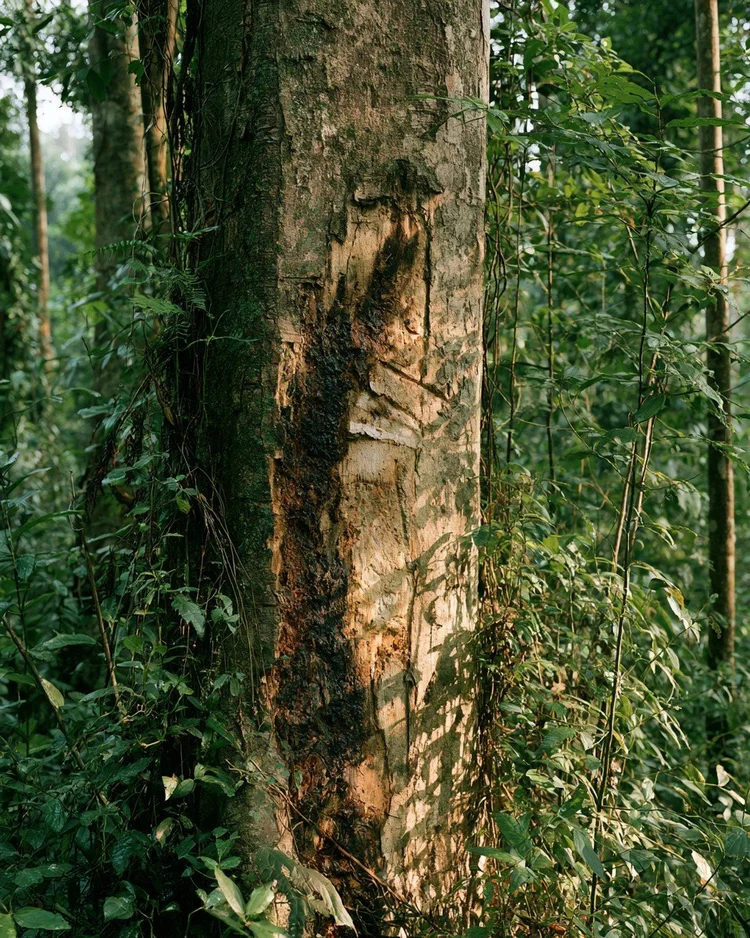
In the backyard gardens around Sujanagar, saplings are planted on flat or gently rising ground. Once a tree is grown, workers hammer hundreds of iron nails into the trunk about an inch apart, since every nail is another wound for the resin to gather around. Over three to five years the resin builds up around the iron. Some trees give usable wood fifteen to twenty years after planting, and trees fifty to a hundred years old give the finest attar of all6.
Locals say attar from nailed trees fetches less than attar from resin that formed naturally6. Ours took its own road. It is jungle-grown. Seedlings were planted out into the forest, and the trees crowding them were thinned so each young Aquilaria could take a greater share of the soil and the light. When the tree was ready, its bark was cut by hand so its own defence would begin, and then the jungle, the fungi, and the rain did the slow work of years.
A great deal of oud with this history is sold under the word wild, and it would read beautifully on a label. We would rather tell you what happened. A tree raised in the jungle, wounded by a person, and healed by the forest is still a rare and precious thing, and every tree grown this way is one that never had to be taken from the last wild stands.
IVFrom chips to oil, the Sylhet way
When the resin has matured, the tree is felled and the dark wood is cut into small chips. In Sujanagar the chips soak in water for a month to a month and a half, in homes or in great drums. Then they are heated in steel cauldrons for as long as fifteen days. The vapour is piped away to cool and condenses drop by drop into raw attar, which is bottled in small glass jars. Even the spent wood is sold on, shipped to the Middle East as husk6.
Forty kilograms of resin-bearing wood yields roughly six to seven tolas of attar, at about 11.6 grams to the tola6. That is seventy to eighty grams of oil from a load of wood heavier than a full suitcase, or about two tenths of one percent.
The long soak shapes the scent as much as the tree does. A study of oils from neighbouring Assam found that several aromatic compounds, agarospirol among them, form during that fermentation itself8, and the animal depth Indian and Bangladeshi oud is loved for is widely credited to it9.
VA village of stills
Today more than eight in ten houses across Sujanagar's thirty villages host a still, and some thirty-five thousand people depend on the work. Traders estimate that around five thousand litres of raw attar leave Moulvibazar every year, bound for Dubai, Saudi Arabia, Qatar, Kuwait, Bahrain, Oman, Malaysia, and Europe, with finished oil reaching $20,000 to $30,000 a kilogram abroad. On 12 February 2024 the agar-attar of Moulvibazar was recognised as a Geographical Indication product6.
Across the border, the same tree is under careful watch. Aquilaria malaccensis is listed as critically endangered after its wild population fell by more than eighty percent across three generations1. India allows oud to leave the country only from cultivated trees, under a national yearly allowance10, and the future of this oud rests in exactly the kind of planting and patient wounding that produced ours.
VIIn our bottle
Meghalayan oud holds a rare balance. It is fully animalic and still comforting. It opens on barnyard, woodsmoke, and a civet warmth, then softens within the hour into castoreum and something close to aged nagarmotha, dry and rooty and faintly spiced. Across a long wear it moves through leather, hot slate, dry straw, tamarind, and oriental tobacco, with a gourmand edge of chestnut and caramel beneath it all.
In the house, it carries the heart of one fragrance.
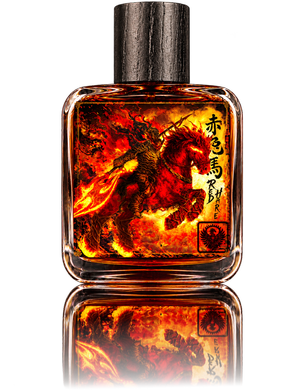 Found in
Red Hare
An animalic oriental built on this Meghalayan oud.
More oudAcross the map
✦ ✦ ✦
Sources
- CITES Standing Committee, Report on Non-Detriment Findings of Aquilaria malaccensis in India, SC77 Inf. 9 (2023).↑
- Mawsynram, Wikipedia.↑
- Kharnaior S., Thomas S.C., A review of Aquilaria malaccensis propagation and production of the secondary metabolite from callus (2021).↑
- Recollection of Aquilaria khasiana from the Mawsynram area of Meghalaya, Rheedea (2021).↑
- Rare agarwood tree found thriving in Assam's Jeypore Reserve Forest, The Brew News.↑
- Bangladesh's Agar-Attar hub: the timeless scent of Sujanagar, The Business Standard.↑
- Mukul eyes "Wood of the Gods" for turnaround, The Assam Tribune.↑
- Metabolite profiling of raw and fermented agarwood and three commercial grades of Assam agarwood oil, Current Science.↑
- River J., Oud Series: the smell of oud by terroir, Fragrantica (2014).↑
- DGFT amends export policy conditions for agarwood chips, powder, and oil (Notification No. 52/2024-25), Taxscan (2025).↑
Photographs
Sylhet basin: NASA Johnson Space Center, ISS052-E-587, public domain. Agarwood plate: Ashenfume.