Provenance Materia Red Champaca
MATERIA · THE NATURAL HISTORY COLLECTION
Red Champaca
The orange champak of India, from the dawn gardens of Vasai to the copper stills of Kannauj
At half past five in the morning, in the villages of Vasai on the coast north of Mumbai, the champak growers begin to pick, and they keep picking until about sunset1. Robert D'Britto's garden in Satpale sends ten to eleven thousand flowers a day to the Dadar flower market, 58 kilometres away by the 9.09 local from Virar2. The flowers open the colour of butter and deepen to orange as they age. Perfumers call them red champaca, and this is the flower at the top of Red Hare.


IWhat it smells like
On the tree the champak smells of fruit and flowers at once, green apple and tutti frutti over a warm, animal breath of indole111213. In the absolute the fruit gives way to rose and to the woody violet of the ionones, threaded with concord grape4141516.
- Opening
To come: the house evaluation of the opening.
- First hour
To come: the house evaluation of the first hour.
- Heart
To come: the house evaluation of the heart.
- Long drydown
To come: the house evaluation of the drydown.
IIIn the house
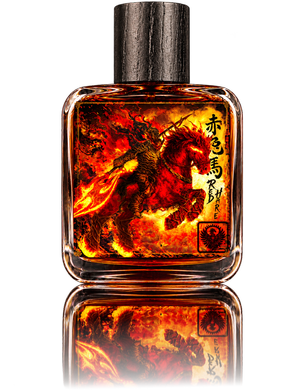
The house works with red champaca in two forms. The absolute, from India, carries the flower at full strength. The attar, distilled in Kannauj into sandalwood in the old way, carries it in the oil it has travelled with for centuries. Together they open Red Hare, the warhorse of the Three Kingdoms, where the champak rises beside honeysuckle over costus root, Java vetiver and a dark base of Meghalayan oud, labdanum and chocolate.
 Found in
Red Hare
Red champaca absolute and Kannauj attar at the top, beside honeysuckle.
View the fragrance


IIIA flower for beetles
The champak grows wild from the eastern foothills of the Himalaya and the Western Ghats of India to Yunnan, Indochina, Sumatra and Java, from the lowlands up to about 2,100 metres17185. In India it is common in the dense forests of Kerala, less so in Tamil Nadu and occasional in Karnataka19. In the forest it is a giant, up to fifty metres tall, with a straight grey trunk nearly two metres across818.
Its scent is an invitation, and the guests are beetles. Beetles were among the first pollinators of flowering plants, and the magnolia family still depends on them almost entirely20. They come for food, chewing the soft petals as they work, and the pollination ecologist Soubadra Devy points to the champak as a prime example of a soft-petalled flower made for them. Beetles find flowers by smell, even in the dark20. Botanists call them mess-and-soil pollinators, for what they leave behind on the petals20.
Once the beetles have done their work, the fruit ripens into a cluster of woody capsules that split open to show two to six seeds wrapped in red or pink flesh. Birds and mammals eat that flesh and carry the seeds away8. Where the tree has been planted far from home, in the eucalyptus stands of Brazil, researchers found that the red coat holds back germination. Ants strip it from the seeds the birds drop, which lets the seeds sprout and spares them from rodents21. A tree grown from seed waits eight to ten years for its first flowers18.
The tree keeps a rhythm of its own. In Odisha it blooms twice a year, in the monsoon from June to September and again in spring from January to April9. Other records give February to May, or March to July in Kerala, and in the warm, wet tropics some trees carry flowers and fruit the whole year round192218. Hail in March and April can strip a tree of its flowers and young fruit17.
IVOne tree, many golds

The champak is a magnolia. For two centuries botanists kept it in a genus of its own, Michelia, which Linnaeus named in 1753 for the Florentine botanist Pier Antonio Micheli, and the champak is the type of that genus256. DNA studies kept placing Michelia inside Magnolia, with a sequence difference of only about 0.63 percent, and in 2004 the botanists Figlar and Nooteboom folded the whole subfamily into a single genus2627. Its accepted name is now Magnolia champaca, published in Pierre's Flore Forestière de la Cochinchine in 18805.
The flowers grow singly where the leaves meet the twigs, each with about fifteen narrow, upward-curving tepals, two to four and a half centimetres long, and their scent carries some distance from the tree2310. They open light yellow and turn orange-yellow, then dark orange, as they mature83. Singapore's botanists list the tree as yellow champaka, orange chempaca and orange champak, and by the Malay name cempaka merah, red cempaka8. An old synonym, Michelia aurantiaca, means the orange Michelia28. Growers in Maharashtra count seven kinds of sonchafa, among them saffron, pale yellow, bright yellow and dense yellow forms29. Red champaca, in the trade, is the champak at its deepest gold.
Botanists recognise two varieties. The typical one belongs to southern India and the Lesser Sunda Islands, and the giant of the Malay Peninsula and Java is var. pubinervia30. The champak also has a white cousin. Magnolia × alba, the white champaca used in China to scent tea, is a hybrid of the champak and Magnolia montana, and it rarely sets fruit3132. Its flowers stay white and smell subtler and fruitier. The champak's are intense and musky3.
VThe city of champak trees
The name is Sanskrit. Campaka became champa in Hindi and Bengali, chenbagam in Tamil, sampige in Kannada and sonchafa, the golden chafa, in Marathi733. It travelled east as champa in Thai, cham pa in Lao and cempaka in Javanese and Malay34.
A whole city took the name. Campā, capital of the ancient kingdom of Anga, stood about twenty-four miles east of modern Bhagalpur in Bihar, and the commentator Buddhaghosa wrote that it was called so because the whole place abounded in large campaka trees. The Buddha stayed there several times35. A kingdom of Champa rose in the Annam region of what is now central Vietnam in 192 CE36, and the scholar G.P. Malalasekera suggested that settlers from India named it after the city of champak trees35.

The tree stands in Buddhist scripture. The Buddhavaṃsa records that Atthadassī, the fourteenth of the twenty-four Buddhas, reached enlightenment at the foot of a campaka tree37. In Myanmar, champak flowers are set in washed glucose bottles before images of the Buddha, where they can last for up to a year38. On the road up Mount Popa, pilgrims buy bottled yellow Michelia flowers for the spirit Min Mahagiri, who in legend was burned alive tied to a Michelia tree39.
Hindu tradition gives it a more complicated place. The champak is held sacred to Krishna and grown in temple precincts, and champaka flowers adorn the hair of the goddess Lalitambika40. The Shiva Purana says that every flower may be offered to Shiva except two, the champaka and the ketaka41, and in some places temple custom offers it to him all the same33. In Tamil Nadu the tree grows in the sacred groves kept by the Malayali and Paliyan peoples, with small shrines among the trunks10.

The scent was a standard of Indian perfumery. Varahamihira's Brihatsamhita gives a compound that imitates it: a base called Smaroddipana, mixed with powdered sandalwood, gives the fragrance of the campaka flower42. The Indologist P.K. Gode devoted a whole study to campaka oil and its making between 500 and 1850 CE43. Rabindranath Tagore gave the flower its best-known poem in English, "The Champa Flower," published in The Crescent Moon in 1913, in which a child imagines becoming a champa flower high on the tree while his mother reads the Ramayana at the window44.
In Aceh, at the northern tip of Sumatra, the bungong jeumpa once crowned the bride and is woven as a motif into the songket cloth of Aceh Besar. Since 2022 it has appeared on the 2,000 rupiah note. The trees have grown scarce, and brides now wear jasmine buds45.
European botanists met the champak in the colonial herbals. Rheede's Hortus Malabaricus and Rumphius's Herbarium Amboinense both figured it before Linnaeus named it, Rumphius with fifteen petals in three rows and Rheede with whorls of eight46. By 1831 its scent had become a measure. Describing a ginger lily in Curtis's Botanical Magazine, the botanist Nathaniel Wallich wrote that it had the yellow of the champaca and even the peculiar fragrance of the latter, only in a less powerful, and therefore more grateful, degree47.
VIThe dawn harvest
Grafting turned the champak into a market crop. A tree grown from seed takes eight to ten years to flower, and a grafted one two to three18. The sonchafa growers of Vasai plant saplings grafted at the Velankar nursery at Kudal, in Sindhudurg, which holds three thousand mother trees and makes about ten thousand grafts a year at 150 rupees each292. Around Vasai, about five hundred families in twenty-five villages grow the flower for Mumbai, and a cooperative at Arnala counts 1,100 members1.

The work follows the flowers. On the Vasai farms the picking begins at half past five in the morning and continues until about sunset1. In Satpale, Robert D'Britto keeps 225 grafted trees, and from March to October each one gives 150 to 200 flowers a day. His workers carry them onto the 9.09 local from Virar and reach Dadar by a quarter to eleven2. "Beginning my day in a fragrant garden gives me a heady feeling," he says2. The flowers travel in polythene bags or plastic boxes, and the market sells them a hundred to a box, for 100 to 150 rupees, and for up to 700 in the eleven days of Ganesh Chaturthi21.
Then the trees rest. They go dormant around September and recover by January. The season is fragile. In late 2022, unseasonal cloud and rain halved the yields, and Subhash Bhatte, with about four hundred trees on an acre, saw his daily pick fall from about eleven thousand flowers to a few thousand1.
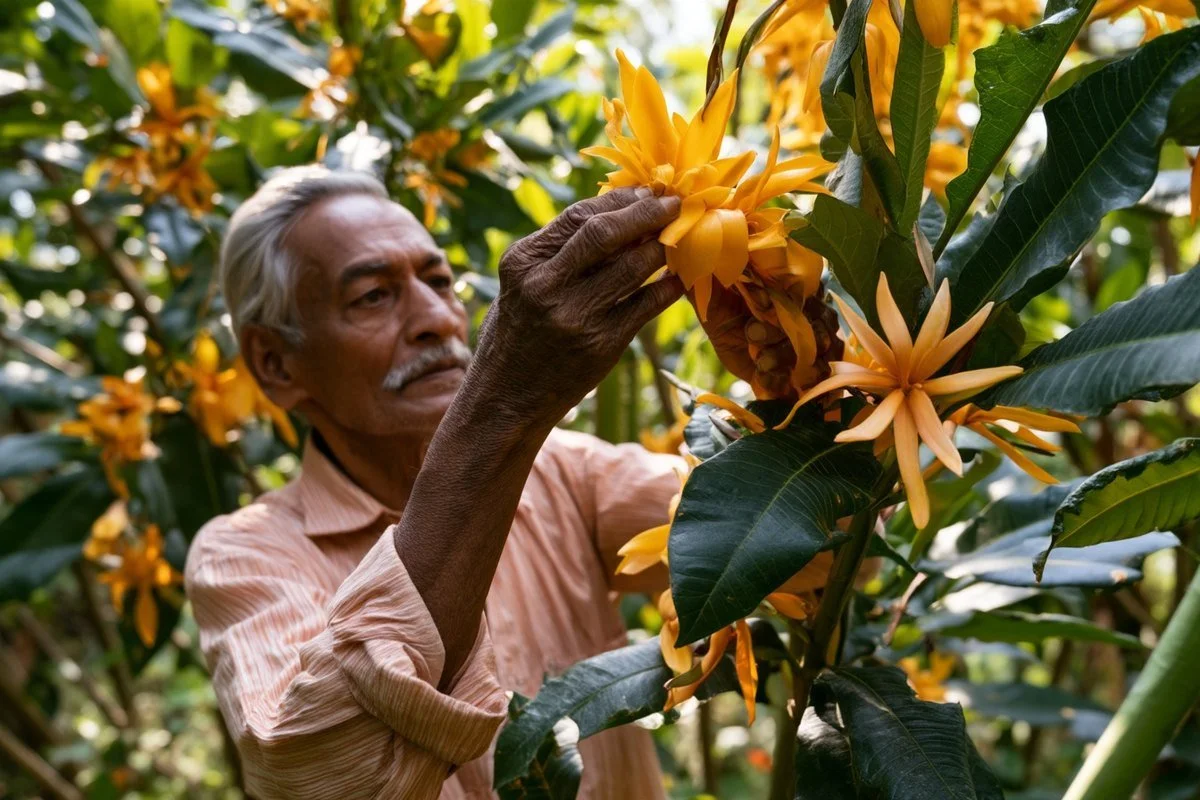
For perfumery the hour matters. Scientists in Singapore who mapped the living flower's chemistry collected fully opened blossoms between seven and half past eight in the morning11. Kannauj's attar makers prize flowers gathered before the monsoon, when they carry six or seven percent water against thirty to forty percent after the rains48. Most champak flowers in India still go to ornament and to the temple, and only small quantities are processed for oil, concrete and absolute9.
The champak is picked at dawn, spoken for by noon, and kept by the still for years.
VIIFrom flower to absolute
Champaca gives very little to steam, and water distillation of the flowers gives very low yields of oil9. The perfumer's champak is made with solvents. The most careful account comes from the Central Institute of Medicinal and Aromatic Plants, which worked with flowers picked on the campus of the Institute of Minerals and Materials Technology in Bhubaneswar9.
Half a kilogram of fresh flowers is steeped in three litres of pentane for six hours, drained, and steeped again in two and a half litres for six hours more. The solvent is drawn off below 35°C, leaving the concrete, a deep yellow, waxy mass, at 1.58 percent of the weight of the fresh flowers9. The concrete is warmed in methanol to 50°C and chilled to minus 15°C for a full day, so the waxes freeze out. When the alcohol is removed, what remains is the absolute, light yellow and partly free of wax, at 1.32 percent of the fresh flower9. That is about seventy-six kilograms of blossom for each kilogram of absolute.
A newer form uses carbon dioxide held liquid at 62 bar and 25°C. Run through the flowers for three hours, it draws out about one percent of their weight, with far less wax, and the institute's chemists judged it organoleptically very superior9.
VIIIThe attar of Kannauj
Kannauj, on the Ganges plain, has made attar for more than four hundred years49. It was the capital of Harsha's empire in the seventh century, and in 2014 Kannauj perfume received a geographical indication of its own50. The town holds some three hundred distilleries51.
The method is called deg and bhapka. Flowers and about an equal volume of water go into a copper still, the deg, and its lid is sealed with a mash of clay and cotton4849. A fire of wood and cow dung heats it from below. The steam runs through a bamboo pipe wrapped in coconut coir to a copper receiver, the bhapka, which stands in a tank of water to cool it and holds a charge of sandalwood oil. The oil catches the scent as it condenses and fixes it484950. One run takes five to six hours, and the next day the deg is filled with fresh flowers and run again into the same oil. The master craftsman Ram Singh, at fifty, judges the heat by touch and by the sound of the steam49.
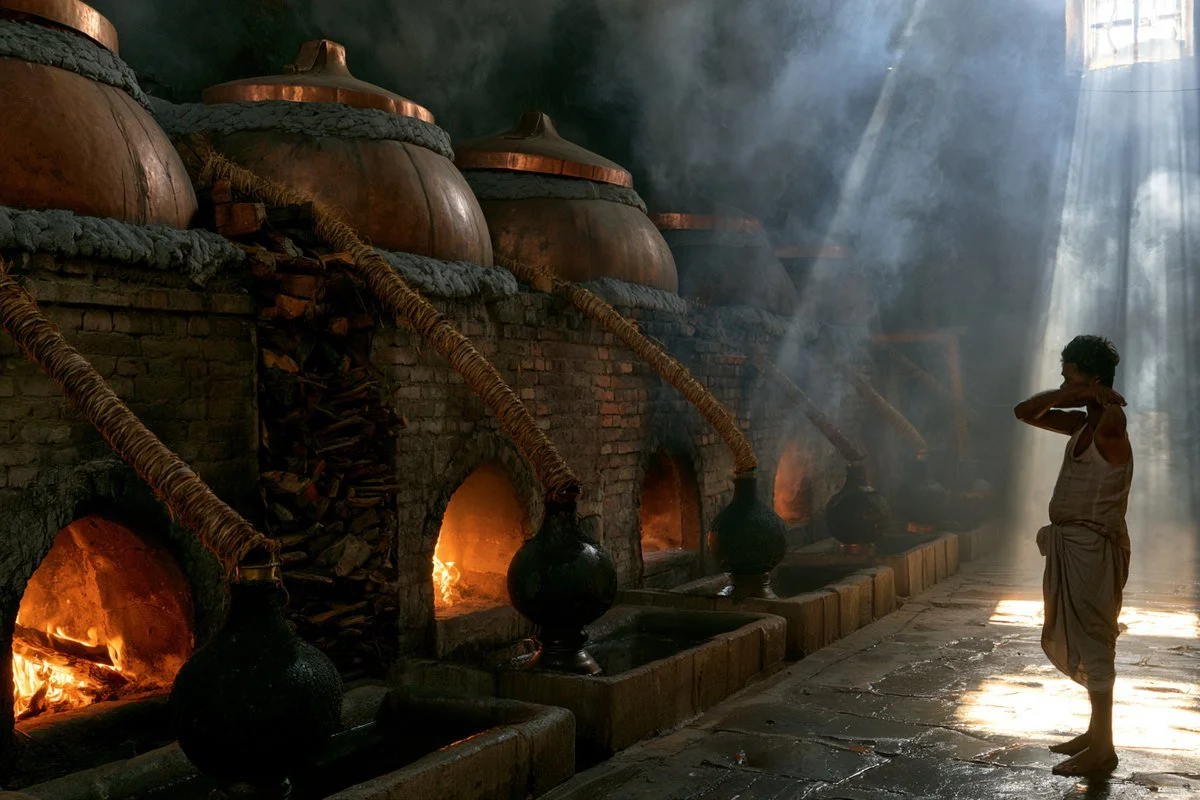
A Kannauj attar takes eighty to a hundred kilograms of flowers for each kilogram of sandalwood oil48, and the finished attar is aged for several months in a bottle of camel skin49. The leather breathes, and the last of the water passes out through it while the scent stays inside.

The base has changed with the price of the wood. Around 2002 a Kannauj attar ran about eighty parts sandalwood to twenty of liquid paraffin or a plasticiser. By 2008 the ratio had turned to ten parts sandalwood to ninety, with sandalwood oil at 90,000 rupees a kilogram against 10,000 for paraffin48. Some modern attars use paraffin in place of sandalwood altogether49.
Names need care here. In north India the word champa often means frangipani, Plumeria, and one account of the Kannauj trade glosses its champa that way751. The national flower of Laos, dok champa, is frangipani too52. A careful buyer asks for Magnolia champaca by name.
IXWhat the chemistry shows
The chemist Roman Kaiser analysed champaca concretes and an absolute in the late 1980s and found more than 240 constituents, several of them unknown in nature until then4. The commercial extracts he tested shared a broad pattern: phenylethyl alcohol at 25 to 34 percent, methyl linoleate at 10 to 18, indole at 2.9 to 12, methyl anthranilate at 2.1 to 9, the ionones at 1 to 5 and phenylacetonitrile at 1.2 to 4.54. A concrete he made himself held 26.8 percent of α- and β-ionone, 11 percent linalool and 10 percent dihydro-β-ionone4. He also found the champak's own signatures, isoxazoles and ionone oximes, some of which he believed form inside the extract itself4.
The living flower smells different again. Over six hours of sampling, the Singapore team caught forty-three compounds rising from fresh blossoms. The largest was methyl 2-methylbutanoate at 23.16 percent, then ethyl 2-methylbutanoate at 9.38, indole at 8.62, the sesquiterpene β-cubebene at 8.57, a linalool oxide at 7.77 and linalool at 7.0911. Methyl anthranilate made up only 0.15 percent. The flower makes the (R) form of linalool11.
Each molecule carries a piece of the portrait. Phenylethyl alcohol smells of rose and rose water, sweet, with a honeyed nuance14. β-Ionone is floral, woody and sweet, with berry and beeswax, and dihydro-β-ionone is earthy, of mahogany, orris and dry amber1553. Methyl anthranilate brings concord grape16. Indole is animalic, and floral when diluted13. The two esters of the living flower are fruit itself, tutti frutti and sharp green apple1254.
The ionones may tie the scent to the colour. They are cut from carotene pigments, and in osmanthus flowers an enzyme of the carotenoid cleavage family has been shown making α- and β-ionone from carotenes55. The same pathway in the champak, and its link to the flower's orange, await their study. The white cousin runs the other way: its flowers are about seventy percent linalool in an extract and over ninety percent in a steam-distilled oil3256.
XGrades and imitations
The chemists rank the forms by their wax. The concrete sits lowest. The partly dewaxed absolute stands above it, and the carbon dioxide extracts and fractions of concrete stand highest, fit for high-grade perfumery9. Lots vary widely. The Bhubaneswar absolute was led by fatty esters, methyl linoleate at 25.3 percent, with phenylethyl alcohol at only 4.29, and the two classic analyses each rested on a single Indian absolute9.
Linalool is the chemist's witness. The living flower makes (R)-linalool11, and the ratio of linalool's two mirror-image forms, read by chiral gas chromatography, has caught many commercial oils stretched with synthetic linalool57. Gas chromatography reads only what evaporates. A vegetable oil added as a diluent shows itself to liquid chromatography, and isotope-ratio mass spectrometry catches synthetic copies of natural molecules5859.
Perfumers have imitated champak since the days of the Brihatsamhita42. A modern champaca accord draws on the flower's own molecules, phenylethyl alcohol for the rose, the ionones for the violet wood, methyl anthranilate for the grape, indole for the warmth and linalool for the lift4. The natural absolute adds the hundreds of trace molecules that give it depth. In the industry's code of practice, champaca absolute is counted for its natural benzyl alcohol and eugenol, up to 1.5 and 0.5 percent, against limits for skin sensitisation60.
XIRare and precious
Every kilogram of champaca absolute begins as about seventy-six kilograms of fresh flowers9, each one picked by hand from trees that rest for months each year and lose their blossom to hail and unseasonal rain117. A Kannauj attar asks eighty to a hundred kilograms of flowers for each kilogram of sandalwood oil, distilled by craftsmen who in 2008 earned about 2,500 rupees a month, lifting sixty-kilogram sacks of flowers amid the steam48.
The champak itself is secure, listed as Least Concern on the global Red List10. Its family is less fortunate. The 2016 Red List of Magnoliaceae assessed 304 wild magnolias and found 48 percent threatened, above all by logging and the clearing of forest for farms61. The champak's light, durable wood is prized for furniture, carvings, tea chests and bead chains108. The flower is the gentler harvest, renewed each morning on the same tree.
Found in
Red Hare
Red champaca absolute and Kannauj attar at the top of the house fragrance of the Three Kingdoms.
More from the MateriaNeighbours of the champak
 ✦ The white cousin
Magnolia
The white champaca, the champak's hybrid cousin, flower of the tea gardens of southern China.
Read the folio
 ✦ India
Tuberose
The night-scented flower of Mexico, grown today across the flower fields of India.
Read the folio
 ✦ The attar's base
Sandalwood
The oil that catches the champak in every traditional Kannauj attar.
Read the folio
 ✦ The Himalaya
Costus
The Himalayan root that sits beneath the champak in Red Hare.
Read the folio
 ✦ Meghalaya & Sylhet
Meghalayan Oud
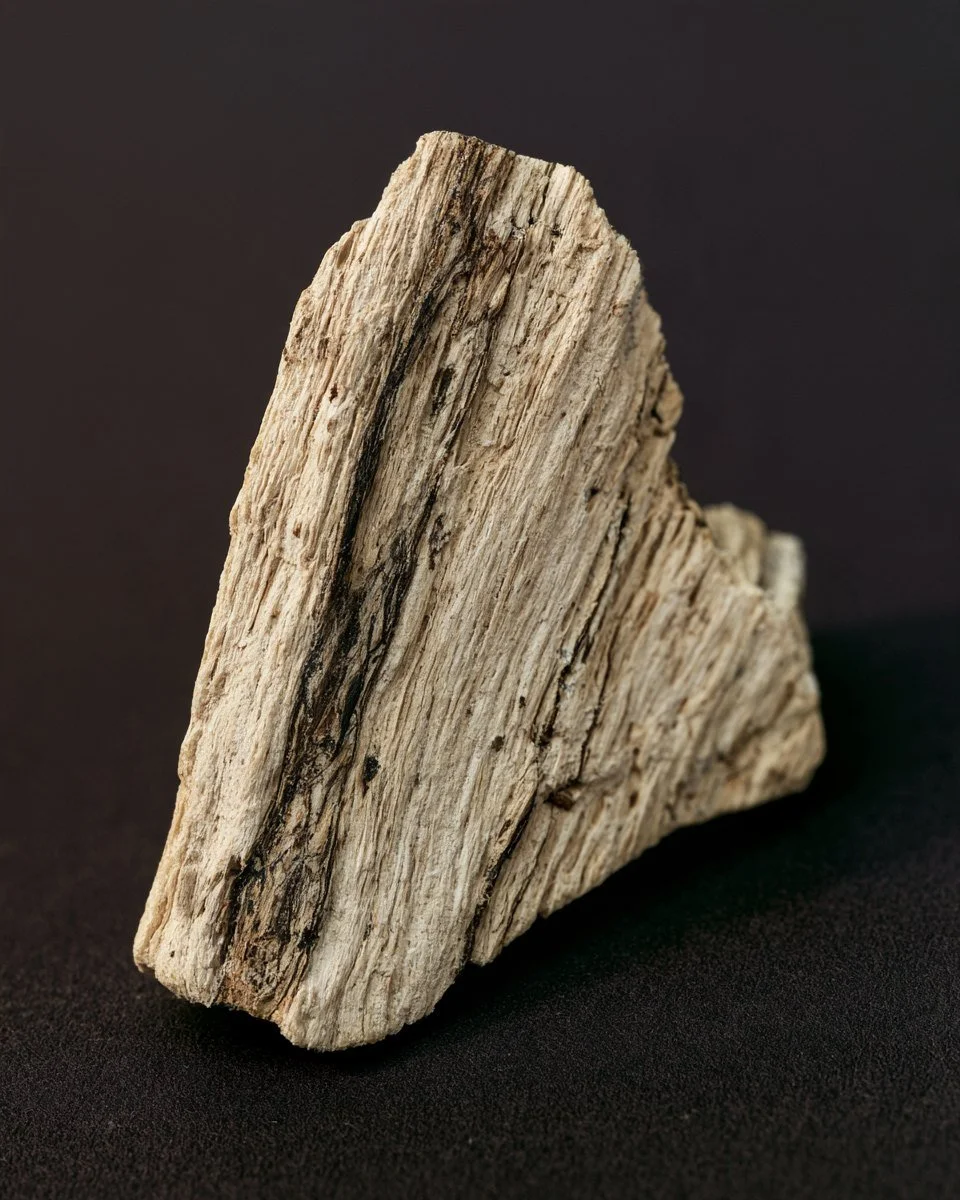
The jungle-grown oud at the base of Red Hare, beneath the champak.
Read the folio
✦ ✦ ✦
Sources & image credits61 references
- Bose H.K., Blooms of despair for sonchafa growers of Palghar, 101Reporters (7 January 2023).↑
- Bose H.K., Mumbai farmer earns lakhs from sonchampa flowers, The Better India (13 June 2020).↑
- National Parks Board Singapore, Comparison of similar plants: Magnolia champaca with Magnolia × alba, Flora and Fauna Web.↑
- Kaiser R., New volatile constituents of the flower concrete of Michelia champaca L., Journal of Essential Oil Research 3(3), 129-146 (1991).↑
- Royal Botanic Gardens, Kew, Magnolia champaca (L.) Baill. ex Pierre, Plants of the World Online.↑
- World Flora Online, Magnolia champaca, WFO Plant List, snapshot 2024-06 (2024).↑
- eFloraofIndia, Magnolia champaca.↑
- National Parks Board Singapore, Magnolia champaca (L.) Baill. ex Pierre, Flora and Fauna Web.↑
- Rout P.K., Naik S., Rao Y.R., Liquid CO2 extraction of flowers and fractionation of floral concrete of Michelia champaca Linn, The Journal of Supercritical Fluids 56, 249-252 (2011).↑
- National Tropical Botanical Garden, Magnolia champaca, NTBG Plant Database, citing the IUCN Red List assessment by Khela S. (2014).↑
- Dhandapani S. et al., Integrated metabolome and transcriptome analysis of Magnolia champaca identifies biosynthetic pathways for floral volatile organic compounds, BMC Genomics 18, 463 (2017).↑
- The Good Scents Company, Methyl 2-methylbutyrate.↑
- The Good Scents Company, Indole.↑
- The Good Scents Company, Phenethyl alcohol.↑
- The Good Scents Company, β-Ionone.↑
- The Good Scents Company, Methyl anthranilate.↑
- Tamil Nadu Agricultural University, Timber tree species: sempagam (Michelia champaca), TNAU Agritech Portal.↑
- Orwa C., Mutua A., Kindt R., Jamnadass R., Anthony S., Michelia champaca, Agroforestree Database: a tree reference and selection guide, version 4.0, World Agroforestry Centre (2009).↑
- ENVIS Centre on Medicinal Plants, FRLHT, Michelia champaca L. (Magnoliaceae), ENVIS FRLHT database, Bengaluru.↑
- Tandon A., Meet the beetles, the tiny titans of pollination, Mongabay India (25 March 2024).↑
- Candiani G., Galetti M., Cardoso V.J.M., Seed germination and removal of Michelia champaca L. (Magnoliaceae) in eucalypt stands: the influence of the aril, Revista Árvore 28(3), 327-332 (2004).↑
- University of Kerala, Magnolia champaca (L.) Baill. ex Pierre, Kerala University Digital Garden.↑
- Spencer R., Magnolia champaca (as Michelia champaca), Horticultural Flora of South-eastern Australia, vol. 2, Royal Botanic Gardens Victoria (1997).↑
- Michelia, Wikipedia.↑
- International Dendrology Society, Michelia, Trees and Shrubs Online.↑
- Figlar R.B., A brief taxonomic history of Magnolia, Magnolia Society International.↑
- Figlar R.B., Nooteboom H.P., Notes on Magnoliaceae IV, Blumea 49(1), 87-100 (2004).↑
- Magnolia champaca, Wikipedia.↑
- Bose H.K., Sonchafa flower farming, The Better India (18 August 2025).↑
- Magnolia Society International, Magnolia classification: subgenus Yulania (updated April 2012).↑
- 物种日历 (Species Calendar), Guokr Nature, 白兰花, 簪在鬓上, 插在襟上 (Bai lan, pinned in the hair and on the lapel), The Paper (澎湃新闻) (17 June 2020).↑
- Liu Bojing (刘波静), Lin Faming (林法明), 毛细管气相色谱/质谱法分析熏茶植物白兰花中挥发性化学成分 (Volatile constituents of the tea-scenting plant bai lan by capillary GC-MS), Food Science (食品科学) 23(6), 127-130 (2002).↑
- C.P.R. Environmental Education Centre, Champaka, Eco-heritage: sacred plants, Chennai (5 August 2022).↑
- Dasuki U.A., Michelia champaca L., in Sosef M.S.M., Hong L.T., Prawirohatmodjo S. (eds.), Plant Resources of South-East Asia 5(3), Timber trees: lesser-known timbers, PROSEA Foundation, Bogor (1998).↑
- Malalasekera G.P., Campā, Dictionary of Pāli Proper Names (1938), reproduced by the University of Göttingen.↑
- Jain A., Tale of two Champas, Live History India (26 April 2019).↑
- Malalasekera G.P., Atthadassī, Dictionary of Pāli Proper Names (1938), via palikanon.com.↑
- Burma Dhamma Blog, Burmese flowers, Insight Myanmar (6 October 2015).↑
- THAILEX Thailand Travel Encyclopedia, Bottled Michelia flowers.↑
- Flowers in ancient literature, Flowers of India.↑
- Shiva Purana, Rudra Samhita, Srishti Khanda 14.36, Vedapath.↑
- Remadevi O., Cosmetics, costumes and ornaments in ancient India (2009), via Wisdom Library.↑
- Gode P.K., Studies in the history of Indian cosmetics and perfumery: the campaka oil and its manufacture (between A.D. 500 and 1850), Bharatiya Vidya 6, 149-156 (1945).↑
- Tagore R., The champa flower, in The Crescent Moon, Macmillan, London (1913), Project Gutenberg.↑
- Setyadi A., Mengenal bungong jeumpa yang muncul di uang kertas baru Rp 2 ribu (The bungong jeumpa on the new 2,000 rupiah note), detikSumut (18 August 2022).↑
- Wight R., Illustrations of Indian Botany, vol. 1, p. 47 (about 1840), via Wikisource.↑
- Wallich N., note on Hedychium, Curtis's Botanical Magazine 58 (1831), via Wikisource.↑
- Behl T.N.S., Fleeting fragrance, Business Today (27 July 2008).↑
- Sachasinh R., This ancient city is the perfume capital of India, National Geographic (17 December 2020).↑
- Kannauj: perfume capital of India, Live History India.↑
- Misra S., Where even drains smell of roses: inside India's perfumery Kannauj on World Fragrance Day, ThePrint (21 March 2021).↑
- Sari A.Y., Dok champa, the fragrant soul of Laos, Seasia (14 October 2025).↑
- The Good Scents Company, Dihydro-β-ionone.↑
- The Good Scents Company, Ethyl 2-methylbutyrate.↑
- Baldermann S., Kato M., Kurosawa M., Kurobayashi Y., Fujita A., Fleischmann P., Watanabe N., Functional characterization of a carotenoid cleavage dioxygenase 1 and its relation to the carotenoid accumulation and volatile emission during the floral development of Osmanthus fragrans Lour., Journal of Experimental Botany 61(11), 2967-2977 (2010).↑
- Punjee P., Dilokkunanant U., Sukkatta U. et al., Scented extracts and essential oil extraction from Michelia alba D.C., Kasetsart Journal (Natural Science) 43(5), 197-203 (2009).↑
- Chanotiya C.S., Yadav A., Enantiomeric composition of (3R)-(-)- and (3S)-(+)-linalool in various essential oils of Indian origin, Natural Product Communications 4(4), 563-566 (2009).↑
- Vargas Jentzsch P., Ramos Guerrero L., Ciobotă V., Detection of essential oils adulteration: a quick overview and current challenges, American Journal of Biomedical Science and Research 4(1), 10-11 (2019).↑
- Do T.K.T., Hadji-Minaglou F., Antoniotti S., Fernandez X., Authenticity of essential oils, TrAC Trends in Analytical Chemistry 66, 146-157 (2015).↑
- The Good Scents Company, Michelia champaca flower absolute, CAS 94333-99-0.↑
- Murphy L., Half of the world's magnolias are threatened with extinction, Global Trees Campaign, on Rivers M. et al., The Red List of Magnoliaceae, BGCI (2016).↑
Photographs
Western Ghats at Panchgani: Cpangarkar, CC BY-SA 4.0. Champak flower, Villupuram: P Jeganathan, CC BY-SA 3.0. Western Ghats near Rajapalayam: Timothy A. Gonsalves, CC BY-SA 4.0. Split champak fruit, Anamalai Hills: Jyotsna Nag, CC BY 4.0. Po Nagar: Ms Sarah Welch, CC0. Champak in the hand, Ezhupunna: Renjusplace, CC BY-SA 4.0. Camel-skin bottles, Kannauj: David Prasad, CC BY-SA 2.0. White champaca: Yercaud-elango, CC BY-SA 4.0. Tuberose: Subhashini Natarajan, CC BY-SA 4.0. Sandalwood: Kavaliltt, CC BY-SA 4.0. Costus, Valley of Flowers: Vinayaraj, CC BY-SA 4.0. All via Wikimedia Commons. Michelia champaca plate: Francisco Manuel Blanco, Flora de Filipinas, about 1880, public domain. Indonesian stamp of 1993: Post of Indonesia, public domain. Plates marked as illustrations: Ashenfume.
Join the discussionHave you picked the champak, grown the tree, or worked with its absolute or attar? Add what you know, or ask a question.