Provenance Materia Tuberose
MATERIA · THE NATURAL HISTORY COLLECTION
Tuberose
The bone flower of the Aztecs, from the night fields of India to the old flower farms of Grasse
Every morning in Ralaba, a village in the Ganjam district on the coast of Odisha, Jumar Dalai straps nearly sixty kilograms of white flowers to his two-wheeler. He gathers them from more than 140 farmers and rides them twenty-five kilometres to the florists of Brahmapur, and on a busy day he makes the run again in the evening1. Ralaba planted these flowers after the Super Cyclone of 1999 tore down its areca palms and betel vines1. Odisha calls the flower rajanigandha. The rest of the world knows it as tuberose, and its absolute runs through Red Hare.
Explore this folio
- IWhat it smells like
- IIIn the house
- IIIA flower that keeps the night
- IVA lily of the agave family
- VOmixochitl, the bone flower
- VIThe Indian hyacinth comes to Europe
- VIIThe flower farms of Grasse
- VIIIThe tuberose lands
- IXBefore eight in the morning
- XFat, solvent and a living flower
- XIWhat the chemistry shows
- XIIGrades and imitations
- XIIIRare and precious


IWhat it smells like
Tuberose smells white and heavy. The absolute is floral, sweet and spicy, with honeysuckle, balsam, orange flower and ylang2, set over the wintergreen of methyl salicylate, the grape of methyl anthranilate and the coconut cream of jasmine lactone14154. After dark the living flower grows fuller and more lactonic16.
- Opening
Green and watery-fresh, with a violet-leaf edge and a cool, camphorous bite of wintergreen, then the heady white flower rising through it.
- First hour
Creamy and buttery, like coconut milk poured over ripe fruit, with the green stem still attached and a soft spice of clove blossom.
- Heart
The full narcotic white flower, milky and lactonic, turning honeyed, with an indolic warmth beneath and a powdery veil like skin.
- Long drydown
Soft, sweet and balsamic, with a warm amber tone, still present on a blotter after more than a week.
IIIn the house
The house works with Indian tuberose absolute, drawn from the single flowers of the Indian fields, for its full night character: the green cool of its esters, the cream of its lactones and the indolic warmth beneath. It runs through Red Hare, the warhorse of the Three Kingdoms, where the white flower lifts the red champaca and honeysuckle over costus, oud and labdanum. It also lives in Courtesan's Embrace, beside red champaca, magnolia and tobacco.
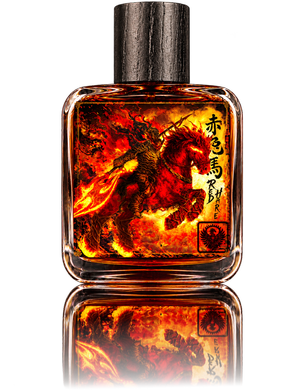 Found in
Red Hare
Indian tuberose absolute among the white flowers of the house fragrance of the Three Kingdoms.
View the fragrance


IIIA flower that keeps the night
In the wild, the tuberose's relatives belong to the night. The genus Polianthes is Mexican, with thirteen to fifteen species, most of them in the Sierra Madre Occidental and the volcanic belt that crosses the middle of the country171819. Most carry whitish flowers, and botanists have long suggested that hawkmoths pollinate most of them17. In a garden trial in Guadalajara in August 2022, the white Polianthes platyphylla was visited only by night-flying moths, and its sweet night scent carried three metres. Polianthes pringlei drew hawkmoths after dark and a bee by day, and the red, scentless Polianthes geminiflora drew only hummingbirds20. The botanists describe the tuberose's own group as pale to white flowers that open in the evening or at night and pour out fragrance20.
The tuberose's own pollinator has yet to be recorded. Its long white tube, its night opening and its night scent match the hawkmoth flowers of its relatives. In the hawkmoth-pollinated wild petunia, methyl benzoate, the tuberose's leading scent molecule, is released mostly at night, and it draws the strongest response from the antennae of the tobacco hawkmoth21. Whether the tuberose grows wild at all is an open question. Kew records a native range in Guanajuato and Michoacán5, and two botanical reviews describe it as known only from cultivation, grown in Mexico before the Spanish conquest1822.
The tuberose rarely sets seed. The single flower is largely self-incompatible, and the double is sterile for most of the season. In breeding work at Guadalajara in 2010, 445 crosses gave just 27 fruits18. The plant lives on through its bulbs. Each bulb sprouts, sends up its flower spike and then withers away, and the young bulbs that form beside it grow for a year and flower in the third23. Growers multiply it from buds at the base of the bulb, so the crop carries little genetic variety24. In the fields of Morelos its worst enemy is the agave weevil, whose larvae bore into the bulbs, and it also suffers thrips, red spider mites and nematodes2518. Its wild cousins are scarcer still. Five Mexican species are listed at risk, none grows inside a protected area, and Polianthes palustris is probably extinct26.
The flower runs on a clock. Indian researchers have shown that its scent is released in a rhythm, with a peak at night. The enzymes that build the scent molecules, and the genes behind them, rise just before the evening peak, and the scent escapes through open pores on the upper surface of the petals27. A Thai team that sampled the air around the blossoms every six hours found the most volatile output at nine in the evening and three in the morning and the least at three in the afternoon3. Between peaks the flower holds part of its scent in reserve, bound to sugars, and the storing peaks as the flower ages and its emission falls away28.
The night changes what the flower says. In 1990 chemists at a fragrance laboratory caught the air around living tuberoses by day and by night. After sunset limonene rose from 8 to 14 percent of the headspace, methyl anthranilate from 1 to 3, jasmine lactone from 0.2 to 1 and δ-dodecalactone from 0.1 to 0.6, while methyl salicylate fell from 12 to 6 and α-terpineol from 11 to 3.5. They described the evening flower as much fuller, floral and lactonic16. The single flower is built for this release. Its petals carry wax crystals, a thinner skin and wide-open pores, and the double flower's petals carry a thicker, ridged skin29.
IVA lily of the agave family

Tuberose looks like a lily and belongs with the agaves. It grows from a swollen, tuberous rootstock, a geophyte of the seasonally dry tropics, and Kew records its native home as Mexico, in southern Guanajuato and northern Michoacán5. Linnaeus named it Polianthes tuberosa in his Species Plantarum of 17535. Polianthes is Greek for many flowers, and tuberosa describes the root11.
In 2017 the botanists Joachim Thiede and Rafaël Govaerts moved it into Agave as Agave amica, a name built on Friedrich Medikus's Tuberosa amica of 17906, and World Flora Online accepted that name in 202231. A 2024 study argued that Polianthes, with two close relatives, forms a branch of its own outside Agave32. Kew today accepts Polianthes tuberosa5, and both names appear in current research.
Counts of the genus run from thirteen to twenty species, all of them Mexican, and only this one is grown for trade17337. Its flower spike rises to about ninety centimetres and carries waxy white, fragrant flowers that open from the bottom of the spike upward11. Gardeners know two forms. The single flower, with one ring of petals, is the more fragrant and the one perfumers want. The double flower, packed with petals, goes to florists as a cut flower8. In India the singles include Mexican Single, Phule Rajani, Prajwal, Shringar, Hyderabad Single and Arka Nirantara, and the doubles include Hyderabad Double, Pearl Double, Suvasini and Vaibhav11. Prajwal, a cross of Shringar and Mexican Single bred at the Indian Institute of Horticultural Research in Bengaluru, is grown for the fragrance industry734.
India names the flower for the night. In Bengali it is rajanigandha, in Marathi rajoni-gandha, in Hindi gulchari and gulshabbo, in Tamil nilasompangi, and in Kannada sugandharaja, the king of fragrance735. Names need care in the markets. In Tamil Nadu sampangi often means tuberose, and in north India the word champa can mean frangipani.
VOmixochitl, the bone flower
The Aztecs called it omixochitl. The word joins omitl, bone, and xochitl, flower, and the Nahuatl dictionaries gloss it as a fragrant white flower, the flor de hechura de hueso, a flower made in the shape of bone36. The historian of botany Emily Walcott Emmart Trueblood, who traced its story in 1973, read the name as bone flower and identified it as the tuberose37. The ethnobotanist Bernard Ortiz de Montellano lists omixochitl among the plants of Xochipilli, the Aztec prince of flowers38. It carried a second Nahuatl name, amole, soap, because its rhizomes are rich in saponins and were used for washing33.
The first Europeans to describe it wrote in wonder. In 1565 the Franciscan Diego de Landa, in Yucatán, recorded it under the Maya name tixzula and called its scent the most delicate he had ever known33. Between 1571 and 1577 Francisco Hernández, physician to Philip II, described "Omizochitl" in his survey of the natural history of New Spain39. In Mexico today the flower is the nardo. In 2014 it covered 276 hectares, 171 of them in Morelos, which grew about 62 percent of the national crop, and Morelos nardo travels to the great wholesale market of Mexico City and to the flower market of Tenancingo9.
VIThe Indian hyacinth comes to Europe

The tuberose crossed the Atlantic through Seville, the gateway for New World plants. By 1594 the Flemish botanist Carolus Clusius had it in his garden, and he was the first writer to mention it40. On 17 September 1600 Juan de Castañeda wrote to Clusius from Seville with a list of plants from the Indies that included a white hyacinth "with the scent of paradise", which the historian Luis Ramón-Laca identifies as the tuberose. The next year Clusius printed it, with a woodcut, as Hyacinthus Indicus tuberosa radice, the Indian hyacinth with the tuberous root41.
England had it by 162940. That year the London herbalist John Parkinson described the greater Indian knobbed jacinth in Paradisi in Sole, a plant of the West Indies whose flowers were "of a very sweete sent, or rather strong and headie", and which in the cold English climate would flower only in mid-August42. The French called it tubéreuse, and the English name came from the French. The Botanical Magazine of 1816 records that it was first grown in France near Toulon40. By 1815 the bulbs reached Britain each year from Genoa and other parts of Italy and sold at twelve to fifteen shillings a hundred, and the Encyclopaedia Britannica noted that the Egyptians steeped the flowers in sweet oil for a scent nearly equal to oil of jasmine43.
The name itself became a quarrel. In 1885 the poet Marc-André Raffalovich argued in the Pall Mall Gazette that tuberose comes from the Latin tuberosus, knobbly-rooted, owes nothing to tubes or roses, and should be spoken in three syllables. Oscar Wilde answered with mockery of the "lumpy flower" and praise for its "tiny trumpets of ivory"44.
Louis XIV built the Porcelain Trianon at Versailles as a palace of flowers, and its beds were chosen for scent as much as colour. The court called it the Palace of Flora45. Tuberose ruled it. On 8 August 1689, Madame de Maintenon wrote that people had to leave the Trianon every evening because the perfume of the tuberoses was too strong to bear45.

The poets took up the same intoxication. Percy Bysshe Shelley gave it two lines of The Sensitive Plant in 1820: "And the jessamine faint, and the sweet tuberose, / The sweetest flower for scent that blows"46. The flower books of the nineteenth century gave it a meaning to match. In Henry Phillips's Floral Emblems of 1825 the tuberose stands for voluptuousness, and in Charlotte de Latour's Le Langage des Fleurs it stands for dangerous pleasures47.
VIIThe flower farms of Grasse
In 1885 the Swiss pharmacist Friedrich Flückiger judged that tuberose was "probably nowhere else cultivated in such quantity as at Grasse". He described the town's three ways of catching its scent: hot infusion in fat, enfleurage on glass plates with the flowers renewed as often as every day, and the washing of the scented fats with alcohol39. In the early twentieth century the country around Grasse held nearly two thousand hectares of perfume plants, about eight hundred of jasmine, seven hundred of rose and about sixty-five of tuberose48. The valley of the Siagne, between Cannes and Grasse, was the tuberose district, and it sent about seventy-five tonnes of flowers a year to the perfumers33.
The fields flourished through the 1930s49. From the 1960s they emptied, as land values rose with the Riviera and synthetics arrived, and in the 1970s many growers sold their plots to developers5048. Today about ten growers work twenty to forty hectares of perfume flowers around Pégomas, Plan-de-Grasse, Plascassier and Opio5048. By 2011 tuberose had become a rarity on the Côte d'Azur, costly, fragile and temperamental, and the last remaining stock of bulbs was gathered up to keep it alive51.

At Pégomas, in the second half of September, the picking begins at seven in the morning to stay ahead of the heat. About ten pickers in linen aprons work the rows under Fabrice Bianchi, whose family has grown perfume flowers for five generations. Each picker holds the flower's tube in one hand and peels the bloom downward with the other, and Bianchi says the flower comes away only with a downward pull. The farm's tuberose covers a hectare and a half, gives two and a half to four tonnes of flowers between August and November, and goes straight to the extraction plant the family built on the farm in 1988. About two tonnes of flowers make one kilogram of concrete51.
A Grasse-born perfumer from an old growing family turned farmer in 2016 and now harvests his own hectare of tuberose from August to November49. In 2018 UNESCO inscribed the perfume skills of the Pays de Grasse, from growing the plant to composing the scent, on its list of the intangible heritage of humanity52, and "absolue Pays de Grasse" now carries a geographical indication of its own49.
VIIIThe tuberose lands
The flower is believed to have reached India from Europe in the sixteenth century5354, and India is now its great home, with about three thousand hectares53. The growing districts run from Bagnan, Kolaghat, Midnapore, Panskura and Ranaghat in West Bengal to Mysore, Kolar and Tumkur in Karnataka, Coimbatore and Madurai in Tamil Nadu, and Pune, Thane and Nashik in Maharashtra5354.
West Bengal had 29,000 hectares under flowers in 2019, and tuberose grows along the edges of its rice fields55. The state raises some 355 crore stems of rose and tuberose a year, and when floods drowned the fields before Durga Puja in 2024, the price of a single tuberose stick jumped from two or three rupees to ten or twelve56. In 2021 Tapan Kar of Degra, in West Midnapore, lost the acre of rajanigandha he had planted in June to the same kind of water57. In a Bengali wedding the flower crowns the bride, hangs in the garlands the couple exchange, dresses the wedding car and covers the marriage bed58. In 1974 it gave its name to Basu Chatterjee's film Rajnigandha, with a title song sung by Lata Mangeshkar to music by Salil Chowdhury59.

Much of Bengal's crop passes through Mullick Ghat. The market is about 130 years old. Trading starts at around four in the morning, when more than two thousand sellers set out flowers brought in from Khirai, Kolaghat, Bagnan, Nadia and the 24 Parganas. About a crore of rupees changes hands on an ordinary day and nearly two crore on a wedding date, and tuberose is one of its best sellers. Krishna Srimani, sixty-three, sells there as his father did before him60.
Ralaba, on the Odisha coast, began with about thirty farmers on ten acres in 2001, and its fields now cover more than eighty acres1. In Bangladesh the farmer Sher Ali began the country's commercial flower trade with tuberose in Jashore in 1983, and the highway market at Godkhali now holds some 120 wholesalers61. Jashore growers spend about 27,200 taka a bigha a year and clear about 120,00062.

In Indonesia the flower is sedap malam. A decree of 1991 made it the mascot flower of East Java, and Desa Rembang in Pasuruan is a centre of the crop10. Indonesia cut 133.75 million stalks in 2024, 111.76 million of them in East Java63, and in 2018 Pasuruan was shipping about fifty thousand stalks a day across Java and another forty thousand off the island64.
The flower has travelled far. In Tianwei, in Taiwan's Changhua County, the young grower Lü Ming-yu sells the flowers and also the tender shoots, which restaurants cook like bamboo shoots65. In Hawaiʻi the tuberose lei, two strands twisted with ti leaf, is a modern classic66, and in 2003 tuberose made up 40 percent of recorded lei flower sales, worth more than 1.48 million dollars67.
IXBefore eight in the morning
In northern India the tuberose blooms from May to October, a season when few other flowers reach the market11. For perfume and for garlands, the pickers take single florets by hand in the early morning, before eight, just as they open. For the florist trade they cut the whole spike before sunrise or late in the evening, leaving four to six centimetres of stem116853. Researchers picking Prajwal for concrete trials worked before half past nine and found that the yield of concrete falls as the day warms and as picking moves toward evening12. A planting begins to flower about three months after the bulbs go in and keeps flowering for two to three years, thinning in winter34, with its peak in August and September69.
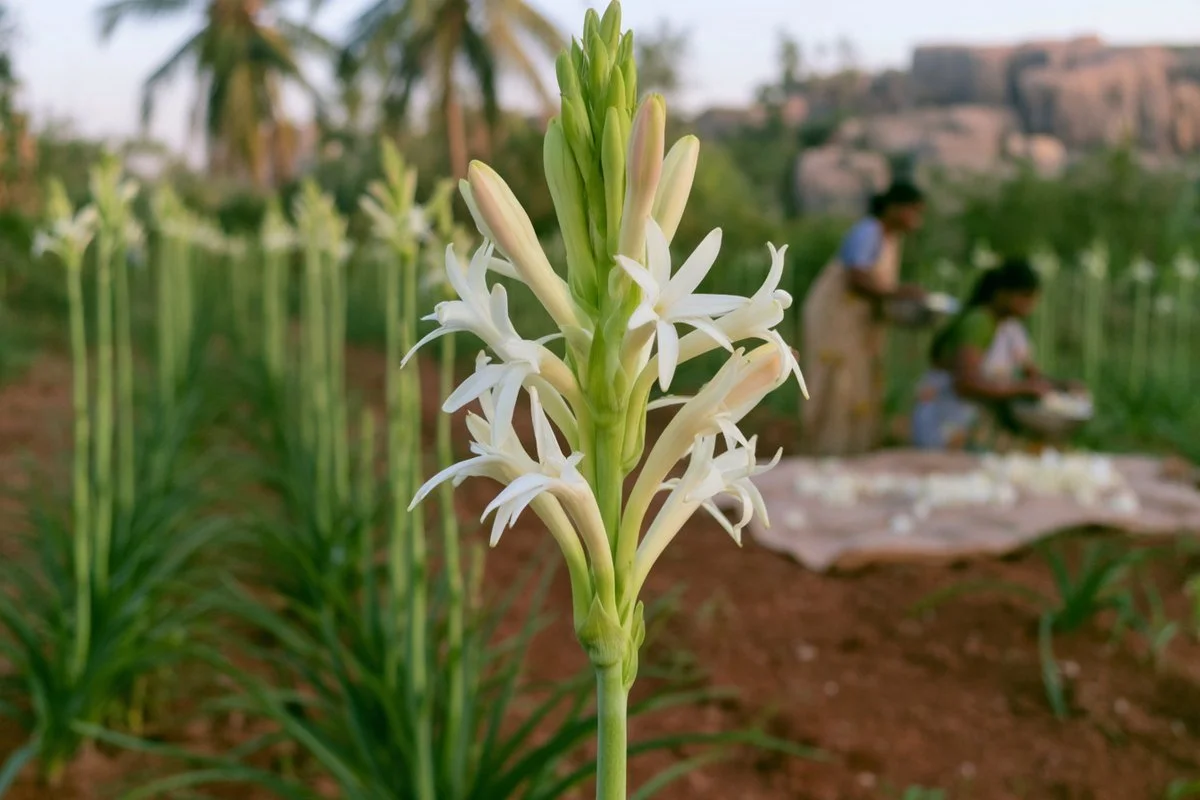
The work runs the whole season. A study of Tamil Nadu farms in 2025 counted 150 picking rounds a year, at a cost of 1.5 lakh rupees a hectare out of total growing costs of 4.13 lakh70. Field yields run from about seven tonnes of loose flowers a hectare on ordinary farms to twenty-six on the research plots for Prajwal and thirty-two for Arka Nirantara7011. In Purba Medinipur, in West Bengal, labour made up 54 percent of the cost of the crop71. At Yettinahalli, in Karnataka's Tumakuru district, the women of the village do the picking, grading and sorting. One farmer there, Ramanjunaiah, harvested 11.74 tonnes of Prajwal from two acres in a year and earned 5.85 lakh rupees72.
The flowers fetch modest sums at the farm gate. In the mid-1990s tuberose sold for five to thirty rupees a kilogram73. In 2025 the perfume factories of Tamil Nadu were paying their contract farmers about seventy rupees a kilogram, while traders paid a hundred and direct sales fetched 13070. Odisha fixed a price of fifty rupees a kilogram in 202474, and in summer Ralaba's flowers sell for 1201.
The tuberose is picked at dawn, and goes on breathing out its scent long after it leaves the stem.
XFat, solvent and a living flower
A picked tuberose keeps breathing. Laid on fat, the blossoms go on living for a long time and keep pouring out scent, and this made the tuberose, with jasmine, the classic flower of enfleurage75. The method is patient. The flowers are spread on purified lard over glass frames and left for a few days, then lifted off and replaced with fresh ones, over and over, until the fat is saturated. That scented fat is the pomade, and washing it with strong alcohol gives the absolute of enfleurage7639.

In 1903 the German chemist Albert Hesse measured what the living flower adds. From 1,000 kilograms of tuberose, enfleurage drew 801 grams of oil into the fat and another 78 grams from the spent flowers. The same weight of flowers extracted directly with solvent gave 56 grams in one account and 66 in another7776. The flowers on the fat had made about twelve to thirteen times the oil they held when they were picked77.
Solvent extraction is the method of the modern trade, and it is quick. The fresh florets are washed with hexane, the solvent is drawn off, and what remains is the concrete, a waxy mass that holds the scent with the flower's natural waxes. Single flowers give 0.08 to 0.14 percent of their weight as concrete, eight to ten kilograms a hectare868. Prajwal, the modern perfumery single, has given 0.10 to 0.17 percent in field trials12, and doubles give less, about 0.06 percent for Pearl Double and Swarna Rekha7. The concrete is then washed with alcohol, which takes up the fragrant fraction and leaves the waxes behind. Removing the alcohol leaves the absolute. About three tonnes of flowers make one kilogram of Indian absolute13.
Tuberose gives itself up to cold methods and fat. Steam ruins it. Distilled with steam, the flowers give only a product with an unpleasant smell77. Carbon dioxide under pressure works on dried flowers. A Mexican team extracting double flowers from Morelos at about 28 megapascals and 50°C drew up to 2.5 percent of their weight in three hours, mostly fatty acids and waxes, with 4.8 to 7.9 percent benzyl benzoate78. In Ralaba, a unit of the Fragrance and Flavour Development Centre of Kannauj works with the growers, and their flowers give about a gram of extract a kilogram, which sells for about four lakh rupees a kilogram1.
XIWhat the chemistry shows
Tuberose speaks mostly in benzenoids, the small aromatic esters that also give wintergreen, grape and almond their smell, set over lactones, terpenes and a trace of indole. The living flower and the extract tell different stories. In the air around the blossom, methyl benzoate leads, with 1,8-cineole, methyl salicylate and methyl anthranilate3. In the absolute, the heavier esters gather. Hesse found methyl benzoate only in the faintest amounts in his extracted oil, along with benzyl benzoate and free benzyl alcohol, and found methyl salicylate only in the oil from the pomade. Methyl anthranilate stood at 1.13 percent in the solvent oil and 3.2 to 5.4 percent in the enfleurage oil. As early as 1899 the French chemist Albert Verley had isolated a ketone he called tuberone at about ten percent77.
Modern analyses agree on the main lines. In absolutes from Yunnan, benzyl benzoate made up 39.8 percent of the single flower's absolute and 26.0 percent of the double's, (E,E)-farnesol 13.3 and 6.4 percent, methyl anthranilate 11.6 and 6.0 percent, and α-terpineol 3.7 and 2.7 percent, with methyl isoeugenol and benzyl salicylate also prominent79. In an Indian hexane extract, the leading compounds were jasmine lactone at 11.4 percent, benzyl benzoate at 10.9, 1,8-cineole at 7.9, methyl benzoate at 6.5, terpineol at 5.6 and indole at 4.780. In one analysis of Indian absolutes, the single Shringar carried 40.4 percent methyl isoeugenol and 1.9 percent indole, and only the single gave the true tuberose odour81. Across fourteen cultivars studied in 2026, single flowers were richer in esters and double flowers carried the monoterpenes82, and seven Indian cultivars fall into four distinct chemical families83.
Each molecule carries a facet of the flower. Methyl benzoate is powerful, phenolic and floral, with wintergreen, almond and the ylang-like note of cananga84. Methyl salicylate is wintergreen and mint, sweet, with a root-beer tone14. Methyl anthranilate smells of Concord grape and orange flower15. Methyl isoeugenol is spicy clove blossom and carnation over wood85. Jasmine lactone is creamy and waxy, of jasmine, peach and coconut, and tuberose is one of its natural sources4. Indole is the flower's shadow. Concentrated, it smells fecal and animal. Diluted, it turns floral86. Headspace work has also found 2-aminobenzaldehyde beside the anthranilate87.
The rarest notes are lactones. In 1982 the chemists Maurer and Hauser found six unsaturated γ-lactones in tuberose absolute, four of them new to science, and named two after the flower: tuberolactone, (Z,Z)-2,7-decadien-5-olide, and a bicyclic lactone they called tuberolide88. The tuberolide sold to perfumers today is a different molecule, a methyl lactone with a waxy, metallic plum note used in tuberose accords89.
XIIGrades and imitations
Quality begins in the field. The single flower is the perfumer's flower, more fragrant and richer in the key odorants88179. The absolute from concrete is a red-brown semi-solid2. The absolute from enfleurage pomade is an orange to red-brown paste, and it lingers on a blotter for about three hundred hours90. The Grasse flower is softer than the Indian one, less fruity and less indolic13.
A precious absolute invites stretching, and laboratories check it the way they check every natural. Gas chromatography fingerprints are compared against the expected ranges, carbon isotope ratios separate plant carbon from petrochemical carbon, and chiral analysis catches synthetic molecules that nature makes in only one mirror form91. Tuberose also carries some of the materials perfumers watch most closely. One reference gives the maximum levels found in the absolute as 5.5 percent benzyl benzoate, 3.6 percent benzyl salicylate, 1.8 percent methyl eugenol, 1.5 percent isoeugenol and 0.3 percent farnesol2. The fragrance industry's own safety standard caps isoeugenol at 0.11 percent of a finished fine fragrance and assumes 1.5 percent in tuberose absolute when an analysis is unavailable92. Under European cosmetics law, a list of fragrance allergens must be named on the label above 0.001 percent in leave-on products. A 2023 expansion added methyl salicylate to a list that already held benzyl benzoate, benzyl salicylate, farnesol, isoeugenol, eugenol, geraniol, benzyl alcohol and linalool, with new products to comply by 31 July 2026 and existing ones by 31 July 202893.
Tuberose accords are old. A 1981 perfumery textbook gives a tuberose base of methyl anthranilate, benzyl acetate, benzyl alcohol, methyl salicylate, oil of wintergreen and the peach and coconut aldehydes, with a touch of jasmine and about one part in a hundred of real tuberose absolute94. The modern palette adds jasmine lactone, the commercial tuberolide, jasmone and the creamy lactones95. These accords give the bright, sweet outline of the flower. The natural absolute holds the waxy depth, the indolic shadow and the night lactones the living blossom makes.
Perfumers have built some of their boldest work on it. In 1948 Germaine Cellier composed Fracas for Robert Piguet around tuberose, softened with a large measure of orange blossom, iris and jasmine, and dedicated it to the actress Edwige Feuillère96.
XIIIRare and precious

Every gram of tuberose absolute begins as about three kilograms of flowers13. A single floret of Mexican Single weighs about 2.1 grams8, so one gram of absolute holds roughly fourteen hundred hand-picked florets, each taken in the early morning as it opened. On a Tamil Nadu farm the picking alone runs to 150 rounds a year70. At the contract price of seventy rupees a kilogram, the flowers in one gram of absolute cost the factory about 210 rupees before any extraction begins70. In 2022 Indian tuberose absolute sold for about 11,000 euros a kilogram, about eleven euros a gram13.
The flower depends on weather and on growers who can bear its risks. Floods in Bengal in 2021 and 2024 drowned whole fields before the festival season5756. In Grasse the tuberose came close to vanishing in the twentieth century and survives on a few family farms5150. The Aztecs' bone flower, carried from Mexico to Seville to Versailles and on to Bengal, still comes to the perfumer one floret at a time.
Found in
Red Hare
Indian tuberose absolute beside red champaca and honeysuckle, in the house fragrance of the Three Kingdoms.
More from the MateriaNeighbours of the tuberose
 ✦ Red Hare
Red Champaca
The orange champak of India, the flower beside the tuberose at the top of Red Hare.
Read the folio
 ✦ China
Magnolia
The white champaca of the tea gardens, the tuberose's companion in Courtesan's Embrace.
Read the folio
 ✦ Enfleurage
Jasmine
The other great flower of enfleurage, which keeps making scent after it is picked.
Read the folio
✦ ✦ ✦
Sources & image credits96 references
- Misra N.R., Rajanigandha perfumes Odisha's cyclone-wrecked Ralaba, Village Square (13 December 2023).↑
- The Good Scents Company, Tuberose absolute (from concrete).↑
- Rodyoung A., Sa-nuanpuag K., Wongs-Aree C., Buanong M., Volatile releasing patterns of tuberose flowers at different maturities and diurnal times of the day, Acta Horticulturae 1088, 307-311 (2015).↑
- The Good Scents Company, Jasmine lactone.↑
- Royal Botanic Gardens, Kew, Polianthes tuberosa L., Plants of the World Online.↑
- International Plant Names Index, Agave amica (Medik.) Thiede & Govaerts, Phytotaxa 306(3), 237 (2017).↑
- Mandal M., Maitra S., Mahata D., Production technology of tuberose (Polianthes tuberosa L.) cultivation, Journal of Pharmacognosy and Phytochemistry 7(6), 2360-2364 (2018).↑
- Safeena S.A., Thangam M., Singh N.P., Evaluation of different cultivars of tuberose under humid agro-climatic conditions of Goa, Journal of Horticultural Sciences 14(2), 109-114 (2019).↑
- Pérez-Arias G.A., Alia-Tejacal I., Colinas-León M.T., Valdez-Aguilar L.A., Daño mecánico por compresión en nardo, Revista Mexicana de Ciencias Agrícolas 7(1) (2016).↑
- Rahmaniah R.N., Indah P.N., Atasa D., Eksistensi dan potensi usaha bunga sedap malam Kabupaten Pasuruan, Jurnal Agribest 8(2), 65-74 (2024).↑
- Singh K.P., Tiwari A.K., Saha T.N., Database on tuberose (Polianthes tuberosa Linn.) 2010-11 to 2013-14, ICAR-Directorate of Floricultural Research, Technical Bulletin 17, Pune (2015).↑
- Elicitation of tuberose concrete, deliberation of recovery and qualitative examination from Agave amica L. cv. Arka Prajwal, Current Journal of Applied Science and Technology, manuscript 86296.↑
- Normand S., Report on the tuberose of Grasse and India, Premium Beauty News (19 September 2022).↑
- The Good Scents Company, Methyl salicylate.↑
- The Good Scents Company, Methyl anthranilate.↑
- Mookherjee B.D., Trenkle R.W., Wilson R.A., The chemistry of flowers, fruits and spices: live vs. dead, a new dimension in fragrance research, Pure and Applied Chemistry 62(7), 1357-1364 (1990).↑
- Rocha M., Good-Ávila S.V., Molina-Freaner F., Arita H.T., Castillo A., García-Mendoza A., Silva-Montellano A., Gaut B.S., Souza V., Eguiarte L.E., Pollination biology and adaptive radiation of Agavaceae, with special emphasis on the genus Agave, Aliso 22(1), 329-344 (2006).↑
- Barba-Gonzalez R., Rodríguez-Domínguez J.M., Castañeda-Saucedo M.C., Rodríguez A., Van Tuyl J.M., Tapia-Campos E., Mexican geophytes I. The genus Polianthes, Floriculture and Ornamental Biotechnology 6, special issue 1, 122-128 (2012).↑
- Solano E., Feria T.P., Ecological niche modeling and geographic distribution of the genus Polianthes L. (Agavaceae) in Mexico, Biodiversity and Conservation 16(6) (2007).↑
- MacNeill B.N., Ortiz-Brunel J.P., Rodríguez A., Ruiz-Sánchez E., Navarro-Moreno J., Hofford N.P., McKain M.R., Floral diversity and pollination syndromes in Agave subgenus Manfreda, Integrative and Comparative Biology 63(6), 1376-1390 (2023).↑
- Hoballah M.E., Stuurman J., Turlings T.C.J., Guerin P.M., Connétable S., Kuhlemeier C., The composition and timing of flower odour emission by wild Petunia axillaris coincide with the antennal perception and nocturnal activity of the pollinator Manduca sexta, Planta 222, 141-150 (2005).↑
- Kumar M. et al., Methods and factors influencing in vitro propagation efficiency of ornamental tuberose (Polianthes species): a systematic review, Horticulturae 8(11), 998 (2022).↑
- Servicio de Información Agroalimentaria y Pesquera, Gobierno de México, Nardo, fact sheet.↑
- Hernández-Mendoza F., Carrillo-Castañeda G., García-Gaytán V., Pedraza-Santos M.E., de la Cruz-Torres E., Mendoza-Castillo M.C., Regeneración in vitro de plantas de Polianthes tuberosa L. a partir de tejido foliar y de botón floral, Tropical and Subtropical Agroecosystems 24, 55 (2021).↑
- Camino Lavín M., Castrejón Gómez V.R., Figueroa Brito R., Aldana Llanos L., Valdés Estrada M.E., Scyphophorus acupunctatus attacking Polianthes tuberosa in Morelos, Mexico, Florida Entomologist 85(2), 392-393 (2002).↑
- Feria-Arroyo T.P., Solano E., García-Mendoza A., Reevaluación del riesgo de extinción de cinco especies del género Polianthes L. (Agavaceae), Acta Botanica Mexicana 92, 11-28 (2010).↑
- Maiti S., Mitra A., Morphological, physiological and ultrastructural changes in flowers explain the spatio-temporal emission of scent volatiles in Polianthes tuberosa L., Plant and Cell Physiology 58(12), 2095-2111 (2017).↑
- Kutty N.N., Ghissing U., Mitra A., study of floral scent synthesis, storage and emission in tuberose, Plant Molecular Biology 106(6), 533-554 (2021).↑
- Bhattacharya R., Mitra A., study of the tepal surfaces of single and double tuberose, Turkish Journal of Botany 47, 202-210 (2023).↑
- Meena, Mahawer, Bairwa, Standardization of NPK dose for growth, floral, bulb and economic parameters on Phule Rajani tuberose, Indian Journal of Horticulture 75(3), 486-491 (2018).↑
- World Flora Online Plant List, Agave amica (Medik.) Thiede & Govaerts, December 2022 snapshot.↑
- Vázquez-García J.A., Rosales-Martínez C.S., Padilla-Lepe J., Hernandez-Vera G., García-Morales L.J., New genera and new combinations in Agavaceae (Asparagales), Phytoneuron 2024-02, 1-14 (2024).↑
- Calvo Irabien L.M., Aromas de México para el mundo, el caso del nardo: Polianthes tuberosa, Desde el Herbario CICY 9, 60-62 (2017).↑
- ICAR-Indian Institute of Horticultural Research, Field day of tuberose variety Arka Prajwal, Kaginahalli, Shivamogga (December 2025).↑
- Polianthes tuberosa, eFlora of India.↑
- Wood S. (ed.), omixochitl, Online Nahuatl Dictionary, Wired Humanities Projects, University of Oregon, citing Karttunen F., An Analytical Dictionary of Nahuatl (1992), p. 179.↑
- Trueblood E.W.E., "Omixochitl", the tuberose (Polianthes tuberosa), Economic Botany 27(2), 157-174 (1973).↑
- Ortiz de Montellano B., Las hierbas de Tláloc, Estudios de Cultura Náhuatl 14, 287-314 (1980).↑
- Flückiger F.A., The essential oil industry in Grasse, American Journal of Pharmacy (1885), abstracted from Archiv der Pharmacie 22, 473.↑
- Hortus Camdenensis, Polianthes tuberosa L., quoting the Botanical Register f. 63 (1815) and Curtis's Botanical Magazine t. 1817 (1816).↑
- Ramón-Laca Menéndez de Luarca L., Las plantas americanas en la obra de Charles de l'Écluse: primeras citas en las cartas de Juan de Castañeda, Anales del Jardín Botánico de Madrid 57(1), 97-107 (1999).↑
- Parkinson J., Paradisi in Sole Paradisus Terrestris, London (1629), Project Gutenberg.↑
- Polianthes, Encyclopaedia Britannica, 5th edition, vol. 17 (1815).↑
- Selleri A., The roots of Wilde's tuberose, Notes and Queries 71(1), 113-115 (2024).↑
- Château de Versailles, Gardens of the Grand Trianon.↑
- Shelley P.B., The Sensitive Plant, Part Second (1820).↑
- Cornell University Library, Henry Phillips, Floral Emblems, in the exhibition Written in Petals.↑
- Hermange A., La parfumerie en état de Grasse, Paris Match (1 July 2019).↑
- Normand S., Report on a Grasse perfumer turned tuberose grower, Premium Beauty News (19 September 2022).↑
- Marengo M., Flâneries florales dans le Pays grassois, Le Globe 162, 61-80 (2022).↑
- Visite chez Mul, cultivateurs de fleurs à parfums depuis cinq générations, Le Temps, Geneva.↑
- UNESCO, Les savoir-faire liés au parfum en Pays de Grasse, Representative List of the Intangible Cultural Heritage of Humanity, 13.COM (2018).↑
- Tamil Nadu Agricultural University, Tuberose, HORT 281, lecture 41, course notes.↑
- Mahawar T.C. et al., Integrated weed management strategies in Prajwal tuberose, Indian Journal of Horticulture 77(4), 720-727 (2020).↑
- Chakraborty S., Bleak monsoon hurts floriculture in West Bengal, Down To Earth (13 August 2019).↑
- Chakraborty S., Floods imperil Durga Puja flowers, The Telegraph, Kolkata (23 September 2024).↑
- Phadikar A., Rain flattens flower fields, crisis looms before Pujas, The Telegraph, Kolkata (27 September 2021).↑
- Ao S., Tuberose tiaras for brides and gods, The Human Flower Project (22 May 2007).↑
- Sharma U., Just two fragrant Salil Chowdhury songs were enough to make 1974's Rajnigandha bloom, ThePrint (5 September 2021).↑
- Press Trust of India, Where a hundred flowers bloom, via LatestLY (15 December 2022).↑
- Seraj S., Rise of a flower kingdom, The Daily Star, Dhaka (8 January 2020).↑
- Zaman F.A. et al., Insights from tuberose farmers: a survey study in Jashore District, Bangladesh, PLoS ONE (2024).↑
- Hakiki S., Pulau Jawa jadi sentra penghasil bunga sedap malam, GoodStats, from Statistics Indonesia data for 2024 (21 August 2025).↑
- Pemerintah Kabupaten Pasuruan, Eksotika harum semerbak sedap malam itu ada di bumi Kabupaten Pasuruan (6 November 2018).↑
- Chen Kuan-pei (陳冠備), Report on the tuberose grower Lü Ming-yu of Tianwei, Changhua, Liberty Times (自由時報) (18 October 2021).↑
- Hitt C., A guide to Hawaiian lei, HAWAIʻI Magazine (1 May 2018).↑
- Lee J.J., Associated Press, Lei makers see higher prices for busy season, Honolulu Star-Bulletin (1 May 2005).↑
- Tamil Nadu Agricultural University, Tuberose, TNAU Agritech Portal.↑
- National Horticulture Board of India, Tuberose: harvest and post-harvest.↑
- Nisha V.S., Parasuraman B., Kannan M., Petals to profit: value chain analysis of jasmine and tuberose in Tamil Nadu, Madras Agricultural Journal 112(10-12), 28-35 (2025).↑
- Bera J., Majumder S., Economics of tuberose cultivation and its marketing: a case study in Purba Medinipur District of West Bengal, Vidyasagar University Journal of Economics XVII (2012-13).↑
- ICAR-Indian Institute of Horticultural Research, Tuberose cultivation transforms a Karnataka village, Indian Council of Agricultural Research.↑
- Dadlani N.K., Cut flower production in India, Food and Agriculture Organization of the United Nations.↑
- Tuberose farmers lament lack of marketing facilities, OrissaPOST (23 May 2024).↑
- Gildemeister E., Hoffmann F., The production of flower perfumes by extraction and enfleurage, The Volatile Oils, vol. 1, English edition (about 1913).↑
- 100 and 50 years ago, Nature 423, 491 (2003), quoting Nature (1903).↑
- Gildemeister E., Hoffmann F., Tuberose oil, The Volatile Oils, vol. 2, section 158, English edition (about 1916).↑
- Fragoso-Jiménez J.C., Tapia-Campos E., Estarron-Espinosa M., Barba-Gonzalez R., Castañeda-Saucedo M.C., Castillo-Herrera G.A., Effect of supercritical fluid extraction process on chemical composition of Polianthes tuberosa flower extracts, Processes 7(2), 60 (2019).↑
- Zhou B., Ren H., Zhang J., Xia K., Qin T., GC-MS analysis of tuberose absolute, Modern Food Science and Technology 28(9), 1215-1218 (2012).↑
- Yadav R., Mohapatra D., Kate A., Giri S.K., Modhera B., study of ultrasound and microwave assisted extraction of tuberose concrete, Biomass Conversion and Biorefinery (2023).↑
- Singh K.P., Suneja P., Mohan J., Singh M.C., analysis of the absolutes of single and double tuberose, Progressive Horticulture 41(2), 145-147 (2009).↑
- Jadhav P.R. et al., study of volatile diversity across fourteen tuberose cultivars, Plant Biology (2026).↑
- Kutty N.N., Mitra A., study of the scent metabolites of seven Indian tuberose cultivars, Phytochemistry 162, 10-20 (2019).↑
- The Good Scents Company, Methyl benzoate.↑
- The Good Scents Company, Methyl isoeugenol.↑
- The Good Scents Company, Indole.↑
- Joulain D., Flavour and Fragrance Journal 2, 149-155 (1987), as indexed in The Pherobase: floral compounds of Polianthes tuberosa.↑
- Maurer B., Hauser A., Identification and synthesis of new γ-lactones from tuberose absolute (Polianthes tuberosa), Helvetica Chimica Acta 65(2), 462-476 (1982).↑
- The Good Scents Company, Methyl tuberate, CAS 33673-62-0.↑
- The Good Scents Company, Tuberose absolute (from pomade).↑
- Pierson M., Fernandez X., Antoniotti S., Type and magnitude of non-compliance and adulteration in neroli, mandarin and bergamot essential oils purchased on-line and potential consumer health risks, Scientific Reports 11, 11096 (2021).↑
- International Fragrance Association, Standard: isoeugenol, 49th Amendment (2020).↑
- SGS, EU expands fragrance allergen list in cosmetic products, on Commission Regulation (EU) 2023/1545 (2023).↑
- Wells F.V., Billot M., Perfumery Technology, 2nd edition, Ellis Horwood (1981), pp. 235-236, via The Good Scents Company.↑
- The Good Scents Company, Tuberose odor type: materials list.↑
- Gattis L., History lesson: the scent of Fracas, Into The Gloss (November 2013).↑
Photographs
Rushikulya river from Ganjam fort: Sidsahu, CC BY-SA 4.0. Tuberose at night: Mugdham7, CC BY-SA 4.0. Chalcatzingo, Morelos: Hipatiamexa, CC BY 4.0. Tuberose in bud, Bardhaman: Joydeep, CC BY-SA 3.0. Pégomas: Jpchevreau, CC BY-SA 4.0. Mullick Ghat: Sumita Roy Dutta, CC BY-SA 4.0. Vesak pilgrims, Indonesia: pwbaker, CC BY 2.0. Red champaca, Villupuram: P Jeganathan, CC BY-SA 3.0. White champaca: Yercaud-elango, CC BY-SA 4.0. Jasmine: Forest and Kim Starr, CC BY 3.0 US. Les Liliacées plate: Pierre-Joseph Redouté, digitally enhanced by Rawpixel, CC BY-SA 4.0. All via Wikimedia Commons. Polianthes tuberosa plate: Curtis's Botanical Magazine, vol. 43, t. 1817, 1816, public domain. Tuberose with carnation: Barbara Regina Dietzsch, Städel Museum, public domain. The Porcelain Trianon: Adam Perelle, about 1680, public domain. Enfleurage in Grasse, about 1930: unknown photographer, public domain. Plates marked as illustrations: Ashenfume.
Join the discussionHave you grown the tuberose, picked it before dawn, or worked with its absolute? Add what you know, or ask a question.