Provenance Materia Siberian Cedar
MATERIA · THE BEAVER MOON COLLECTION
Siberian Cedar
The stone pine of the taiga, its nutcracker, its sable and its healing resin
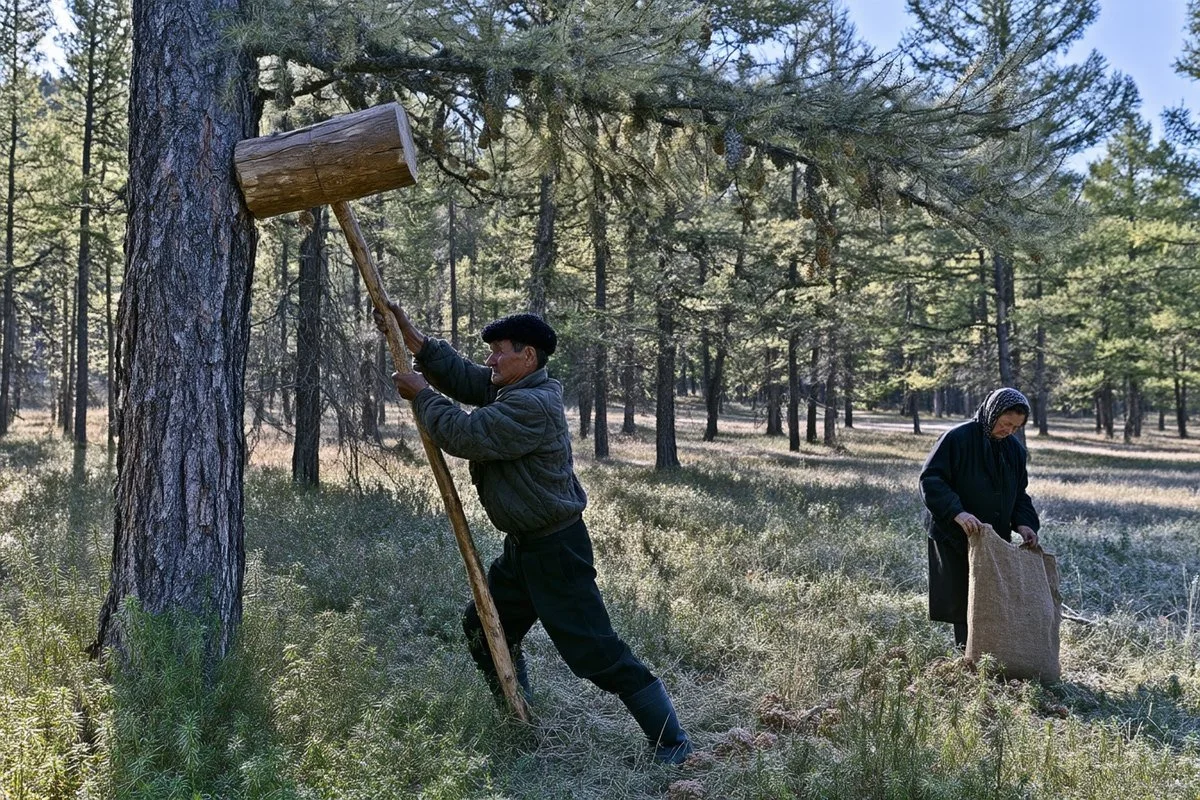
In late September 2016 the newspaper correspondent Nikolai Savelyev drove past the end of the asphalt in the Irkutsk region, forded rivers for some thirty kilometres to Rudny, an abandoned geologists' settlement, and climbed about ten kilometres over the Ulyakh pass into the valleys of the Yerma. An old man the crew called Nikola built the kolot, a notched block of larch wedged onto a pole a little over two metres long. The crew swung it against the trunks, hung a tuft of moss on each tree they had beaten, and filled five sacks of cones a person each day. The trees had given nothing for two years, and the cones that fell that autumn were heavy and sticky with resin1. The trees were Siberian cedar, Pinus sibirica. Their resin is the perfumer's material.
Explore this folio


IWhat it smells like
Siberian cedar burns faintly peppery, a flicker of woodsy light within the tree's shadows. Over a long wear it moves through four stages.
- Opening
To come.
- First hour
To come.
- Heart
To come.
- Long drydown
To come.
IIIn the house
Siberian cedar lives in the base of Beaver Moon, the house fragrance of the November moon. There it burns faintly peppery, a flicker of woodsy light within the tree's shadows, beside a sweet castoreum kissed with raspberry, the cool smoky roots of Haitian vetiver and Kua myrrh. Above it the heart holds black copal, Siberian rhododendron, Siberian and balsam fir and Thai oud from 2015, and blood orange, Madagascar elemi and neroli light the way in. The house keeps the cedar in two forms: an essential oil distilled from wild resin, and a resinoid of the house's own making, drawn from the raw resin in a long alcohol tincture.
 Found in
Beaver Moon
Cedar in the base, faintly peppery beneath the resins of the November moon.
View the fragrance

IIIThe tree called kedr

Siberian cedar is a pine. The French naturalist Du Tour gave it its Latin name in 1803, in the eighteenth volume of the Nouveau Dictionnaire d'Histoire Naturelle2. Its Russian name came earlier and stuck. The first Russian explorers called it after the famous cedar of Lebanon, and the botanist F. Keppen held that the Ural Cossacks borrowed a name they knew only from hearsay5. In Russian it is still kedr, and in English translation it is still Siberian cedar.
A stone pine
It belongs to a small group of pines called the stone pines. Their cones stay shut when ripe, and their large seeds have no wings, so birds carry them away4. Its nearest relative is the Swiss stone pine of the Alps, Pinus cembra. Some botanists treat the two as one species, and the Siberian tree is told apart by slightly larger cones and by three resin canals in each needle, against two in the Alpine one34.
The tree in the hand
A grown cedar stands 30 to 45 metres tall on a trunk up to two metres across9. Its bark is smooth and pale brown when young, and turns grey, scaly and deeply fissured with age10. The needles come in bundles of five, 6 to 13 centimetres long, and each one stays on the branch three to five years9.
The cones take three growing seasons to finish. Female cones are begun in July or August, pollinated the following June and fertilised a year after that, and the seeds ripen in August and September of that third year11. A ripe cone is 6 to 13 centimetres long and holds 80 to 140 seeds9. It falls with its seeds still locked inside11.
Most cedars live 300 to 500 years, and some reach 700 or 8009. On the Uurgat lava field in Mongolia, living and dead Siberian pines gave scientists a drought record reaching back 2,060 years12, and one series of rings from that work spans 1,198 years10. The wood is light, soft and easily worked, with pink heartwood, and goes into furniture, pencils and musical instruments. Siberian households held that cedar chests keep moths away and that milk keeps longer in cedar vessels9.

Three harvests from one tree
People take three things from the cedar: its wood, its nuts and its resin. Pinolenic acid makes up 17 to 19 percent of the fat in the nut13. When Russians speak of cedar oil, they usually mean this pressed nut oil, a food. Russian pharmacies sell cedar resin dissolved in it, at five and twelve and a half percent14.
The perfumer's cedar is the resin. Like every pine resin it is an oleoresin, a blend of a volatile oil, called turpentine, and a solid part, called rosin. Siberian cedar resin carries 7 to 10 percent of neutral compounds alongside these, two to three times the share in Scots pine resin, and among its acids is one that marks it out, lambertianic acid68.
IVBird, sable and beetle
A cone that never opens needs a partner to spread its seeds, and the cedar's partner is a bird. The spotted nutcracker, Nucifraga caryocatactes, carries up to a hundred nuts at a time in a pouch under its tongue. Over a season one bird stores 60 to 70 kilograms of nuts, sometimes as much as 90, and finds its caches again under deep snow15. Russian studies count up to 20,000 nuts carried by a single bird in a year5, buried three to fifteen kilometres from the tree11.

The bird forgets some, and rodents rob others. Rodents destroy 30 to 75 percent of the caches, and the birds recover 10 to 35 percent16. What remains sprouts in clusters that foresters call nests. In the Northern Urals, the number of cedar seedlings tracked the number of nutcrackers caching the year before so closely that the one predicts the other17. A nest sends up five to seven seedlings a year, and 14 to 16 percent of them live to fifteen18. The caches can carry the forest forward by two to four kilometres a year16.
The nut year
The cedar crops in pulses. Good years come every four to six years in the southern taiga and every eight to ten in the far north16. The whole forest keeps time with it. Cedar forests give about 60 percent of Russia's sable catch19. When the crop fails, sables range more widely for food20, and foresters reckon that six to eight kilograms of nuts a hectare is the least that keeps sable and squirrel numbers up16. In 2018 the Irkutsk crop was about a third of a poor 2017, and bears that needed the nuts before hibernation came to the edges of villages21.
The resin is a seal
The resin has its own work. When a beetle bores into a conifer, oleoresin flows into the tunnel, traps the insect and slows its digging. Beetles can struggle for hours in a heavy flow, and many are found dead in hardened resin. Behind that first flow the tree walls off invaders in lesions of dead cells and fresh resin22.
Cedar holds off at least one newcomer. In a 2011 experiment at Tomsk, logs from a local cedar forest were the least favourable of all the conifers tested for the four-eyed fir bark beetle, an invader from the Far East. They held at most eight beetle families and raised no larvae. The beetles bored mostly near the cut ends of the logs, where the author suggests the resin flowed less23.
A changing forest
Some attackers break through. The small spruce bark beetle, identified in Siberia in 2019, had spread through about 1,500 hectares of cedar forest in each of the Tomsk and Kemerovo regions by late 2021, killing trees from the crown down24. The Siberian silk moth, whose caterpillars strip fir and cedar of their needles, damaged more than 1.4 million hectares of dark conifer forest in its outbreak of 2011 to 201725. When three quarters or more of a stand is stripped, the stand usually dies26.
Near Tomsk, thirty years of counting showed cone production falling by about a third, mainly because the great crop years stopped coming. Late spring frosts and warm Septembers, both more frequent with warming, were the causes27. Climate models disagree about the tree's future range. One projects its habitat in central Siberia halving by 208028, and another expects the evergreen conifers to gain ground northward as the permafrost retreats29. Through all of it, the resin that seals the cedar's wounds is the same resin the gatherer takes from its bark.
VFrom Tobolsk to Kedrograd
The cedar's resin enters the Russian record as a medicine. In 1638 the governor of Tobolsk ordered it gathered for the treatment of wounds516.
The tsars' cedars
Moscow wanted the tree itself. In 1665, by state decree, the governor of Verkhoturye sent sixty-seven cedars to Moscow for the palace gardens5. A 1724 entry in the chronicle of Solikamsk records a decree of Peter the Great sending 1,300 cedars to the gardens of Saint Petersburg516.
The travelling naturalists of the eighteenth century took notes. Peter Simon Pallas recorded in 1786 that young cedar shoots were taken against scurvy5. Stepan Krasheninnikov noted cedar-branch tea against the same disease, and Ivan Lepekhin called the nut the main forest fruit of the Urals30. Taiga villagers chewed lumps of hardened resin from wounded trunks as gum, which local belief held good for toothache16.

The monastery cedars
Monasteries planted the tree far from its home. The grove of the Tolga monastery near Yaroslavl, planted in the second half of the sixteenth century, is about four hundred years old by ring count5. The Koryazhma monastery in the north earned part of its income selling cedar nuts and seedlings31.
On the Solovetsky Islands, ring counts date the monastery's cedars to plantings of 1887 to 1899 and 1910 to 1912. The grove held 46 trees in 1926 and 1927, and 27 in 201731.
Village groves and the artel
From the early seventeenth century, Russian settlers kept cedar stands near their villages, cleared other trees from them and tended them as orchards16. The rules were hard. A Tobolsk order of 1755 barred settlers from felling cedar for building. In the Tomsk district, breaking a branch cost ten strokes of the rod and felling a tree twenty-five to a hundred. Around Surgut, offenders were reportedly tied naked to a tree for the midges30.
The nut harvest ran on artels, crews of five to eight and sometimes twenty, led by an elder. They built a camp in the taiga with a winter hut and storehouses raised on posts out of reach of bears. Climbers went up with iron claws and knocked the cones down with long poles. In open groves the crews swung the kolot, a log mallet of 16 to 98 kilograms on a handle two to three metres long30. The trade was large. In a good nineteenth-century year merchants shipped about 330 tonnes of nuts up the Ob from Berezov, and up to about 3,100 tonnes a year passed through Tyumen to European Russia30.
The peoples of the cedar
For the Khanty of the Ob, the cone harvest is one of the times they are most likely to meet a bear. A hunter who finds a den may signal it in silence by putting a cedar branch in his hat, and at the bear festival a stone pine is tied to the bear's house to stand for its forest32. The northern Altaians kept a festival of the cedar, Tyuryuk-Bayram, at the start of the nut harvest in late August or early September. It lapsed in Soviet times and was revived in 2000 at the village of Tunzha, with contests in climbing a cedar and throwing the mallet33.
Soviet cedar
On 17 August 1921 Lenin signed a decree on the gathering of wild oil seeds, and a state body for the cedar nut trade was set up with works at Biysk, Novonikolaevsk and Tomsk34. The resin followed. In 1932 P. K. Kutuzov laid out the first experimental tapping plots near Lake Teletskoye in the Altai. In 1946 A. P. Pentegov opened the first industrial plot near Baturino in the Tomsk region, which gave more than fifteen tonnes of resin in its first year16. During the Second World War a turpentine balsam made from cedar resin went to military hospitals5.
In December 1957 F. Ya. Shipunov, a student at the Leningrad forestry academy, proposed an enterprise that would use the whole of the cedar taiga, beyond its timber. The government of the Russian republic created the station on 12 December 1959 in the Altai. In 1960 its nut harvest beat the plan more than twice over, and regional officials seized it and froze the station's accounts until protests reversed the decision. The press ran about two hundred articles on it in six years35. The writer Vladimir Chivilikhin gave the settlement its name, Kedrograd, the cedar city36. The station became a logging enterprise in 1961, and a resolution of February 1966 ended repeated felling in its cedar plots35.
A norm of 1989 banned all felling of cedar stands, and the rule passed into the Forest Code37. Today the cedar forests set aside for the nut harvest are the one class of protective forest where timber cutting is banned outright3839.
VIThe cedar lands
The cedar's range runs about 4,500 kilometres from west to east11, from the Urals at 58 degrees east to the Stanovoy Range at 126, and from Igarka on the lower Yenisei at 68 degrees north to central Mongolia at 45. In the north it grows at 100 to 200 metres, and in the southern mountains at 1,000 to 2,400 metres, often up to the treeline. It is hardy to at least 60 degrees of frost3.

Tomsk and the Ob. Lowland taiga and village groves. The Bazoy grove alone covers more than 2,500 hectares, and village groves give up to 1,100 kilograms of nuts a hectare in good years16. The first industrial cedar resin came from Baturino, in 194616. In August 2025 Tomsk buyers paid gatherers 350 to 420 roubles a kilogram of nuts40.
The Altai. Mountain cedar around Lake Teletskoye, home of Kedrograd and of the Soviet tapping trials. The Chuya district produced 1,290 tonnes of cedar resin in ten years from 194816, and cedars near Teletskoye reach 44 metres5. Gatherers at Karakoksha fill five to ten sacks of cones a day41.
Krasnoyarsk and the Sayan. Russia's leading nut region, and with Tomsk the region hardest hit by the Siberian silk moth4226. In the poor year of 2026, gatherers were paid at least 650 roubles a kilogram43.
Irkutsk and Baikal. Irkutsk holds the largest stock of cedar timber in Russia, about 1,628 million cubic metres16. On Baikal's eastern shore the cedar crosses with the dwarf Siberian pine10. In the valleys of the Yerma the kolot sounded in September 20161.
Khanty-Mansi. The northern Ob, cedar of the Khanty and of the old Berezov nut trade3230. In the Tundrinsky cedar forest, more than nine trees in ten on the richest plots carry resin-stained wounds from the kolot44. Good nut years come here every eight to ten years16.
Mongolia. About 612,700 hectares of cedar, at 1,400 to 1,700 metres in the Khentii and about 2,000 in the Khangai45. The best-studied cedar resin oil comes from here7.

VIIGathering the resin
Cedar resin reaches people in two ways. The tree gives some on its own, in drops and lumps from its wounds, and some is cut from it by tapping.
From the wound
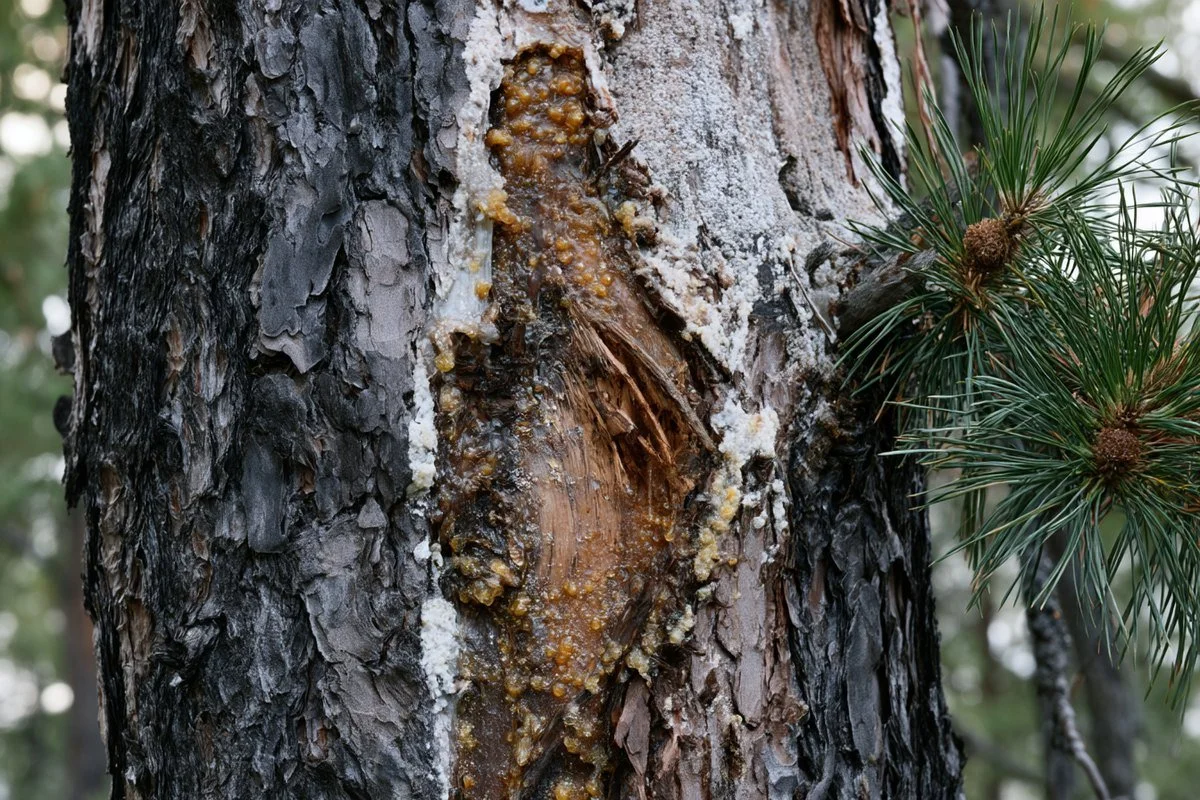
Any break in the bark brings resin. The kolot leaves scars and resin-stained wounds on the trunk44. Taiga people have long taken the hardened lumps from wounded trunks16, and the drops that fall to the ground can be gathered too. In the open air the resin changes. Its volatile oil slowly evaporates, and over time the resin hardens into the chewing lumps Siberians call sera1647.
Tapping
Soviet foresters tapped cedar by cutting shallow channels into the bark and catching the flow below. Cedar needed only two or three fresh cuts a season to keep flowing, where pine needed about a hundred. The resin ran into containers of polyethylene film that held up to a kilogram and were emptied once a season, which cut the labour by 40 percent. A cedar forest gave 40 to 80 kilograms of resin a hectare a year, and trees were tapped for ten to twenty years before felling, their wounds healing fully16. The Soviet chemical encyclopedia gives the average yearly yield of cedar tapping as 0.6 to 0.8 kilograms, against 1.0 to 1.1 for Scots pine6.
Cedar resin stayed a small trade. By 1968 only a few plants processed it48. In the 1970s many cedar forests were taken out of timber use and made into nut-harvesting zones49. Russia's current rules for resin tapping, in force from September 2026, list pine, spruce, larch and fir, and they forbid tapping wherever felling is banned5051. Felling is banned in the nut zones38.
The forest economy
The nuts carry the cedar economy. In 2023 the Siberian regions harvested about 17,900 tonnes, led by Krasnoyarsk, Tomsk, Tuva and the Altai, and half to nine tenths of the crop went abroad42. Gatherers in Krasnoyarsk earn 1,500 to 3,000 roubles a day, and up to 90 percent of them work informally43. Resin is gathered on the same ground, in far smaller amounts.

VIIIFrom resin to oil
Fresh cedar resin is roughly a fifth to a third volatile oil by weight, depending on how long it has lain in the air. The rest is rosin, with the cedar's neutral diterpenes16476.
The essential oil
The oil is drawn off with steam. The resin is warmed until it flows, steam passes through it and carries the volatile molecules over, and in the cooler they condense with the water and separate as an oil. The rosin stays behind in the still536. At a fifth to a third volatile oil, each kilogram of essential oil takes about three to five kilograms of resin.
The resinoid
A resinoid keeps what the still leaves behind. The resin is dissolved in a solvent, filtered, and the solvent removed in whole or in part54. The result holds the heavier molecules: the resin acids, the neutral diterpenes and what remains of the volatile oil.
Where the scent comes from
In the resin oil of Mongolian cedar, about two-fifths is α-pinene and nearly a quarter is δ-3-carene, with β-pinene close to a tenth7. α-Pinene smells fresh, piney, camphor-sweet and earthy55. δ-3-Carene is sweet, diffusive and penetrating, resinous with a citrus edge56, and in a 2025 comparison of four cedar pines it turned up only in the Siberian one8. β-Pinene is dry, woody and resinous, with a spicy, peppery undertone like nutmeg57, a likely source of the faint pepper in the cedar of Beaver Moon.
The oil also carries a heavier molecule, cembrene, a diterpene with a ring of fourteen carbons, at about five to six and a half percent758. Chemists at Novosibirsk first described the cedar's cembrene family in 196559, and named a new sesquiterpene, sibirene, from the same resin8. In the resinoid the resin acids dominate, abietic, isopimaric and lambertianic acid among them8. Abietic acid, the largest share, has almost no odour of its own60.
IXKept fresh
For most of its history Siberian cedar resin served the pharmacy and the workshop. Its turpentine went into camphor and paint, and its rosin into abietic acid, plasticisers and the immersion oils of microscopes165. In perfume it belongs to the balsamic family, beside the pine resinoids and the oil of its Alpine cousin, which perfumers describe as green, resinous, fruity and balsamic61.
Judging the real thing
Siberian cedar resin carries a chemical signature. It holds lambertianic acid and the cembrene diterpenes, and it lacks pimaric acid8. Its neutral share, 7 to 10 percent, is two to three times that of Scots pine resin6. Those markers let a laboratory tell genuine cedar resin from the common pine resin that grows across the same country.
Fresh stock
Resin oils are at their best fresh. As turpentine ages in air its terpenes form peroxides and epoxides, and these oxidation products are the main cause of skin allergy to turpentine, with δ-3-carene the key one62. Rosin behaves the same way, and its main allergen forms on contact with air63. The International Fragrance Association asks that pine-family oils be kept with peroxides as low as practicable, for instance with an antioxidant added at production64. Good practice is simple: full bottles, cool and dark.
The cedar through the centuries
- 1638
The governor of Tobolsk orders cedar resin gathered for wounds5.
- 1665
Sixty-seven cedars travel from Verkhoturye to the palace gardens of Moscow5.
- 1724
Peter the Great's decree sends 1,300 cedars to Saint Petersburg5.
- 1755
A Tobolsk order bars settlers from felling cedar for building30.
- 1803
Du Tour names Pinus sibirica2.
- 1921
Lenin's decree founds the Soviet cedar nut trade34.
- 1932
The first cedar tapping plots open near Lake Teletskoye16.
- 1946
Baturino, near Tomsk, gives the first industrial cedar resin16.
- 1959
Kedrograd is founded in the Altai35.
- 1965
Novosibirsk chemists describe cembrol and cembrene in the resin59.
- 1989
All felling of cedar stands is banned37.
- 2000
The Altai festival of the cedar is revived at Tunzha33.
XRare and precious
Siberian cedar is common, and ranked of least concern for its survival3. Its resin is scarce in trade. Soviet tapping of all species peaked at 198,000 tonnes of resin in 196565, while cedar resin passed through a handful of plants48. What reaches a perfumer today is gathered by hand, a lump or a drop at a time, in forests kept for their nuts.
The house's cedar
Essential oil. A single small distillation of wild resin from the Russian taiga. Its distiller describes it as uplifting and soothing, with touches of pine and layers of soft, smooth, powdery sweetness led by honey and black pepper. The chemistry points the same way: the fresh pinenes above, the peppery β-pinene within5557.
Resinoid. The house's own, made from the raw resin in a long alcohol tincture, concentrated after the steep. It holds the resin acids and diterpenes the still leaves behind, the heavy and slow part of the resin.
Raw resin. Sticky lumps gathered where they fell, the starting point for the resinoid. Its gatherers describe it as sweet, woody and earthy, with a hint of musk.
XIFor the perfumer
The tapping, distillation, chemistry and standards behind Siberian cedar oil and resinoid, for quick reference at the bench.
Tapping & yields
History. P. K. Kutuzov set up experimental cedar tapping plots near Lake Teletskoye in 1932. A. P. Pentegov opened the first industrial plot at Baturino, Tomsk region, in 194616.
| Measure | Figure | Source |
|---|---|---|
| Resin a year, cedar | 0.6 to 0.8 kg (Scots pine 1.0 to 1.1, larch and spruce 0.3 to 0.5) | 6 |
| Resin a hectare a year | 40 to 80 kg | 16 |
| Re-cuts a season | 2 to 3 (pine about 100) | 16 |
| Receiver | Polyethylene film, up to 1 kg, emptied once a season, labour cut 40% | 16 |
| Tapping span | 10 to 20 years before felling, wounds heal fully | 16 |
| Baturino, first year | Over 15 t | 16 |
| Chuya district, Altai, 1948 to 1957 | 1,290 t | 16 |
Fresh and aged resin. Bekh and colleagues give cedar resin as about 30 percent turpentine and 70 percent rosin16. An NMR analysis of whole resin found about 14 mol% monoterpenes8. The volatile share falls with exposure. Fresh pine resin holds 35 to 38 percent turpentine and drops to 16 to 20 after exposure to air47. Resin gathered from the ground sits at the low end.
Distillation. The industrial pine method: resin diluted and melted at 85 to 100°C with steam, heated in the still to about 110°C, then live steam blown through until the batch reaches 160 to 170°C, over 90 to 150 minutes for a 4 to 5 tonne still. Small stills of 0.5 to 1 tonne take 20 to 30 minutes. Rosin and turpentine come out between 4:1 and 6:153.
Labour in a kilogram. At 20 to 30 percent volatile oil, one kilogram of essential oil takes about three to five kilograms of resin. At 40 to 80 kilograms of tapped resin a hectare a year, that is the yearly flow of about a twentieth to an eighth of a hectare of tapped cedar16.
Resinoid. By the international vocabulary, a resinoid is an extract of a dry plant raw material made with one or several solvents, which are then removed in whole or in part54. No published process for a Pinus sibirica resinoid was found. The house's is an ethanol tincture of the raw resin, concentrated after a long steep.
Molecular composition
The first systematic review of the species' chemistry, covering needles, shoots, bark, wood, seeds and oleoresin, appeared in 201566. Novosibirsk chemists separated 18 monoterpene hydrocarbons from cedar, larch and fir oils by gas chromatography in 196567, and isolated three muurolenes from the resin in 196668.
| Molecule | Share | Odour |
|---|---|---|
| α-Pinene | 39.1758 | Fresh, camphor-sweet, piney, earthy55 |
| δ-3-Carene | 23.0758 | Sweet, diffusive, penetrating, resinous, citrus56 |
| β-Pinene | 9.1758 | Dry woody, resinous, with a spicy, peppery nutmeg undertone57 |
| Cembrene (neocembrene) | 4.9 to 6.5758 | Faint, wax-like69 |
| β-Phellandrene | 2.158 | |
| Camphene | 1.758 | |
| Terpinolene | 1.358 | |
| α-Terpineol | 1.058 | |
| Caryophyllene | 0.958 | |
| Longifolene | 0.658 | Sweet woody, fir needle, a little medical70 |
| Bornyl acetate | 0.658 | |
| Limonene | 0.558 | Citrus, orange, fresh, sweet71 |
Whole resin by NMR. Three trees over sixty years old, sampled in 2018 in the Minsk Central Botanical Garden: monoterpenes about 13.9 mol%, resin acids 67.9, isocembrol 8.3, cembrene 1.8. Scaled to the monoterpenes alone, α-pinene about 46 percent, δ-3-carene 33, β-pinene 13, camphene 4 and limonene 4. δ-3-Carene appeared in the Siberian cedar alone among Siberian, Korean, European and dwarf cedar8.
| Acid | Share |
|---|---|
| Abietic | 25.38 |
| Isopimaric | 22.6 |
| Lambertianic (a labdane, the cedar marker) | 11.6 |
| Neoabietic | 3.1 |
| Dehydroabietic | 2.0 |
| Palustric | 1.5 |
| Sandaracopimaric | 1.0 |
| Levopimaric | 0.8 |
| Pimaric | not detected |
The cembranes. The high-boiling neutral fraction holds cembrol, a diterpene alcohol with a fourteen-membered ring, together with abietinal, δ-cadinol and a C17 lactone. Dehydrating cembrol gives cembrene59. 4-Epiisocembrol occurs alongside isocembrol in the resin, and dehydration of either gives cembrene and isocembrene72. In the related Korean pine resin, cembrene, isocembrene and several other diterpenoids appear to form during storage and treatment73. Whether the same holds for Siberian cedar is unconfirmed.
Odour of the heavy end. Abietic acid is effectively odourless as a solid60. Cembrene A is described as a colourless oil with a faint, wax-like smell69. No peer-reviewed odour descriptions were found for isocembrol or lambertianic acid. The resinoid's scent rests on the residual monoterpenes and sesquiterpenes, held by the acids.
Needle, bark & nut
| Molecule | Needle oil | Resin oil |
|---|---|---|
| α-Pinene | 57.258 | 39.1 |
| β-Phellandrene | 19.7 | 2.1 |
| β-Pinene | 7.7 | 9.1 |
| Limonene | 2.2 | 0.5 |
| δ-3-Carene | 0.8 | 23.0 |
Needles. 500 kilograms of needles give about 2.5 kilograms of oil, about 0.5 percent16. Across six Eurasian five-needle pines including this one, needle oils range from 5 to 63 percent α-pinene, 0 to 16 δ-3-carene and 0.4 to 24 caryophyllene74.
Bark. A diethyl ether extract of the bark gave resin acids led by lambertianic acid at 42.0 percent, abietic 33.1, isopimaric 13.9, dehydroabietic 6.5 and neoabietic 3.4. Isocembrol with 4-epiisocembrol made up 16.7 percent of the neutral fraction75.
Nuts. Kernels are about 60 percent fat5. Pinolenic acid makes up 17.0 to 19.2 percent of the fatty acids of P. sibirica seed oil, against 13.7 to 15.6 in Korean pine13. Russian "cedar oil" is usually this fatty oil. Food-grade cedar balsams dissolve the resin in it at 5 or 12.5 percent14.
Skin sensitivity
Turpentine. Turpentine oil is classed as a skin sensitiser. In a human maximisation test 18 of 25 subjects reacted. The intact terpenes are minor sensitisers, and their oxidation products, hydroperoxides and epoxides, are the major ones. δ-3-Carene was named as the key allergen, with α-pinene the relevant one in low-carene oils. In German data, rates were above 1 percent until the mid-1970s, below 1 percent in the early 1990s, and about 2 to 3 percent in 1996 and 199762.
Rosin. The main allergens of colophony are oxidised abietadiene-type resin acids formed in air. 15-Hydroperoxyabietic acid was the first identified and is still regarded as the major sensitiser63. Abietic acid itself is a weak allergen or none. Half of sensitised people reacted to gum rosin at 0.1 percent, and the most sensitive at 0.00176.
At the bench. A carene-rich oil and a resin-acid resinoid call for fresh stock, antioxidant protection, minimal headspace and cold, dark storage.
Standards & regulation
| Date | Measure | Source |
|---|---|---|
| 1982 | Soviet standard for gum turpentine from pine resin, three grades, combined pinenes at least 60, 55 and 50 percent, density 0.855 to 0.863 | 77 |
| 1989 | All felling of cedar stands banned, later carried into the Forest Code | 37 |
| 2012 | Russian rules for resin tapping cover pine, spruce and larch, and forbid tapping where felling is banned | 51 |
| 20 January 2020 | The International Fragrance Association's 49th Amendment comes into force. Pine-family oils, turpentine and δ-3-carene to be kept with peroxides as low as practicable, under 10 mmol/L | 6478 |
| 2021 and 2026 | New Russian tapping rules list pine, spruce, larch and fir | 50 |
| 2023 | Nut-harvesting zones confirmed as the one protective forest class with a full ban on timber harvest | 3938 |
The table is a history. Check the current International Fragrance Association standards and the law of the market before formulating.
Authenticity
| Marker | Points to |
|---|---|
| Lambertianic acid and cembrane diterpenoids present | Cedar pine resin8 |
| Pimaric acid absent | Cedar pine resin8 |
| δ-3-Carene present | Siberian cedar among the cedar pines8 |
| Neutral fraction 7 to 10% | Cedar resin. Scots pine resin carries 3 to 4%6 |
What to watch for. Scots pine resin grows across the same range and is far more abundant. Cedar balsams are sold diluted in nut oil and other vegetable oils14. No published enantiomer method for P. sibirica resin was found.
Building the accord
The top. α-Pinene and β-pinene give the pine and the dry, peppery lift. δ-3-Carene brings the sweet, penetrating citrus-resin edge that sets Siberian cedar apart from the other cedar pines tested5557568. Limonene adds a sweet citrus brightness, and longifolene a sweet woody fir-needle depth7170.
The base. The resinoid's acids and diterpenes carry little odour and slow the volatile fraction's escape. Pine and fir resinoids, hydrogenated rosin esters and stone pine oils sit in the same balsamic family61.
Trade & provenance
| Year | Figure | Source |
|---|---|---|
| 19th century | Up to about 3,100 t of nuts a year through Tyumen to European Russia | 30 |
| 1965 | Soviet resin tapping, all species, peaks at 198,000 t | 65 |
| 1968 | Only a few plants process a small amount of cedar resin | 48 |
| 1984 to 1992 | Krasnoyarsk nut harvest averages 740 t a year, 2.7% of the possible | 46 |
| 2022 | Cedar stands, Siberian and Korean, cover 38.6 million ha, 5.5% of the forest fund | 19 |
| 2022 | 19,200 t of nuts harvested by business | 79 |
| 2022 | Pine nut exports 21,300 t, worth $38 million, 18,500 t to China | 52 |
| 1 August 2024 | Export duty on in-shell nuts, 25%, rising to 50% from August 2025 | 80 |
| 2026 | Krasnoyarsk gatherers paid at least 650 roubles a kg in a poor year, wholesale 5,000 to 5,500 | 43 |
From the record. Ignatenko records that Peter the Great planted two cedars on Vavchug Island in 1702 to mark two ships5. In Mongolia, cedar covers 5.2 percent of the 13.8 million hectares of northern forest45. The Kedrograd station's capital budget fell from 230,000 to 57,400 roubles after the failed crop of 196236. The sable's range roughly matches the combined range of the Siberian, Korean and dwarf cedars20.
Found in
Beaver Moon
Siberian cedar oil and resinoid in the base of the house fragrance of the November moon.
The Beaver Moon collectionMore from the November moon
 ✦ Folio No. 24
Siberian Rhododendron
The white wing of the Sayan Mountains, cold and fruity in the heart of Beaver Moon.
Read the folio
 ✦ Folio No. 22
Myrrh
Kua myrrh, sweet and resinous as prayer smoke, beside the cedar in the base.
Read the folio
 ✦ Folio No. 23
Oakmoss & Treemoss
The lichens of oak and pine, gathered from bark, and part of Beaver Moon.
Read the folio
✦ ✦ ✦
Sources & image credits80 references
- Savelyev N., Thousands of Siberians head into the taiga with their families (in Russian), Rossiyskaya Gazeta (28 September 2016).↑
- Royal Botanic Gardens, Kew, Pinus sibirica Du Tour, Plants of the World Online.↑
- Pinus sibirica, Wikipedia, citing Farjon A., Pinus sibirica, IUCN Red List e.T42415A2978539 (2013) and the Great Russian Encyclopedia 13, 783 (2009).↑
- Politov D.V., Krutovsky K.V., Phylogenetics, genogeography and hybridization of five-needle pines in Russia and neighboring countries, USDA Forest Service Proceedings RMRS-P-32, 85-97 (2004).↑
- Ignatenko M.M., Siberian Cedar: Biology, Introduction, Culture (in Russian), Nauka, Moscow (1988).↑
- Radbil' B.A., Oleoresin (in Russian), Chemical Encyclopedia.↑
- Carrión-Prieto P. et al., Physicochemical studies of Siberian pine (Pinus sibirica) derived chewing gum, Trends in Phytochemical Research 2(2), 119-124 (2018), reporting Shatar and Adams (1996).↑
- Skakovskii E.D. et al., NMR analysis of the oleoresin composition of cedar pines (in Russian), Izvestia of the St Petersburg Forest Technical Academy 253, 260-281 (2025).↑
- Great Russian Encyclopedia, Siberian stone pine (in Russian).↑
- Earle C.J., Pinus sibirica, The Gymnosperm Database, citing Farjon A., A Handbook of the World's Conifers (2010) and Hessl A.E. et al., Science Advances 4(3), e1701832 (2018).↑
- Biological and ecological characteristics of Siberian cedar (in Russian), kedrovik.forest.ru.↑
- West Virginia University, Scientists use ancient trees and climate models to understand past and future drought in Mongolia, WVU Today (14 March 2018), on Hessl A.E. et al., Past and future drought in Mongolia, Science Advances 4(3), e1701832 (2018).↑
- Baker E., Miles E., Calder P., [Review of pinolenic acid, data tables], Progress in Lipid Research 82, 101097 (2021), tables.↑
- Encyclopedia of Medicines RLS, Cedar oleoresin in cedar nut oil, 12.5% and 5% (in Russian).↑
- Kolbin V., The nutcracker (in Russian), Nauka i Zhizn 6 (2008).↑
- Bekh I.A., Krivets S.A., Bisirova E.M., Cedar, the Pearl of Siberia (in Russian), Pechatnaya Manufaktura, Tomsk (2009).↑
- Tantsyrev N.V., Sannikov S.N., Usoltsev V.A., Geographical features of Pinus sibirica Du Tour renewal, Lesnoy Zhurnal 2023(6), 44-56.↑
- Tantsyrev N.V. et al., Geographical peculiarities of Pinus sibirica Du Tour natural regeneration as related to its seed crops, Current World Environment 19(1) (2024).↑
- Great Russian Encyclopedia, Cedar forests (in Russian).↑
- Bobrov V., Treasure of the nation (in Russian), Vokrug Sveta 8 (2001).↑
- Loban E., Cedar crop failure (in Russian), AiF Irkutsk (16 October 2018).↑
- Byers J.A., Host tree chemistry affecting colonization in bark beetles, in Cardé R.T., Bell W.J. (eds.), Chemical Ecology of Insects 2, Chapman and Hall, New York (1995), section 5.4.↑
- Kerchev I.A., [Laboratory colonisation of conifer logs by the four-eyed fir bark beetle, Tomsk] (in Russian), Tomsk State University Journal of Biology 3(19), 169-177 (2012).↑
- Krivets S.A., Kerchev I.A., Bisirova E.M. et al., Small spruce bark beetle as a new challenge for forest protection in Siberia, Siberian Journal of Forest Science 2023(1), 43-57.↑
- Pavlov I.N. et al., New outbreak of Dendrolimus sibiricus Tschetv. in Siberia (2012-2017), Contemporary Problems of Ecology 11(4), 406-419 (2018).↑
- Goroshko A.A. et al., Risk modeling for the emergence of the primary outbreak area of the Siberian moth, Forests 16(1), 160 (2025).↑
- Goroshkevich S., Velisevich S., Popov A., Khutornoy O., Vasilyeva G., 30-year cone production dynamics in Siberian stone pine (Pinus sibirica) in the southern boreal zone: a causal interpretation, Plant Ecology and Evolution 154(3), 321-331 (2021).↑
- Tchebakova N.M., Parfenova E.I., The 21st century climate change effects on the forests and primary conifers in central Siberia, Bosque 33(3), 253-259 (2012).↑
- Parfenova E.I. et al., [Projected ranges of Siberian conifers in the 2050s], Forests 15(10), 1691 (2024).↑
- Lebedeva A.A., Safyanova A.V., The cedar nut harvest in Siberia (in Russian), Sovetskaya Etnografiya 4, 107-116 (1979).↑
- Leonova V.A., Frolova A.V., [Siberian cedar plantings at the Koryazhma and Solovetsky monasteries] (in Russian), Lesnoy Vestnik 22(3), 149-154 (2018).↑
- Wiget A., Balalaeva O., Sharing the world with bears, Human Ecology 50, 1129-1142 (2022).↑
- Chemchieva A.P., [On Tyuryuk-Bayram, the Altai festival of the cedar] (in Russian), Historical, Philosophical, Political and Law Sciences 12(74), part 3, 195-198 (2016).↑
- Khodorych A., Cedars decide everything (in Russian), Kommersant-Dengi 32 (15 August 2005).↑
- Katashev M.S., The Kedrograd movement: first attempts to organise sustainable forest management in the cedar forests of Siberia (in Russian), Manuscript 8(94), 27-30 (2018).↑
- Gavrilov Ye., Kedrograd (in Russian), vtourisme.com (27 January 2017).↑
- Nikishin A., Protecting the Siberian cedar needs its own law (in Russian), Parlamentskaya Gazeta (20 November 2018).↑
- Forest Code of the Russian Federation, Article 115 (in Russian).↑
- Federal Forestry Agency of Russia, Letter No. IS-02-54/22237 on nut-harvesting zones (in Russian) (18 September 2023).↑
- Anokhina A., [The 2025 cedar nut harvest in Tomsk region] (in Russian), RIA Tomsk (23 August 2025).↑
- Zhulaeva I., Who the cone gatherers are and how the business works in Gorny Altai (in Russian), Tolk (11 March 2025).↑
- Sokolova M., Russian cedar nuts are flowing to China (in Russian), Parlamentskaya Gazeta (26 June 2024).↑
- NGS24, [Cedar nut prices and harvest in Krasnoyarsk, 2026] (in Russian) (2 November 2026).↑
- Morozov A.E. et al., [On the Tundrinsky cedar forest and kolot damage] (in Russian), Lesa Rossii i Khozyaistvo v Nikh 2(97), 56-68 (2026).↑
- Ariunbaatar T., Temuujin B., Lyankhua B., Study of cone and seed characteristics of Pinus sibirica in difference between Khangai and Khentii mountains, Mongolian Journal of Botany 5(31), 171-181 (2023).↑
- Bekh I.A., [The nut resources of the cedar forests of the Siberian Federal District] (in Russian), Journal of Siberian Federal University, Biology 1(4), 414-421 (2008).↑
- Korostelev A.S. et al., On the quality and losses of oleoresin (in Russian), Ural Forestry Institute, 123-129.↑
- Atamanchukov G.D., Oleoresin and the Use of Its Processed Products (in Russian), Lesnaya Promyshlennost, Moscow (1968).↑
- Shishikin A.S. et al., [On the nut-harvesting zones of cedar forests] (in Russian), Siberian Journal of Forest Science 2024(5), 70-78.↑
- Ministry of Natural Resources of Russia, Order No. 117 of 5 March 2026 on the rules for resin harvesting and Order No. 911 of 9 November 2020 (in Russian).↑
- Federal Forestry Agency of Russia, Rules for resin harvesting, Order No. 23 of 24 January 2012 (in Russian), via FAOLEX.↑
- Interfax, [Russian pine nut exports, 2022].↑
- Coppen J.J.W., Hone G.A., Gum Naval Stores: Turpentine and Rosin from Pine Resin, FAO Non-Wood Forest Products 2, Rome (1995).↑
- International Organization for Standardization, ISO 9235:2013, Aromatic natural raw materials: vocabulary.↑
- The Good Scents Company, alpha-Pinene.↑
- The Good Scents Company, delta-3-Carene.↑
- The Good Scents Company, beta-Pinene.↑
- Shatar S., Adams R.P., Analyses of the leaf and resin essential oils of Pinus sibirica (Rupr.) Mayr from Mongolia, Journal of Essential Oil Research 8(5), 549-552 (1996).↑
- Lisina A.I., Rezvukhin A.I., Pentegova V.A., Composition of the neutral fraction of the resin of Pinus sibirica, II, Chemistry of Natural Compounds 1(4), 193-197 (1965).↑
- Perflavory, Abietic acid.↑
- The Good Scents Company, Balsamic odour index.↑
- TRGS 908, justification for turpentine oil as a skin sensitiser (in German), Bundesarbeitsblatt 8/1999, 87.↑
- Karlberg A.-T., Hagvall L., Colophony: rosin in unmodified and modified form, in Kanerva's Occupational Dermatology, Springer (2018).↑
- The Good Scents Company, Turpentine oil, recording the International Fragrance Association specification of the 49th Amendment.↑
- Yarunov A.S., Petrik V.V., From the history of resin tapping (in Russian), Lesnoy Zhurnal 5, 138-144 (2003).↑
- Rogachev A.D., Salakhutdinov N.F., Chemical composition of Pinus sibirica (Pinaceae), Chemistry and Biodiversity 12(1), 1-53 (2015).↑
- Vol'skii L.N., Dubovenko Zh.V., Gershtein N.A., Pentegova V.A., [Monoterpene hydrocarbons of Siberian cedar, larch and fir oils by gas chromatography], Chemistry of Natural Compounds 1(6), 300-301 (1965).↑
- Pentegova V.A., Dubovenko Zh.V., [Muurolenes of Pinus sibirica oleoresin], Chemistry of Natural Compounds 2(3), 136-138 (1966).↑
- Cembrene A, Wikipedia.↑
- The Good Scents Company, Longifolene.↑
- The Good Scents Company, d-Limonene.↑
- Raldugin V.A., Pentegova V.A., [4-Epiisocembrol in the oleoresins of Pinus koraiensis and P. sibirica], Chemistry of Natural Compounds 7(5), 669-670 (1971).↑
- Raldugin V.A., Pentegova V.A., [Secondary diterpenoids of Pinus koraiensis oleoresin], Chemistry of Natural Compounds 12(2), 157-161 (1976).↑
- Domrachev D.V. et al., [Needle essential oils of Eurasian five-needle pines], Russian Journal of Bioorganic Chemistry 38(7), 780-789 (2012).↑
- Grishko V.V., Demenkova L.I., Raldugin V.A., Chemical composition of the bark of Pinus sibirica, Chemistry of Natural Compounds 30(2), 266 (1994).↑
- Nilsson U. et al., Development of an analysis method for quantification of colophonium components in cosmetic products, Danish Environmental Protection Agency, Environmental Project 1272 (2009).↑
- GOST 1571-82, Gum turpentine, specifications (in Russian).↑
- Critical Catalyst, The 49th Amendment to the IFRA Code of Practice.↑
- Zadera S., The area of wild nut forests in Russia has grown (in Russian), Rossiyskaya Gazeta (9 August 2023).↑
- FreshPlaza, Pine nut export duty implemented to boost domestic processing in Russia (11 April 2024).↑
Photographs
Chemalsky district, Altai: Maksim Teltsov, CC BY 3.0. Cones in the Urals: ugraland, CC BY 2.0. Seminsky Pass: Ludvig14, CC BY-SA 4.0. Cones in the Taigish Valley, Ergaki: Vyacheslav Argenberg, CC BY 4.0. Siberian pine nuts: Eugene Zelenko, CC BY-SA 4.0. Spotted nutcracker, Ust-Koksa: dmitry_kulakov, CC BY 4.0. Cedar bark, Solovetsky Islands: Alain Bigou, CC BY-SA 2.0 FR. Range map: W. B. Critchfield and E. L. Little Jr., US Forest Service, public domain. Old cedar on the Ob: Aleksey 6666, CC BY-SA 4.0. Pine nut stall, Ulaanbaatar: US Forest Service, Forest Health Protection, public domain. Rhododendron adamsii: Anbudilin, CC BY-SA 4.0. Myrrh: Nesnad, CC BY 4.0. Oakmoss: pol parrhesia, CC0. All via Wikimedia Commons. Plates marked Illustration are renders made by Ashenfume to illustrate the text. Beaver Moon key art: Ashenfume.
Join the discussionHave you walked a cedar taiga, gathered the cones, or worked with this resin? Add what you know, or ask a question.