Provenance Materia Deer Musk Mongolian
MATERIA · THE STAG COLLECTION
Mongolian Deer Musk
The khüder of the larch forests, the Gudderi of Marco Polo, and a musk of Mongolian medicine
On calm days in early spring, the gates of five forest pens stood open in the Bukhun Shar Mountains of Arkhangai, in central Mongolia, and the musk deer that had wintered inside walked out into the larch and birch on their own. In the first three weeks, 11 of the 15 were found within one or two kilometres of the pens, and over the next two months their tracks and feeding signs kept turning up in the snow1. The animal is the Siberian musk deer, the khüder of the Mongolian forests2, a small tusked deer that Mongolians call the forest police for the whistle it gives at danger3. Its males carry musk. More than seven centuries ago Marco Polo, travelling in the empire of the Great Khan, wrote down the deer’s name in the Tartar tongue as Gudderi45, and Mongolian physicians still put its musk into their remedies6. This is Mongolian deer musk.
Explore this folio


IWhat it smells like
Mongolia’s musk deer is the Siberian species, and its musk is the Siberian kind, low in muscone and sharp when raw. It changes from forest to bottle in four stages.
- The fresh gland
Unpleasant and penetrating, an odour that almost hides the musk inside it8.
- The dried pod
Ammoniacal and rather urinous, with a faintly burnt, smoky edge the Victorians called empyreumatic910.
- The aired grain
Dried in the air, the grain loses the ammonia note of the raw secretion11.
- The aged tincture
Pale brown to dark amber, and fully musky only after months of ageing12.
IIIn the house
In the house, deer musk takes the form of the Deer Musk Pod Accord, composed at Ashenfume from a study of the true material, the musk and the pod together, with traces of hyraceum and castoreum for its animal warmth. It sits in the base of Stag, the house forest chypre of the November woods. The musk deer of the Khangai and the Khentii keep their musk. This folio follows them as the house’s field study of the animal behind the accord.
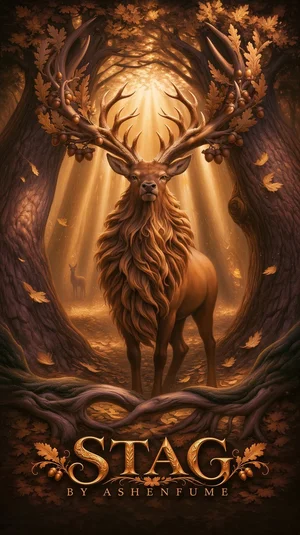 The house musk
Stag
The Deer Musk Pod Accord in the base of the house forest chypre.
View the fragrance

IIIThe forest police

Mongolia has one musk deer, the Siberian, Moschus moschiferus, the species Linnaeus named in 1758 and zoologists later fixed in the Altai13. Its typical form ranges from Siberia into eastern Kazakhstan, Mongolia and the north of China14, and in Mongolia it lives at the southern edge of that range, in the forests that come down from the Siberian taiga onto the mountains of the north. Mongolians call it khüder, or badanga khüder2.
It is a small deer, built for steep ground and snow. The adults caught in the Khangai between 2020 and 2024 weighed 10.9 kilograms on average, their hind feet measured 31.6 centimetres, and the males’ upper canines 6.3 centimetres1. The hind legs are longer than the forelegs, so the back slopes forward, and the side hooves are almost the size of the main ones and print in the snow beside them15. The males carry their long, curved canines in place of antlers15. A musk deer lives up to twelve years and weighs up to 15 kilograms3, and its generation length is about six years2.
The zoologist Delegnyam D. explains its local nickname. Mongolians call the musk deer the forest police, for the whistle it gives to warn the other animals of danger3. It lives alone on a small, well-known patch of ground, and marks it with its glands, its urine and its pellets1615.
The male carries the musk, in a gland between the navel and the genitals17. The rut falls in November and December, and the secretion of the Siberian musk deer stirs the sexual behaviour of the females1618. The young are born at the end of spring and in June16. The full natural history of the species is told in the Siberian Deer Musk folio.
IVLarch and lichen
The Mongolian musk deer lives in mountain taiga. In the Khan-Undur range of the Khangai, the donor forest for the reintroduction, it lives in larch and pine. The Khangai Mountains National Park covers about 8,885 square kilometres between 1,500 and 3,900 metres, a country of taiga, alpine meadow and rock outcrops1. The Bukhun Shar Mountains of Arkhangai, where the deer were set free, are mixed Siberian larch and birch forest with meadows, scree slopes and cliffs, most of it below 2,500 metres1.
Lichen carries it through the winter. Across its range, lichens make up about 70 percent of a musk deer’s winter stomach by weight19. In their acclimatisation pens the Khangai deer ate hay and the tree lichens Usnea longissima and Bryoria, about 1.2 kilograms a day, roughly 70 percent hay and 30 percent lichens and mosses1.

The Mongolian musk lands
The Khentii. The forest ranges northeast of Ulaanbaatar, running north toward the Siberian border, once the densest musk deer country in Mongolia1.
Khövsgöl. The taiga around the great lake in the far north, whose musk once went to the market town of Mörön20.
The Khangai. The mountains of the centre, taiga, alpine meadow and rock between 1,500 and 3,900 metres. The Khan-Undur range kept a steady population, which made it the donor forest for the reintroduction1.
The Bukhun Shar. A locally protected range of about 350 square kilometres in Arkhangai, across the districts of Bat-Ölzii, Ölziit, Khairkhan and Erdenemandal, larch and birch with scree and cliffs1.
Selenge and the border. The old trade frontier at Altanbulag, opposite Russian Kyakhta21.
VGudderi

The oldest written trace of the deer’s Mongol name comes from a Venetian. In the late thirteenth century Marco Polo crossed the lands of the Great Khan, and in the country of Tibet he found many of the animals that produce musk, which were called, he wrote, in the Tartar language Gudderi. The hunters kept great numbers of large dogs to catch them, and so procured great abundance of musk4. His editor Henry Yule noted, after the orientalist Julius Klaproth, that the word is Mongol, and that it appears as kuderi in Kovalevski’s Mongolian dictionary4.
The French scholar Paul Pelliot followed the word further. Polo’s manuscripts spell it gudderi, guderi and gudery, and Pelliot identified it as küdäri, the Mongol name of the musk deer. The Mongol name of the musk itself is another word, written ji’ar, from an older jibar5. The modern khüder carries Polo’s word into the present.
Polo described the animal too. In the province he called Erguiul, east of Kanchau, he found what he called the best musk in the world. The animal was like a gazelle, with feet and tail like a gazelle’s, a coat of coarse hair and no horns, and slender tusks about three inches long. When it was taken, the hunters found at the navel, between the flesh and the skin, a swelling full of blood, which they cut out with all its skin attached, and the blood inside was the musk. The flesh, he added, was very good to eat. He carried the dried head and feet of one of these animals home to Venice22.
VIMusk in Mongolian medicine

At home, musk belonged to the physician. Mongolian medicine was taught in its own medical schools in the thirteenth century. Later, Tibetan medicine came into Mongolia, and its recipes were gradually translated into Mongolian23. The Mongolian materia medica draws on some 260 animal sources alongside its plants and minerals23. By one count, musk goes into 537 of some four thousand Mongolian traditional medicines6.
Mongolian physicians have given it for clots in the brain, for stroke and for numbness of the joints6, and for loss of taste and numbness of feeling24. It remains one of the six ingredients of Khurtsiin deed-6, a traditional remedy for headaches, made with chebulic myrobalan, safflower, costus root, the herb Odontites vulgaris and guggul resin7. These are the practices of a medical tradition, and Mongolian researchers have begun to study them in the laboratory6.
The tradition went quiet and came back. Traditional medicine was banned in Mongolia for many years and has grown again since 19907. Musk for that work comes from a farm. The Institute of Traditional Medicine and Technology keeps musk deer at Shar Khooloi, in Gachuurt on the edge of Ulaanbaatar, and takes the musk from the living deer67.
VIIThe northern musk in the bottle
In the perfume trade, the musk of the Mongolian deer belonged to the Siberian grade. The chemist and perfume manufacturer George William Askinson priced a Siberian or Russian pod at about a quarter of a Chinese one in 1892, and knew a weaker, rather urinous variety as Cabardine25. John Charles Sawer found the Siberian musk much less powerful and somewhat empyreumatic, smoky and burnt at the edge, and judged the musk of the Altai rarely adulterated to any extent10. The chemistry agrees with the graders. The Siberian secretion is mostly waxes and steroids, with no more than half a percent of muscone1816.
A perfumer used it as a tincture. Askinson made his Extrait de Musc with two and a half ounces of musk to five quarts of alcohol, and valued it above all for fixing other, very volatile odours25. The tincture came out pale brown to dark amber and turned fully musky only with months of ageing12. Sawer called musk the wings of the perfume it was added to10. The formulas that carried it are set out in the appendix of the Siberian Deer Musk folio.

VIIIThe road through Urga

For two centuries Mongolia stood on the road between Russia and China. After the Treaty of Kyakhta in 1727, each empire built a trading post on its side of the border, and in 1730 the Qing side began the town of Maimaicheng, the town of buying and selling, a few hundred feet south of Russian Kyakhta. Today it is Altanbulag, in Mongolia’s Selenge province21. From there the trade road ran 170 miles south to Urga, the city now called Ulaanbaatar, and on across the Gobi to Peking. Among the goods the Chinese merchants sold at Kyakhta were silk, tea, rhubarb and musk26.
The twentieth century turned the trade north. From 1926 to 1985 Mongolia delivered 119 million furs to its northern neighbour, with 13 million kilograms of game meat27. Mongolia closed musk deer hunting in 19533.
IXThe return
Poaching for the gland, logging and the pine-nut harvest have thinned the forests1. In the 1970s Mongolia held an estimated 60,000 to 80,000 musk deer, and a national survey of 1986 estimated 44,0002. By the early 2000s about 6,525 remained1. Through the 1990s the musk went out by hand, and the permanent musk traders at Ulaanbaatar’s Tsaiz market grew from five in 1994 to forty in 200120. The Mongolian Red List of Mammals lists the musk deer as Endangered2.
The return began with local people. Galdanjamts L., a herder who leads a volunteer community protecting the musk deer, works in forest and mountain country often reachable only on foot, and his neighbours call him Khuder Galdaa, Musk Deer Galdaa3. Then came the nets. Over the winters of 2020, 2022 and 2024, teams of twenty to twenty-five biologists, students and rangers followed fresh tracks in new snow in the Khan-Undur range and drove each deer slowly toward soft nylon nets strung across its line of escape, working only between minus 20 and minus 5 degrees. No drugs were used. Of 38 drives, 15 caught a deer, and every one came through capture, the 130-kilometre journey and the winter pens to walk free in the Bukhun Shar1. The authors describe it as the first formally documented reintroduction of the species in central Mongolia1. The full figures are in the appendix.
Mongolian musk through the centuries
- 13th century
Mongolian medicine is taught in its own medical schools23.
- Late 13th century
Marco Polo writes down the musk deer’s name in the Tartar tongue as Gudderi4.
- 1727 to 1730
The Treaty of Kyakhta, and the Qing trading town of Maimaicheng, now Altanbulag21.
- 1758
Linnaeus names the Siberian musk deer13.
- 1892
Askinson prices the Siberian grade at a quarter of Tonquin25.
- 1953
Mongolia closes musk deer hunting3.
- 1963
Pelliot traces Gudderi to the Mongol küdäri5.
- 1986
A national survey estimates 44,000 musk deer2.
- 1990
Traditional medicine begins to grow again in Mongolia7.
- 2006
The Mongolian Red List of Mammals lists the musk deer as Endangered2.
- 2020
The first musk deer are caught in the Khan-Undur for the Bukhun Shar1.
- 2026
The reintroduction is published, with all 15 deer through capture and release1.
The house musk
Stag
The Deer Musk Pod Accord in the base of the house forest chypre.
AppendixFor the perfumer
The medicine, the counts, the trade and the reintroduction behind Mongolian musk, set out for reference. The animal is the Siberian musk deer, so for the chemistry of its musk and the old perfumery formulas see the appendix of the Siberian Deer Musk folio, and for tinctures and the absolute the Deer Musk folio.
In medicine
| Measure | Figure |
|---|---|
| Medicines made with musk | 537 of about 4,000, by Boldsaikhan’s count6 |
| Traditional uses | Clots in the brain, stroke, numbness of the joints, loss of taste and feeling624 |
| Khurtsiin deed-6 | A headache remedy of six ingredients: musk, chebulic myrobalan, safflower, costus root, Odontites vulgaris and guggul7 |
| Source today | Deer bred by the Institute of Traditional Medicine and Technology at Shar Khooloi, Gachuurt, musk taken from the living deer6 |
| Animal sources in the materia medica | About 26023 |
The name
| Word | Meaning and source |
|---|---|
| Gudderi, guderi, gudery | Marco Polo’s spellings of the Tartar name of the musk deer45 |
| Küdäri | The Mongol name of the musk deer, after Pelliot5 |
| Ji’ar, from jibar | The Mongol name of musk itself, after Pelliot5 |
| Khüder, badanga khüder | The musk deer in Mongolian today2 |
Counts
How to read the counts. Mongolia had no national musk deer survey for more than thirty years before 200420. The figures below come from different methods and areas, so read them as a trend.
| Period | Figure |
|---|---|
| 1970s | 60,000 to 80,000 animals2 |
| 1970s, density | 21 to 35 per 1,000 ha in the Khentii, 6 to 8 in the Khangai1 |
| 1986 | 44,000, in 63 districts of six provinces2 |
| 1990 to 2000, one population | 1.2 to 0.2 per km²2 |
| Early 2000s | 1.9 per 1,000 ha, about 6,525 in all1 |
| Decline | 70% in 30 years, UNDP3. 83% since the 1970s, UN News28 |
| Status | Endangered, Mongolian Red List of Mammals, 2006, with a call to reassess as Critically Endangered if hunting is not reduced2 |
| Causes named | Habitat loss and logging, the harvest of Siberian pine nuts, poaching for the gland, herd dogs and overgrazing13 |
Price
| Years | Ulaanbaatar | Mörön |
|---|---|---|
| 1990 to 1992 | 20,000 to 25,000 | Not recorded20 |
| 1993 to 1995 | 45,000 to 50,000 | 16,000 in 199420 |
| 1996 to 2001 | 120,000 to 240,000 | 80,000 in 200120 |
By the gram, 2001. Traders paid suppliers about 4 dollars a gram and sold to Chinese buyers at 6 to 820.
Routes
| Measure | Figure |
|---|---|
| Khentii musk | About 30% to Mongolian markets, 70% smuggled straight to China20 |
| Khövsgöl musk | About 65% to Mörön20 |
| Carriers | Students 48%, trusted agents 32%, poachers 20%20 |
| Traders at the Tsaiz market | 5 in 1994, 40 in 200120 |
| Males reportedly killed, 1998 | Over 3,000, with up to five females to a male in some areas20 |
| South Korean imports from Mongolia, 1995 | 250 kg20 |
The return
| Measure | Figure |
|---|---|
| Captures | 15 deer in 38 drives, 5 males and 10 females, 12 adults and 3 young1 |
| Nets | Soft nylon, 300 to 400 m long, 1.5 to 2 m high1 |
| Drives | 1.5 to 4.5 km toward the nets1 |
| Working temperatures | Minus 20 to minus 5 °C1 |
| Handling | 16.4 minutes on average, no drugs1 |
| Journey | About 130 km, 2 to 3 hours by small truck1 |
| Pens | Five, each 100 by 100 m, in larch and birch forest1 |
| Winter feed | About 1.2 kg a day, 70% hay, 30% lichens and mosses1 |
| Survival to release | 15 of 151 |
| After release | 11 near the site in three weeks, at least 9 recorded over two months1 |
The Stag collectionMore from the November forest
 ✦ Folio No. 7
Deer Musk
The whole story of musk, from the musk roads of Tibet to the farms of the Qinling.
Read the folio
 ✦ Deer musk by region
Siberian Deer Musk
The same deer across the border, Cabardine in the price lists and musk in the Korean pill.
Read the folio
 ✦ Folio No. 28
Siberian Fir
The soft fir of the dark taiga, one of the three conifers that open Stag.
Read the folio
✦ ✦ ✦
Sources & image credits28 references
- Lkhagvasuren A., Baláž I., Samiya R., Amgalan B., Tulis F., Jagj G., Sainjargal M. and Lkhagvasuren D., Reintroduction of the Siberian musk deer (Moschus moschiferus Linnaeus, 1758) in Central Mongolia: first practical experiences, Russian Journal of Theriology 25(1), 55-65 (2026).↑
- Clark E.L., Munkhbat J., Dulamtseren S., Baillie J.E.M., Batsaikhan N., Samiya R. and Stubbe M. (eds), Moschus moschiferus, Mongolian Red List of Mammals, Zoological Society of London (2006), via the National Red List database. Mongolian names from record 189.↑
- Otgonbayar E., Mongolia’s critically endangered musk deer returns home, United Nations Development Programme, Mongolia (22 April 2021).↑
- Polo M., The Book of Ser Marco Polo, Book II, chapter XLV, Concerning the province of Tebet, trans. H. Yule, rev. H. Cordier, 3rd edition, John Murray, London (1903), vol. 2, pp. 45 and 49, via the Toyo Bunko Digital Silk Road archive.↑
- Pelliot P., Notes on Marco Polo, vol. 2, entry 249, Gudderi, Imprimerie nationale, Paris (1963), p. 742, via the Toyo Bunko Digital Silk Road archive.↑
- Gochoo R., Namsrai O., Begzsuren D., Jargalsaikhan B.-E., Lkhagvasuren E. and Chimedtseren Ch., The effect of musk on neurons in the pattern of ischemic stroke, Central Asian Journal of Medical Sciences 6(2), 66-73 (2020).↑
- Myadagbadam U., Purevsuren S., Chimedragchaa Ch., Tserenkhand G. and Norovnyam R., Standardization study of Khurtsiin deed-6 traditional medicine, Pharmacognosy Journal 14(3), 610-621 (2022).↑
- Avenas P., À propos de la muscone et de la muscarine, L’Actualité Chimique 507, Société Chimique de France (2025).↑
- Felter H.W. and Lloyd J.U., Moschus, King’s American Dispensatory (1898), via Henriette’s Herbal.↑
- Sawer J.Ch., Odorographia: a natural history of raw materials and drugs used in the perfume industry, vol. 1, Gurney and Jackson, London (1892), chapter on the odour of musk.↑
- Moschus, The British Pharmaceutical Codex (1911), via Henriette's Herbal.↑
- Arctander S., Perfume and Flavor Materials of Natural Origin, Elizabeth, New Jersey (1960), entries for musk and tincture.↑
- Grubb P., Moschus moschiferus moschiferus Linnaeus 1758, in Mammal Species of the World, 3rd edition (2005), via Zenodo.↑
- Wilson D.E. and Mittermeier R.A. (eds), Moschus moschiferus Linnaeus, 1758, Handbook of the Mammals of the World, vol. 2, Lynx Edicions, Barcelona (2011), via Zenodo.↑
- Musk deer (Moschinae), Grzimek’s Animal Life Encyclopedia, via Encyclopedia.com.↑
- Zaitsev V.A., Kabarga: ekologiya, dinamika chislennosti, perspektivy sokhraneniya (Musk deer: ecology, population dynamics and prospects for conservation), Centre for Wildlife Protection and Sikhote-Alin Biosphere Reserve, Moscow (2006), in Russian.↑
- Liu K., Xie L., Deng M., Zhang X., Luo J., Li X., Zoology, chemical composition, pharmacology, quality control and future perspective of musk (Moschus): a review, Chinese Medicine 16, 46 (2021).↑
- Sokolov V.E. et al., Musk deer (Moschus moschiferus): reinvestigation of main lipid components from preputial gland secretion, Journal of Chemical Ecology 13, 71-83 (1987).↑
- Mulder J., Moschus moschiferus, Siberian musk deer, Animal Diversity Web, University of Michigan Museum of Zoology (1999).↑
- Homes V. (ed.), No Licence to Kill: the population and harvest of musk deer and trade in musk in the Russian Federation and Mongolia, TRAFFIC Europe (2004).↑
- Altanbulag, Selenge, Wikipedia.↑
- Polo M., The Travels of Marco Polo, Book I, chapter 57, Of the kingdom of Erguiul, trans. H. Yule, rev. H. Cordier, 3rd edition (1903), via Project Gutenberg.↑
- Shi R., Wang E., Wang M., Zhang C., Damda T.-A. and Li M., Exploring traditional Mongolian materia medica: the path of progress from tradition to modernity, Frontiers in Pharmacology 16, 1554448 (2025).↑
- Gochoo R., The effect of musk on a pathologic model of ischemic stroke, Caucasus Journal of Health Sciences and Public Health 4, supplement 8 (2020).↑
- Askinson G.W., Perfumes and Their Preparation, trans. I. Fuerst, Norman W. Henley, New York (1892).↑
- Kyakhta and Kyakhta trade, Wikipedia.↑
- Wingard J.R. and Zahler P., Silent Steppe: the illegal wildlife trade crisis in Mongolia, Mongolia Discussion Papers, World Bank and Wildlife Conservation Society (2006).↑
- From the field: saving the Mongolian musk deer, UN News (21 November 2021).↑
Photographs
Autumn forest near Bugat: Alex Ang, CC BY-SA 3.0. Siberian musk deer: Mary Russell, Duchess of Bedford, no known restrictions. Larches in October east of Ulaanbaatar: Mongolia Expeditions, CC BY 3.0. Musk deer plate from Schreber, Die Säugthiere: public domain. Siberian larch in Gorkhi-Terelj National Park: USDA Forest Service, public domain. Tarvagatai Mountains in the Khangai: BáthoryPéter, CC BY-SA 3.0. Musk apparatus from Guibourt, Histoire naturelle des drogues simples: public domain. Yuan dynasty iron medicine grinder, Inner Mongolia Museum: BabelStone, CC BY-SA 3.0. Maimaicheng (Altanbulag) in 1885, from George Kennan, Siberia and the Exile System: public domain. Musk deer in Sagarmatha National Park: Sangyam adventurer, CC BY-SA 4.0. Siberian musk deer, Kalarsky district: Dmitry Ivanov, CC BY 4.0. Siberian fir near Beloretsk: Aleksandr Zykov, CC BY-SA 2.0. All via Wikimedia Commons. Stag key art: Ashenfume.
Join the discussionHave you walked the Khentii or the Khangai, heard the musk deer’s whistle in the larches or seen musk at work in Mongolian medicine? Add what you know, or ask a question.