Provenance Materia Deer Musk Siberian
MATERIA · THE STAG COLLECTION
Siberian Deer Musk
The musk of the taiga deer, from the lichen forests of the Sikhote-Alin and the Altai to the perfumer’s tincture and the physician’s pill
Between 12 December 2012 and 8 March 2013, a team of Russian and American researchers that included Jonathan Slaght and the musk deer specialist Vladimir Zaitsev walked some 158 kilometres of snow in the central Sikhote-Alin, in Primorye, reading every fresh track that crossed their lines. Of 694 animal signs, 524 belonged to one small deer, more than any other hoofed animal in those woods, and its trails kept to the old conifer forest where beard lichens hang from the branches1. The deer stands little more than half a metre at the shoulder. Its hind legs are longer than its forelegs, and in place of antlers the males carry two slender tusks that reach down below the jaw23. Beneath the belly of the adult male lies a small gland. For centuries its musk travelled from the Altai and the Far East through the border market of Kyakhta to the pharmacies of China and Korea, and west by way of St Petersburg to the perfumers of Europe, who knew the Siberian grade as Cabardine456. This is the musk of Siberia.


IWhat it smells like
The trade knew the Siberian musk as Cabardine, flatter, yellower and sharper than the Tonquin of Yunnan. It changes from forest to bottle in four stages.
- The fresh gland
Unpleasant and penetrating, an odour that almost hides the musk inside it11.
- The dried pod
Ammoniacal and rather urinous, with a faintly burnt, smoky edge the Victorians called empyreumatic612.
- The aired grain
Dried in the air, the grain loses the ammonia note of the raw secretion13.
- The aged tincture
Pale brown to dark amber, and fully musky only after months of ageing14.
IIIn the house
The house’s musk is the Deer Musk Pod Accord, composed at Ashenfume from a study of the true material, the musk and the pod together. At its heart sits the warm, left-handed form of muscone, and around it the pod itself, dried leather and hide and a little hay, with traces of hyraceum and castoreum for the animal warmth. The musk deer of the taiga keeps its musk. The accord is the base of Stag, the house forest chypre, and it carries the same season as this folio. Stag is the forest in November, and in the Sikhote-Alin the musk deer’s rut runs through November and December5.
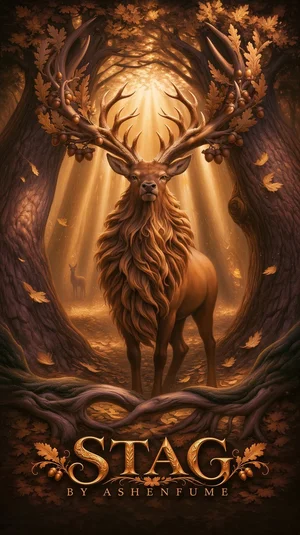 Found in
Stag
The Deer Musk Pod Accord in the base of the house forest chypre.
View the fragrance

IIIThe taiga deer

When Carl Linnaeus named the musk deer in 1758, he gave its home as Tartary toward China, and later zoologists fixed the type in the Altai Mountains of southwest Siberia15. The animal he described was the Siberian musk deer, Moschus moschiferus, the northernmost of the seven species716. Peter Simon Pallas described it again in 1779 as Moschus sibiricus, a name now folded into Linnaeus’s15. The Russians call it kabarga.
Its range is the widest of any musk deer. The typical form runs from the Altai north along the Yenisei to 69 degrees north, down to the middle Lena, over the Verkhoyansk and Stanovoy ranges, and into eastern Kazakhstan, Mongolia and northern China. A smaller form, parvipes, lives in the Russian Far East, the Korean peninsula and northeast China, and another, sachalinensis, on Sakhalin2. A grown animal measures 65 to 90 centimetres from head to rump and 56 to 61 at the shoulder, and weighs 7 to 17 kilograms. Its coat is softer and less quilly than the coats of the southern species2.
Everything about it is built for deep snow and steep ground. The hind legs are much longer than the forelegs, so the back slopes forward, and the animal can bound like a hare. It runs very fast and tires after 200 to 300 metres17. The side hooves are almost the size of the main ones and print in the snow beside them3. Korean naturalists describe them as shaped like high heels, spreading the weight so the deer stays up on deep snow18. The males carry long, curved upper canines in place of antlers. In the females the canines stay hidden in the mouth3.
The musk is a male’s affair. The gland sits on the belly, and an adult’s is about three centimetres wide and four to five deep8. Dried, it is 85 to 90 percent musk8. The TRAFFIC investigators of 2004 used 23 grams as the standard weight of a gland8, and in the Sikhote-Alin Zaitsev gives the adult male’s as 15 to 18 grams5. A young male begins to mark his ground with the gland at his tail at about ten months, in March5.
IVLife beneath the conifers
The Siberian musk deer is a creature of old conifer forest. In the Sikhote-Alin its densest numbers live under closed spruce, fir and Korean pine with a cluttered understorey, and it spends the whole year below about 650 to 750 metres there5. In the Altai it lives far higher, at 1,900 to 2,600 metres8. Rock outcrops give it a refuge from dogs and wolves5.
Winter feeds it on lichen. In the Far East the beard lichens of the trees, Usnea, Ramalina, Evernia and Bryoria, make up 60 to 65 percent of its winter diet, and most of what it eats has fallen from the branches onto the snow5. Across its range, lichens make up about 70 percent of a musk deer’s winter stomach by weight19. To reach more, it climbs. Zaitsev watched females and young climb inclined trunks to about two metres, and a young male to five5.
It lives alone on a small, well-known patch of ground. In the Sikhote-Alin an adult male of three to eight years holds 90 to 380 hectares, about 203 on average, and a female about 39. He patrols his ground and marks it again and again5. Musk deer also mark with the glands of the nose and hooves, with urine and with pellets3.
The rut falls in November and December. Activity rises, the males rest and eat less, and their urination rises one and a half to two times5. The musk gland serves the rut. The secretion of the Siberian musk deer stirs the sexual behaviour of the females20. The young are born at the end of spring and in June, and the northern deer carry more young than the southern species, 1.7 to 1.8 embryos to a female5. In Korea the breeding season runs from early December to early January21.
Its hunters are small and quick. In the Sikhote-Alin from 1962 to 1981 the yellow-throated marten, the kharza, took 68.7 percent of the musk deer that died, and the marten and the lynx together took about nine or ten percent of the population each year5. In Yakutia and the Ussuri country the sable hunts it too2223.

The forest and the lichen
Slaght’s survey of the Sikhote-Alin winter found the same tie between deer and lichen that Zaitsev had seen from the trunks. The musk deer kept to mature and over-mature conifer forest, the forest old enough to carry the hanging lichens, and turned up more often the farther the forest lay from fresh cuts and main roads1.
The Siberian musk lands
The Altai and Sayan. The type country of the species, where the deer lives high, at 1,900 to 2,600 metres158. The Victorian perfumery writer John Charles Sawer gave its musk to a deer he called Moschus altaicus, of the mountains along the Irtysh12.

Krasnoyarsk and the Yenisei. The rock pillars and fir forest of the Stolby reserve, outside Krasnoyarsk, whose musk deer the Soviet post put on a four-kopeck stamp in 1975.
Transbaikalia. The mountain taiga east of Lake Baikal, the country of the Kalarsky deer on the cover of this folio10.
Yakutia and the north. The northern edge of the range, the Verkhoyansk slopes and the middle Lena2, the country of the Evenk reindeer herders, one of whose families took twenty musk deer in a single summer of the 1940s24.
The Amur and Khabarovsk. The largest musk deer population of the Far East lives in Khabarovsk8.
Primorye and the Sikhote-Alin. The densest musk deer country of all, with up to 30 animals to a thousand hectares under the spruce, fir and Korean pine85.
Sakhalin. The island form, sachalinensis, smaller than the mainland deer2.
Korea. The small form parvipes2, called sahyang noru in Korean21. It is Natural Monument No. 216, and lives along the Baekdudaegan ridge and the demilitarised zone18.
Mongolia. The same deer at the southern edge of its range, in the Khentii, Khövsgöl and Khangai, with a folio of its own.
VCabardine, the Russian musk
In the price lists of the nineteenth century, Siberian musk had a name and a place of its own. The chemist and perfume manufacturer George William Askinson sorted all musk by origin into four kinds, Chinese or Tonquin, Siberian or Russian, Assam or Bengal, and Bokharian. A Russian pod was worth about a quarter of a Chinese one, and a special variety of it, weaker and rather urinous, was known as Cabardine9.
The American dispensatory of 1898 adds the road. Siberian musk, also called Russian musk, was exported from St Petersburg. It resembled the Chinese and was often far inferior, with an ammoniacal, somewhat fetid odour. Cabardine came in flat, oval sacs with paler, thinner hairs, and a smell feebler, less aromatic and urinous6. In London the British pharmacists of 1911 found the Cabardine pods flatter and yellower than the Tonquin, and seldom seen on the market13. John Charles Sawer, writing in 1892 for the perfume trade, found the Siberian musk much less powerful, more nauseous and somewhat empyreumatic, the old word for a smoky, burnt note. He also judged the Altai musk rarely adulterated to any extent, at a time when much Chinese musk was opened and refilled in Shanghai12.
A buyer tested any pod the same way. Askinson’s pod was the size and shape of half a walnut. A dilute alkali brought up its odour markedly after a short time, hot water dissolved about eight tenths of it and strong alcohol about a tenth, and a little burnt in an open porcelain dish left about a tenth of its weight as ash9.
Chemistry has since given the grade a profile. When Sokolov and his colleagues analysed the principal lipids of the Siberian secretion in 1987, they found waxes and steroids and no muscone among them, and Zaitsev puts the muscone of Siberian musk at no more than half a percent205. The Chinese pharmacopoeia sets a minimum of two percent for the dried musk it accepts25. The sharp, ammoniacal grade of the old graders is a musk low in muscone.
VIThe perfumer’s musk

In the perfumer’s workroom, musk went into the bottle as a tincture. Askinson’s formula for the Extrait de Musc was two and a half ounces of musk to five quarts of alcohol. He prized it above all for its useful property of fixing other, very volatile odours9. The perfumery chemist Steffen Arctander later set the standard at three percent musk in 90 percent alcohol, often with a little alkali, aged at least six months before filtering14. In 1960 the chemist J. Pickthall described the same slow work to the Society of Cosmetic Chemists. The grains stood in alcohol for several months, and the filtered tincture gave character and tenacity to the finest perfumes26.
Musk worked in small measures. A few centigrams on a scale, Askinson wrote, could fill a large hall with their odour for years9. Sawer valued musk as a basis for toilet perfumes for its stability, and for its great diffusibility he called it the wings of the perfume it was added to12. In a fine perfume, Askinson advised, the musk should always be so small that its presence is not distinctly noticed, and in extreme dilution it scented the finest soaps and sachets9.
His book shows where the tincture went. It entered the amber extracts at a pint and a half to a quart to the batch, and the hunters’ bouquet, the Bouquet à la Maréchale, the double lavender water, the thousand-flower waters, the Spring Nosegay and the Rondeletia in smaller amounts. The grain itself went straight into a few, three grains in the Court Bouquet and eight in the essence of reseda9. Cabardine stood in the same price lists at a quarter of the price of Tonquin, a sharper, more urinous musk that, like every musk, rounded only with long ageing in alcohol914. The amounts are set out in the appendix.
VIIMusk in medicine and culture
Most Siberian musk ended in medicine. In Russia musk was long used as an aphrodisiac and as a folk medicine for convulsions, asthma, abscesses and bruises, and even as a contraceptive8. Western pharmacy shared the habit. In 1898 the American dispensatory described musk as a stimulant to the nerves and circulation and listed it for low fevers, obstinate hiccough, whooping cough, epilepsy, asthma, palpitations and the convulsions of infants, given as a pill or an emulsion at five to twenty grains every two or three hours6. These were the beliefs and practice of their day.
The taiga peoples knew the deer as game. The Nanai, Udege, Ulch and Yakut hunters eat its meat and use its hide8. China valued the gland. Musk is recorded in the Shennong bencao jing, the classic Chinese materia medica, and the Chinese pharmacopoeia today accepts the Siberian musk deer as one of three sources of medicinal musk2725.

Korea built musk into its most famous remedies. The court physician Heo Jun finished the Dongui bogam in 1610, and the royal medical office printed it in 161328. Its recipe for gongjindan, first recorded by the Yuan physician Wei Yilin, takes 160 grams each of deer antler, angelica root and cornelian cherry with 20 grams of musk, powdered and kneaded with honey into pills. Korean physicians have long used musk as a heart tonic, a stimulant and an antispasmodic29. The emergency pill woohwang cheongsimwon gathers some thirty ingredients, and in the Dongui bogam recipe each pill holds 45 milligrams of ox bezoar and 38 of musk. Koreans still take it before examinations and in moments of great strain30.
Siberia filled those pills. Around the turn of the millennium, nearly all the musk legally imported into South Korea came from Russia, and in 1997 a government survey found 129 clinics of traditional medicine holding 486 kilograms of musk between them. About a third of the practitioners asked called musk indispensable8. In 2014 one maker of cheongsimwon was buying its musk from Russia at about 120 million won a kilogram, and making a second version of the pill with civet31.

VIIIThe road to Kyakhta
From 1727 the trade between Russia and China ran through Kyakhta, on the Mongolian border south of Lake Baikal, and by 1800 Russia’s exports through it were worth about 4.2 million roubles a year. Musk crossed that border among the silk, tea and rhubarb4. Zaitsev records that in 1855 Russia sold 81,200 musk glands to China at 500 roubles a pound, and that most Russian musk went east to China, Korea and the other Pacific countries, with some to western Europe5.
Demand rose through the second half of the nineteenth century, and the hunter and writer Alexander Cherkasov recorded in 1884 that trapping musk deer had become an easy, profitable trade for the villages of rural Siberia8. In the Ussuri country the explorer Vladimir Arsenyev noted in 1914 that Chinese hunters took 25,000 to 30,000 glands a year5. When the border with China closed in the mid-1930s, the exports dropped sharply, and in the 1970s and 1980s a Russian hunter received 10 to 12 roubles for a gland85. Around the turn of the millennium the legal Russian musk went to Hong Kong, South Korea, Germany, Singapore, China, Switzerland, France and Japan8.
IXThe thinning forests
The price of the gland has cost the deer dearly. Most are taken by wire, and in Zaitsev’s records snares account for more than 99 percent of the musk deer killed in the Sikhote-Alin. A snare takes whatever walks into it, and for every male with a gland worth taking, three to five musk deer die58. Around 2000 the illegal harvest gave 400 to 450 kilograms of musk a year, against about 72 kilograms taken legally8. In the Ussuriysky reserve, winter routes that found 12 musk deer tracks per ten kilometres in 1987 to 1991 found 0.1 in 2016 to 202023.
The work of return has begun. In August 2025 the ministry of nature of Altai Krai and the Tigirek reserve signed an agreement to conserve the musk deer, part of a plan for a national park to protect it32. The global Red List places the Siberian musk deer as Vulnerable33, and the international convention on wildlife trade watches the trade in its musk34. Perfumery today builds its musks as accords of aroma materials35, and the taiga deer goes on marking its ground among the lichens. The full counts and prices are in the appendix.
Siberian musk through the centuries
- 1613
Heo Jun’s Dongui bogam is printed in Korea, with its musk pills2829.
- 1727
The Russia and China trade settles at Kyakhta, south of Lake Baikal4.
- 1758
Linnaeus names Moschus moschiferus, from Tartary toward China15.
- 1779
Pallas describes the Siberian deer as Moschus sibiricus15.
- 1855
Russia sells 81,200 musk glands to China, by Zaitsev’s account5.
- 1884
Cherkasov records musk trapping as a profitable Siberian village trade8.
- 1892
Askinson prices a Russian pod at a quarter of Tonquin, and Sawer calls the Siberian musk empyreumatic912.
- 1898
The American dispensatory records Russian musk shipped from St Petersburg6.
- Mid-1930s
The border with China closes and the musk exports drop sharply8.
- 1960
Pickthall describes the months-long musk tincture to the Society of Cosmetic Chemists26.
- 1987
Sokolov and colleagues analyse the lipids of Siberian musk20.
- 2012 to 2013
Slaght and Zaitsev track musk deer through a Sikhote-Alin winter1.
Found in
Stag
The Deer Musk Pod Accord in the base of the house forest chypre.
AppendixFor the perfumer
The chemistry, the old formulas, the gland, the counts and the trade behind Siberian musk, set out for reference at the bench. For tinctures, the absolute and the general chemistry of musk, see the appendix of the Deer Musk folio.
Chemistry of the Siberian grain
A low-muscone musk. When Sokolov and his colleagues analysed the principal lipids of the Siberian musk deer’s secretion in 1987, they found no muscone among them20. Zaitsev puts the muscone of Siberian musk at no more than half a percent5. The Chinese pharmacopoeia, which accepts the Siberian deer as a source of medicinal musk, sets a minimum of two percent for dried musk2725. The sharp, ammoniacal character the old graders gave Cabardine sits beside this low muscone6.
| Constituent | Share | Note |
|---|---|---|
| Waxes | 38% | Siberian musk, principal lipids20 |
| Steroids | 38% | Cholesterol, androsterone and related androstanes2036 |
| Free fatty acids and phenols | 10% | 20 |
| (R)-Muscone | Not found among the lipids, 1987. At most 0.5%, Zaitsev | 205 |
| Muscone, forest musk deer for comparison | 2.0% minimum in the pharmacopoeia, 1.66% mean on a Fujian farm | 2537 |
Authenticity. In a 2021 Korean study, two Russian pocket musks judged genuine by experts gave the same chromatographic pattern as the certified standard, along with a distinct violet spot the authors took for a natural musk component38.
Old formulas
How to read the formulas. These are Askinson’s batch quantities of 1892, in the old English measures of his translator. The tincture is his Extrait de Musc, 2½ oz of musk to 5 quarts of alcohol9.
| Preparation | Musk |
|---|---|
| Tincture of musk | |
| Extrait d’Ambre II | 1 quart9 |
| Extrait d’Ambre I | 1½ pints9 |
| Bouquet des Chasseurs | 20 fl. oz9 |
| Couronne de Fleurs | 13½ fl. oz9 |
| Spring Nosegay | 10 fl. oz9 |
| Eau de Mille Fleurs B | ½ pint9 |
| Bouquet à la Maréchale | ½ pint9 |
| Rondeletia Odoratissima | 4¼ oz9 |
| Eau de Lavande Double | 3 fl. oz9 |
| Grain musk | |
| Essence of Reseda | 8 grains9 |
| Eau de Lavande Ambrée | 8 grains9 |
| Court Bouquet | 3 grains9 |
In medicine
| Remedy | Musk | With |
|---|---|---|
| Gongjindan | 20 g to the batch | Deer antler, angelica root and cornelian cherry, 160 g each, with honey29 |
| Woohwang cheongsimwon | 38 mg a pill | 45 mg ox bezoar and some thirty ingredients in all30 |
Musk in Korean clinics, 1997. 129 clinics held 486 kg, and about 32 percent of practitioners surveyed called musk indispensable8.
The gland
| Measure | Figure |
|---|---|
| Size, adult | About 3 cm wide, 4 to 5 cm deep8 |
| Standard weight, TRAFFIC 2004 | 23 g8 |
| Adult male, Sikhote-Alin | 15 to 18 g5 |
| Altai, 1997 to 1998 | 23 to 25 g8 |
| Altai, 2001 | 17 g8 |
| Musk in a dried gland | 85 to 90%8 |
| Drying | About three weeks, pinned with its skin, until no dark liquid comes when squeezed8 |
Counts
How to read the counts. These are the official spring counts of the Russian hunting service as published in 2004. Field surveys put the Far East higher, at about 140,000 animals, so the official figures are a floor8.
| Region | 1998 | 2002 |
|---|---|---|
| Russian Federation | 150,400 | 126,5808 |
| Chita (Transbaikalia) | 25,000 | 18,2108 |
| Khabarovsk | 26,300 to 30,090 | 18,1508 |
| Primorye | 15,000 | 17,0008 |
| Krasnoyarsk | 10,700 | 13,9008 |
| Amur | 12,490 | 4,1508 |
| Sakhalin | 1,100 (1999) | 1,4008 |
| Place | Figure |
|---|---|
| Sikhote-Alin, density | Up to 30 per 1,000 ha8 |
| Eastern Siberia, density | 14 to 25 per 1,000 ha8 |
| Southern Altai, density | 2 to 4 per 1,000 ha8 |
| Sikhote-Alin Reserve | About 3,000 in 1980 to 1982, 2,000 to 2,200 in 2004 to 20055 |
| Altai | Up to 27,000 in the 1980s, 4,000 to 5,000 by 20035 |
| Altai Reserve | About 1,500 in 2019, with the sharpest falls after hard winters39 |
| Ussuriysky reserve, tracks per 10 km | 12.0 in 1987 to 1991, 0.1 in 2016 to 202023 |
| Ussuriysky reserve, sable tracks per 10 km | None in the late 1970s, 17 in 2016 to 202023 |
| Central Sikhote-Alin, winter 2012 to 2013 | 524 musk deer track records of 694 animal signs1 |
| South Korea | Fewer than 5018 |
Trade
| Year | Quota | Legal export |
|---|---|---|
| 1995 | 70 | Not reported |
| 1998 | 35 | Not reported |
| 2000 | 83.3 | 70.88 |
| 2001 | 76.2, with 20.6 from stock | 57.28 |
| 2002 | 65.5 | 25.48 |
| Importer | Kilograms |
|---|---|
| Hong Kong | 205, mostly re-exported to South Korea, Japan and France8 |
| Germany | 628 |
| South Korea | 578 |
| Singapore | 318 |
| France | 228 |
| Measure | Figure |
|---|---|
| Legal harvest, 1999 and 2000 | 3,157 deer, about 72 kg of musk8 |
| Illegal harvest | 400 to 450 kg a year, the musk of 17,000 to 20,000 males8 |
| Share of kills poached | Over 80%8 |
| Snares, Sikhote-Alin | Over 99% of kills, up to 1,100 snares for one hunter5 |
| Deer killed for each usable male | 3 to 58 |
| Females in the catch, Taezhnaya river | 67 to 70%5 |
| Smuggled musk caught by customs | 5 to 7%8 |
| Seizure, February 2026 | 300 glands, 4.7 kg, bound by sea for East Asia40 |
Price
| Year | Price |
|---|---|
| 1855 | 500 roubles a pound, sold to China, by Zaitsev’s account5 |
| 1892 | A Russian pod about a quarter of a Chinese Tonquin pod9 |
| 1970s to 1980s | 10 to 12 roubles a gland, paid in Russia5 |
| 1991 to 1993 | About 5 dollars a gram to hunters8 |
| 1999 to 2002 | 2 to 3 dollars a gram to hunters, 4 to 5 from middlemen8 |
| 1999 to 2001 | About 12 dollars a gram, South Korean import8 |
| Around 2002 | 24 to 36 dollars a gram, South Korean retail8 |
| 2004 to 2006 | 100 to 150 dollars for an adult male’s gland, 70 to 80 for a young male’s5 |
| 2014 | About 120 million won a kilogram, bought from Russia by a Korean maker31 |
| 2019 | About 200 dollars a gram, Altai41 |
| 2026 | 12.3 million roubles for 4.7 kg seized, a customs valuation40 |
The Stag collectionMore from the November forest
 ✦ Folio No. 7
Deer Musk
The whole story of musk, from the musk roads of Tibet to the farms of the Qinling.
Read the folio
 ✦ Folio No. 29
Amber
The Labdanum Amber that keeps the musk glowing in Stag.
Read the folio
 ✦ Folio No. 28
Siberian Fir
The soft fir of the dark taiga, the same forest the musk deer walks.
Read the folio
 ✦ Deer musk by region
Mongolian Deer Musk
The khüder of the larch forests, the Gudderi of Marco Polo and a musk of Mongolian medicine.
Read the folio
 ✦ In Stag
Oakmoss
A lichen of the oak, cousin to the beard lichens the musk deer lives on.
Folio to come
 ✦ In Stag
Orange Blossom
The flower of the bitter orange, honeyed in the heart beside the musk.
Folio to come
✦ ✦ ✦
Sources & image credits41 references
- Slaght J.C., Milakovsky B., Maksimova D.A., Seryodkin I.V., Zaitsev V.A., Panichev A.M. and Miquelle D.G., Anthropogenic influences on the distribution of a Vulnerable coniferous forest specialist: habitat selection by the Siberian musk deer Moschus moschiferus, Oryx 53(1), 174-180 (2019).↑
- Wilson D.E. and Mittermeier R.A. (eds), Moschus moschiferus Linnaeus, 1758, Handbook of the Mammals of the World, vol. 2, Lynx Edicions, Barcelona (2011), via Zenodo.↑
- Musk deer (Moschinae), Grzimek’s Animal Life Encyclopedia, via Encyclopedia.com.↑
- Kyakhta and Kyakhta trade, Wikipedia.↑
- Zaitsev V.A., Kabarga: ekologiya, dinamika chislennosti, perspektivy sokhraneniya (Musk deer: ecology, population dynamics and prospects for conservation), Centre for Wildlife Protection and Sikhote-Alin Biosphere Reserve, Moscow (2006), in Russian.↑
- Felter H.W. and Lloyd J.U., Moschus, King’s American Dispensatory (1898), via Henriette’s Herbal.↑
- Mammal Diversity Database, Moschus moschiferus Linnaeus, 1758, American Society of Mammalogists (2026).↑
- Homes V. (ed.), No Licence to Kill: the population and harvest of musk deer and trade in musk in the Russian Federation and Mongolia, TRAFFIC Europe (2004).↑
- Askinson G.W., Perfumes and Their Preparation, trans. I. Fuerst, Norman W. Henley, New York (1892).↑
- Ivanov D., Siberian musk deer, Kalarsky district, Zabaykalsky Krai, 14 September 2024, iNaturalist observation 245048248.↑
- Avenas P., À propos de la muscone et de la muscarine, L’Actualité Chimique 507, Société Chimique de France (2025).↑
- Sawer J.Ch., Odorographia: a natural history of raw materials and drugs used in the perfume industry, vol. 1, Gurney and Jackson, London (1892), chapter on the odour of musk.↑
- Moschus, The British Pharmaceutical Codex (1911), via Henriette's Herbal.↑
- Arctander S., Perfume and Flavor Materials of Natural Origin, Elizabeth, New Jersey (1960), entries for musk and tincture.↑
- Grubb P., Moschus moschiferus moschiferus Linnaeus 1758, in Mammal Species of the World, 3rd edition (2005), via Zenodo.↑
- Mammal Diversity Database, Moschidae, American Society of Mammalogists (2026).↑
- Huffman B., Siberian musk deer, Moschus moschiferus, Ultimate Ungulate fact sheet.↑
- Green Korea and Hankyoreh, The musk deer, endangered and seen only as money, Wildlife Record series (7 March 2023), in Korean.↑
- Mulder J., Moschus moschiferus, Siberian musk deer, Animal Diversity Web, University of Michigan Museum of Zoology (1999).↑
- Sokolov V.E. et al., Musk deer (Moschus moschiferus): reinvestigation of main lipid components from preputial gland secretion, Journal of Chemical Ecology 13, 71-83 (1987).↑
- Oh H.-S., Sahyang noru (musk deer), Encyclopedia of Korean Culture, Academy of Korean Studies (2024), in Korean.↑
- Argunov A.V. and Tirsky D.I., Cases of sable (Martes zibellina) hunting musk deer (Moschus moschiferus) in Yakutia, Zoologicheskii Zhurnal 101(6), 703-708 (2022), in Russian.↑
- Maslov M.V., Litvinov M.N., Litvinova E.A. and Markova T.O., Possible causes of the decline of the musk deer Moschus moschiferus in the Ussuriysky Reserve, Sibirskii Ekologicheskii Zhurnal 6, 832-838 (2023), in Russian.↑
- Argunov A.V. and Safronov V.M., New data on the distribution of musk deer (Moschus moschiferus) in Yakutia, Izvestiya RAN, Biological Series 5, 549-554 (2022), in Russian.↑
- Chinese Pharmacopoeia Commission, Moschus (she xiang), Pharmacopoeia of the People’s Republic of China, vol. I (2020), via ShennongAlpha, Westlake University.↑
- Pickthall J., The musk odour, Journal of the Society of Cosmetic Chemists 11(7), 423-424 (1960).↑
- Liu K., Xie L., Deng M., Zhang X., Luo J., Li X., Zoology, chemical composition, pharmacology, quality control and future perspective of musk (Moschus): a review, Chinese Medicine 16, 46 (2021).↑
- Dongui bogam, Encyclopedia of Korean Culture, Academy of Korean Studies, in Korean.↑
- Kim D.-R., Gongjindan suits the Taeeum constitution, Weekly Kyunghyang (16 October 2012), in Korean.↑
- Woohwang cheongsimwon and cheonwang bosimdan, Geonganghan Iut, November and December 2007, p. 45, in Korean.↑
- Holding to natural musk and bezoar, Daily Pharm (19 December 2014), in Korean.↑
- In Altai, a national park is proposed to save the musk deer, Altapress, Barnaul (2025), in Russian.↑
- Siberian musk deer, Wikipedia.↑
- Convention on International Trade in Endangered Species, Appendices I, II and III, archived January 2009, University of North Texas web archive.↑
- Musk, Wikipedia.↑
- German Sport University Cologne, Department of Biochemistry, Musk deer: secretions from the musk glands, Doping Glossary.↑
- Lu X. et al., Musk yield and muscone content of captive forest musk deer at Zherong, Fujian, Chinese Journal of Ecology 44(7), 2297-2303 (2025).↑
- Cho C.W., Gao D., Kang J.S., Jung H.W. and Park Y.-K., Quality comparison of musk products using a chromatographic pattern analysis, Korean Journal of Herbology 36(4), 41-50 (2021), in Korean.↑
- Kalinkin Yu., Musk deer of the Altai Reserve: experience of counting, Altai State Nature Biosphere Reserve (2019), in Russian.↑
- Federal Customs Service of Russia, Far Eastern customs seize 300 musk deer glands, press release, republished 9 February 2026.↑
- Bargain H., Russian poachers are going after musk, the gold of Siberia, The Moscow Times (20 December 2019).↑
Photographs
Autumn taiga in the Stolby reserve: T0n-whale, CC BY-SA 4.0. Siberian musk deer, Kalarsky district: Dmitry Ivanov, CC BY 4.0. Winter in the Wild Stolby: Alfir Fakhraziev, CC BY-SA 4.0. Musk deer after Richard Friese, Brockhaus and Efron: public domain. Mountains of the central Sikhote-Alin: Olga Ukhvatkina, CC BY-SA 4.0. Soviet stamp of 1975, the musk deer of the Stolby reserve: Post of the Soviet Union, public domain. Musk pod from Guibourt, Histoire naturelle des drogues simples: public domain. Dongui bogam in the National Museum of Korea: Ulrich Lange, CC BY 4.0. Caravan at Kyakhta after Thomas Witlam Atkinson, Le Tour du monde (1863): public domain. Musk deer in Sagarmatha National Park: Sangyam adventurer, CC BY-SA 4.0. Labdanum coils, Deutsches Apotheken-Museum, Heidelberg: Zinnmann, CC BY 4.0. Siberian fir near Beloretsk: Aleksandr Zykov, CC BY-SA 2.0. Larches in October east of Ulaanbaatar: Mongolia Expeditions, CC BY 3.0. Oakmoss at Myrstigen: W.carter, CC0. Bitter orange blossom: Zeynel Cebeci, CC BY-SA 4.0. All via Wikimedia Commons. Stag key art: Ashenfume.
Join the discussionHave you walked the taiga in winter, held an old Cabardine pod or taken a musk pill in Seoul? Add what you know, or ask a question.