Provenance Materia Hay
MATERIA · THE STAG COLLECTION
Hay
The sweet grass of the mountain meadows, from the hay barns of the Alps to the first fougère
Over two days in June 2023 a jury walked the mown meadows of the Queyras, high in the French Alps: an agronomist, a botanist, a beekeeper and the president of the regional park's scientific council, led by Patrick Gauthier, who raises beef cattle at Vars. One meadow they judged belongs to Franck Tonda of Aiguilles. It lies at 1,900 metres, an hour by tractor from his farm, thick with aromatic plants and never fertilised. The prize went to the Gaec du Val d'Azur at Arvieux, for two hectares of north-facing meadow mown late in the season1. That September, at the fair of Le Monêtier-les-Bains, Alain Prorel sharpened his scythe and mowed by hand as his father had taught him, while Pierre Savoldelli's mare, Alaska, drew a mower across the grass at about 3,000 square metres an hour2. Some forty farmers still mow about 1,000 hectares of meadow in the Queyras, to feed their herds through the long winter indoors1. Cut and dried in the sun, the grass of meadows like these is hay. Drawn out with a solvent and washed with alcohol, it becomes one of the sweetest materials in perfumery, hay absolute.


IWhat it smells like
Hay absolute begins as a meadow drying in the sun. The house keeps two, both French and both from mountain hay, and each has its own character on the blotter.
- The drying meadow
Cut grass gives off its sharp green molecules within minutes, the smell of a mown lawn8. As the swath dries in the sun the coumarin comes, strongest in the late afternoon and evening9.
- French mountain hay
Olive green to brown, thick, and pourable once warmed. Gourmand from the first breath: coumarin over sweetened mate and clary sage, with honey, plum jam and a shading of cocoa. Marzipan and chamomile lift the opening, and green tea and a wheatfield come through as it settles.
- High Alps hay
Brown green, and so thick it usually comes thinned. Warm and radiant: honey and cured tobacco over the coumarin, sweet dry grass and chamomile, dried apricot and a powdery green, with a faint animal warmth underneath.
- The long drydown
The French mountain absolute stays sweet for many hours. The High Alps absolute thins to a well-dried haystack, a little bitter, as its animal warmth fades, and holds on a strip for more than two weeks.
IIIn the house
The house keeps two hay absolutes, both made in France from the hay of mountain meadows, and uses them as a pair. The first is drawn from dried French mountain grasses. It is the gourmand one, coumarin, sweetened mate and clary sage with honey, plum jam and cocoa, as its makers describe it. The second comes from hay of the High Alps. It is the one for dried grass and cured tobacco, honeyed and radiant, with the chamomile and dried apricot its buyers find in it.
In Stag
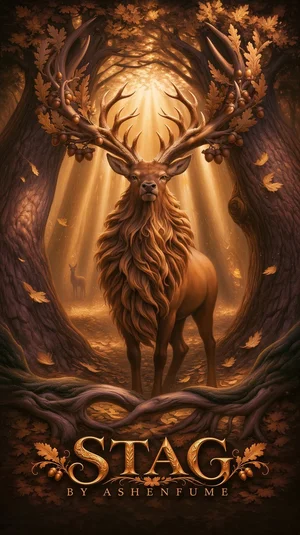
Stag opens cold, on Scots pine, Siberian fir and black spruce, with bitter galbanum and a warm turn of mandarin. Its base is warm and animal: the Deer Musk Pod Accord, oakmoss, sandalwood and labdanum amber. Hay lies between them in the heart, beneath orange blossom, and carries the perfume from the one to the other. It is an absolute drawn from meadow grasses cut in late summer and dried in the sun, and it smells of honeyed straw and cured tobacco leaf. Much of Stag's golden amber colour comes from it. A little hay also runs through the Deer Musk Pod Accord, part of the dried leather and hide of the pod. Hay is grass cut in summer and stored to feed the herds through the winter. In Stag it does the same work, the warmth of a summer meadow kept for a forest in November.
 Found in
Stag
Hay in the heart of the house forest chypre, between the cold conifers and the warm musk.
View the fragrance

IIIA meadow of many grasses

Hay is grass cut and dried to feed animals through the winter. The English word comes from the Old English hēg, from a Germanic word for that which is cut, kin to hew11. The French foin comes from the Latin fenum12, and the same Latin word survives on the spice shelf. Fenugreek is faenum graecum, Greek hay, and fennel is faeniculum, little hay13.
A hay meadow holds dozens of plants, grasses, clovers and flowers together, and its smell comes mostly from a few of them. Perfumers have always known the material simply as new-mown hay. In 1960 the chemist Steffen Arctander, whose survey of natural materials remains the perfumer's reference, headed his entry Hay Absolute, explained that the hay meant is new-mown hay, foin coupé, and named no single species4.
Sweet vernal grass
One grass carries most of the sweetness. Carl Linnaeus named sweet vernal grass, Anthoxanthum odoratum, in 175314, and both halves of the name describe it: a fragrant grass with early, yellowish flowering heads3. The French call it flouve odorante or foin d'odeur, scented hay14. It grows in tufts 20 to 50 centimetres tall, with a dense, narrow flowering spike15, and it is among the first grasses of the year to flower, from April into July16.
Its scent is coumarin, and it gives hay its characteristic smell3. Britain's wild plant charity places that smell somewhere between vanilla and almond17. In June its leaves can hold more than 2.5 percent coumarin by dry weight18. Farmers valued it little as fodder. In 1816 George Sinclair's survey of the grasses grown at Woburn judged it unproductive, and still it stayed in the seed mixtures for permanent pasture, because good hay was expected to smell of it3.
The holy grasses
Its nearest relatives are the holy grasses, named Hierochloë, holy grass in Greek, by the Scottish botanist Robert Brown in 18101920, and joined to Anthoxanthum by two botanists in 198521. Holy grass, vanilla grass or bison grass, long known as Hierochloe odorata, is now Anthoxanthum nitens2223. It grows in the French Alps, in the Écrins and the Mercantour2422, and it has been protected across France since 198225. Alpine sweetgrass, Hierochloe alpina, the name some registries give for hay absolute, is a plant of the far north2627, recorded on French soil only at Saint-Pierre-et-Miquelon, off Newfoundland28. Arctander's answer still holds. Hay absolute is the extract of meadow hay, mixed grasses with their flowers and clovers, and its sweetness is the coumarin of sweet vernal grass43.
A meadow made by mowing
A hay meadow is half wild and half made. In the mountains of Europe the old meadows were cleared from forest and kept open by mowing once or twice a year, a little manure and light grazing late in the season, and left alone they turn to scrub29. European law protects the species-rich mountain hay meadows, usually above 600 metres30, and sweet vernal grass is one of their characteristic plants2931. In the French Alps, when mowing stops, a coarse fescue takes over and the variety of plants falls sharply32. The Queyras jury praised Franck Tonda for keeping that fescue, the queyrel of the valley, in check without fertiliser1.
A good meadow is crowded. An old English hay meadow can hold fifty kinds of plant in a square metre33. Yellow rattle, a meadow flower, taps the roots of the grasses around it and thins them, letting other flowers in, and farmers took the rattle of its ripe seeds in their dry pods as the sign that the hay was ready to cut34.

Why one meadow smells unlike another
Three things set the scent of a meadow: the land, the plants and the cut. When scientists compared hay from Austria, Italy and Switzerland, they found its scent made mostly of terpenes, with coumarin, acetic acid and linalool. The coumarin alone told hay grown north of the main chain of the Alps from hay grown south of it, and the acetic acid told apart hay from two districts of South Tyrol, Kastelruth and the Passeier valley35.
The plants change with the land. The watered meadows of the Crau, on the stony plain east of Arles, are thick with false oat-grass, cocksfoot and clover36, and the Queyras meadows the jury walked are full of aromatic plants1. In medicinal hay flowers the coumarin rises and falls with the share of clover37. The season counts too. In Alpine hay the second cut, the aftermath, carried more of the floral, lavender-scented linalool than the first3538.
Hay absolute carries the same signature of place. Both of the house's absolutes are French and both are mountain hay, one from dried grasses of the French mountains and one from the High Alps, and the first chapter sets their two characters side by side.
IVWhen the grass is cut
A living meadow smells only faintly sweet. The London perfumer G.W. Septimus Piesse noticed in 1857 that tonka beans and vernal grass are nearly scentless while they grow and turn aromatic once they are cut39. The coumarin is there, locked away. In the leaves of sweet clover, where the chemistry was worked out, the plant stores it as an odourless compound bound to a sugar, kept inside the cell's central vacuole, and the enzyme that frees it waits outside, in the spaces between the cells40. Many plants store their coumarins this way, ready for the moment a cell is broken41. When a leaf is chewed, cut or dried, the two meet. The enzyme strips off the sugar, and the freed acid curls shut on itself into coumarin42. Light drives one step of the chain43.
Drying does the rest. Sweet clover leaves dried at 40°C turned up to about 90 percent of their stored form into free coumarin, and leaves dried at 30°C made little44. That is the smell of a hayfield on a hot afternoon. The chemist G.S. Clark noted in 1995 that freshly cut grass drying in the sun gives off a coumarin odour in the late afternoon and evening, and by the next morning it has gone9.

Two smells, one after the other
The first smell of mowing comes before any coumarin. A cut blade of grass makes a family of small six-carbon molecules from the fats in its own cell walls, the green leaf volatiles, and they rise and fade in turn within the first minutes, from the sharp green of (Z)-3-hexenal to the grassy (Z)-3-hexenol and the fruity hexenyl acetate8. They are distress calls. In low doses they prime neighbouring plants for attack, and they draw in the parasitic wasps that lay their eggs in caterpillars46.
Cut grass and clover give off a first burst of these molecules, then a second, stronger release that lasts for hours as the swath dries47. On a mown meadow in Austria's Stubai valley the flow peaked on the day of cutting and faded by the third or fourth day48.
A bitter defence
For the plant, the sweetness is a weapon. Coumarin tastes bitter to livestock49, and in feeding trials blister beetles offered sweet clover leaves high and low in coumarin chose the low ones50. Sweet vernal grass turns the same chemistry on its neighbours. In Japanese grasslands, where it has spread into the native turf, coumarin is the main agent that holds back the seedlings of the native Zoysia grass, and after rain it washes out of the grass's dead leaves into the soil1851.
VThe labours of summer
The Romans wrote down how to make hay, and their instructions still hold. In the first century BCE the scholar Varro told farmers to cut the hay when the grass stops growing and starts to dry in the heat, to turn it with forks, tie it in bundles when it is dry and carry it to the barn52. A century later Columella warned that hay dried too far is no better than straw, and hay put away too green rots in the loft, grows hot and can catch fire53. Pliny the Elder set the mowing at about the first of June, when the grass ear begins to shed its flower, and wrote that a rick built before the hay is dry steams in the morning and bursts into flame once the sun is up. One man, he reckoned, could mow about a quarter of a hectare in a day54.

By the Middle Ages haymaking had its own month in the calendar of labours painted into books of prayer. The most famous is in the Très Riches Heures of Jean, Duke of Berry, painted from 1412 to 1416 by the Limbourg brothers55 and kept today in the Musée Condé at Chantilly57. On the page for June, two women rake the mown hay on the bank of the Seine and pile it with a pitchfork into small stacks, while men mow in the middle distance, bare-legged, under knotted kerchiefs and straw hats56.
A century and a half later Pieter Bruegel the Elder painted the same labour on a grander scale, in the Haymaking of 1565 that opens this journal, made for the country house of the Antwerp merchant Niclaes Jongelinck10.
In the high meadows
In the Alps much of the work is still done by hand. In Switzerland about 4,000 hectares of Wildheu, wild hay, are still cut by hand on remote slopes too steep for cattle, generally above 1,500 metres. The mowers work with scythes, rakes, climbing irons and ropes, and carry the hay down on their backs in bundles or nets of 50 to 60 kilograms, by sledge, by cable or by helicopter. Cantonal corporations set the first day of mowing, around July, so that no one cuts too early58.
The French Alps keep the same calendar. Above Villar-d'Arène, below the Col du Lautaret, the old hay terraces lie at 1,900 to 2,100 metres, and when farmers began to give the meadows up they left the steepest and hardest to reach first32. Julie and Sylvain Protière, who took over the Ferme du Lautaret in 2019 with about thirty Hérens cows, spend several weeks of every summer haymaking, Sylvain working the steep slopes with a motor mower and an old-fashioned rake59.
VIThe fragrant grasses
Where the sweet grasses grew wild, people kept them close. In Germany holy grass was strewn outside the churches on feast days20. In Norway it was called marigras, Mary's grass, a name the bishop and naturalist Johan Ernst Gunnerus recorded in 1772. Norwegians and Sámi wore it in their caps and kerchiefs for church, for Easter, for weddings and for courting. They laid it among the linen in their chests to scent it and keep the insects off, hung braids of it in their houses, and used it to flavour tobacco and snuff. In southeastern Norway the dried sweet vernal grass was brewed as fjell-te, mountain tea20.
Across the Atlantic, sweetgrass is a sacred plant. Its leaves are usually plaited into a long braid and burned as a purifying smudge. The Siksika, the Blackfoot, call it sipátsimo and burn it at daily prayer and at the Sundance, and in the Anishinaabe language it is wiingaashk. The Haudenosaunee, Mi'kmaq and Wolastoqiyik weave it into baskets60. In Poland the same grass scents a vodka. Żubrówka is a rye vodka flavoured with bison grass, named for the bison of the Białowieża Forest, documented from the sixteenth or seventeenth century and made under that name since 1928. Each bottle holds a single dried blade, because the grass must be dried to release its scent6162.
Hay flowers and hay baths
Hay was also medicine, as belief and practice. The Bavarian priest Sebastian Kneipp of Wörishofen, whose book on the water cure first appeared in 188663, prescribed hay flowers, the leaves, flowers and seed that fall from hay, as foot baths and sitz baths64, and his followers swept them from the hayloft floor for hot packs65.
In South Tyrol the hay itself became the bath. At Völs am Schlern, the local story goes, farmers who slept in the hayloft during the mowing woke with their tiredness gone66, and guests have come to lie in the hay for more than a hundred years67. The grass comes from meadows never fertilised. Moistened, it ferments and heats to 40 to 60°C, and bathers lie wrapped in it for about twenty minutes, among arnica, lady's mantle, thyme and gentian68.

VIIThe birth of the fougère
The molecule behind the smell of hay was found twice in the same year. In 1820 the Munich chemist A. Vogel drew crystals from the tonka bean and from the flowers of melilot, or sweet clover, and took them for benzoic acid69. That same year the French pharmacist Nicolas Guibourt argued that the crystals between the two halves of the tonka bean were something new, and in 1826 he named them coumarine, from coumarou, an Amerindian name for the tonka tree70. In 1835 the chemist Guillemette showed that the crystals of melilot were the same substance71.
Perfumers already knew the smell. In 1857 Piesse wrote that fresh tonka beans have an intense odour of newly made hay, and that the vernal grass to which new hay owes its smell probably holds the same principle. His tincture of tonka, a pound of beans to a gallon of spirit left a month in the summer heat, led a bouquet called Bouquet du Champ, prized for its likeness to a hayfield72. From the late 1850s to the First World War, by M. Raffard's cultural history of 2025, the smell of new-mown hay fascinated the wealthy of Britain, France and America73.
Chemistry soon made the smell cheap. In 1868 the English chemist William Henry Perkin published the first synthesis of coumarin74. Coumarin entered perfumery in 188275, the year Paul Parquet composed Fougère Royale, whose accord of synthetic coumarin with lavender and oakmoss founded the fougère, the family of perfume named for a fern7677. The fern has a scent of its own. In 2011 French chemists found 7.4 percent coumarin in the beech fern, and named coumarin and the cut-grass molecules among the main odorants that French ferns and fougère perfumes share78.
The absolute came later and stayed small. In 1960 Arctander recorded hay absolute as made only in France, in very limited quantities, for a weak demand, though the raw material was plentiful4.
When sweet clover turned poisonous

Coumarin has one darker chapter, and it begins in spoiled hay. In the early 1920s cattle in Ontario and North Dakota began dying of a bleeding disease. The veterinarian Frank Schofield of the Ontario Veterinary College traced it to sweet clover hay that had gone mouldy, and showed that the blood of cattle fed on it was slow to clot8081. On a Saturday in February 1933, in a blizzard, a Wisconsin farmer named Ed Carlson drove about 190 miles to Madison with a dead heifer, a milk can of blood that would not clot and about a hundred pounds of the spoiled hay82. He found the biochemist Karl Paul Link83, whose laboratory isolated the poison in 1939 and identified it in 1940 as dicoumarol, two coumarin units joined by a single carbon82. A later variant became warfarin, a rat poison from 1948 and a medicine from 19548381.
The difference matters for the perfumer. Coumarin itself leaves the blood to clot as usual45. In damp, mouldy sweet clover, fungi turn its precursor into 4-hydroxycoumarin, and formaldehyde bridges two of those molecules into dicoumarol84. The danger lies in hay put up wet. Animals grazing even high-coumarin sweet clover in the field are safe85, and the moulds do their work in hay baled before it is dry4986. The appendix sets out the full chronology.
VIIIFrom meadow to absolute
Hay for the extractor is made the same way as hay for the barn, and the making sets its smell. Freshly cut grass is about 80 percent water. Its cells keep breathing and burning their sugars until the moisture falls to about 30 to 40 percent, and rain in the first two days washes the goodness out of it87. So the swaths are tedded, tossed and spread to dry, and later raked into windrows, both jobs done in the morning before the dew is gone88. Finished hay holds at least 85 percent dry matter88, and in store it settles to about 12 percent moisture, or it moulds89. In the sun the green molecules of the cut fly off and the coumarin comes out844.
The sweat of the barn
Dry hay goes on changing in the stack. A new stack sweats, warming to about 60°C a few days after baling, with little harm. Hay put up too wet goes further, and most hay fires break out within six weeks of baling89, as Columella and Pliny warned5354. Above about 77°C hot hay begins to brown, by the same reaction that browns bread crust, and the damaged hay turns golden to caramel and smells sweet, of tobacco90. Farm advisers in Alberta know heat-damaged fodder by its cured-tobacco odour91.

Into the extractor
Arctander recorded that the hay is extracted with petroleum ether, which dissolves its scent with its waxes and pigments, and that this first extract, which the trade calls a concrete, is washed with alcohol to give the absolute4. By the international standard, the extract is dissolved in ethanol, chilled and filtered to take out the waxes, and the ethanol is distilled off92.
What remains is dark and thick. Arctander found commercial hay absolutes viscous liquids of dark amber, dark green or brownish green, and some lots soft masses of olive brown. Their scent was powerful, very sweet and diffusive, coumarin-like and faintly herbaceous, with a jam-like undertone of figs or preserved prunes. He also knew a pale hay oil, probably distilled from the extract at very low pressure, sweet and herbaceous, like clary sage, wet tea leaves and hay4.
IXThe perfumer's hay
In the old perfumery trade, new-mown hay was a perfume before it was a material. Piesse built his Bouquet du Champ on extract of tonka in 185772. In 1892 G.W. Askinson wrote that the favourite perfumes called new-mown hay were mixtures of essences and extracts, and that every one of them must hold tincture of tonka, because coumarin gives the keynote of hay. His own New-Mown Hay took a quart each of triple rose, geranium, jasmine, orange flower and rose, with two quarts of tonka tincture, and some perfumers added a pint of cassie for a greenish colour. A second version steeped tonka beans and orris root with vanillin, bergamot, a few drops of neroli, rose, lavender and clove, and a pinch of nettle and patchouli herb, for two weeks93. Tonka ran through the chypre of the day too. Piesse's Eau de Chypre carried extract of tonka bean beside musk, vanilla and orris in rose spirit39. The formulas are in the appendix.
When the absolute came, perfumers set it to the same work. Arctander placed hay absolute in new-mown hay bases with flouve, melilot, tonka, woodruff and deertongue, and as a herbaceous-sweet undertone in lavender, fougère, chypre, colognes, tea, tobacco and forest notes, with interesting effects in jasmine and orange flower. The pale hay oil went into citrus colognes, lavender fougères, orange flower bases and masculine fragrances, beside clary sage, champaca, mimosa and bergamot4.
The sweet grasses of the bench
Hay absolute has always had kin. Flouve absolute, from sweet vernal grass alone, was for many years made by a single house in Grasse, at under 200 kilograms a year. It is very sweet and herbaceous, with notes of licorice, roots and moss and an exceptional tenacity6. Melilot develops its smell only as the plant dries and its stored compounds release their coumarin79. Woodruff, the May-wine herb, was extracted in small batches in the south of France94. Deertongue, from the sandy pine flats of the American southeast, was dried in the sun on blankets and sold by the bale95. Tonka, the bean that gave coumarin its name, holds 20 to 47 percent in its absolute967.
Hay and tobacco
The sweet grasses and tobacco have long kept company. Norwegians flavoured their tobacco and snuff with holy grass20, and Piesse warned that tonka used without care makes a perfume snuffy, from its familiar use in snuffboxes39. Deertongue went mostly to the tobacco companies95, and laboratory studies of drying sweet clover were expected to serve the drying of deertongue for that trade44. Perfumers describe flouve absolute as sweet and tobacco-like, and in 2009 the chemist Brian Lawrence wrote that it recalls certain English pipe tobaccos697. Hay takes the same turn in the barn, toward the cured-tobacco smell of heated fodder91, and Arctander set hay absolute into tobacco notes as readily as into lavender and chypre4.
Where the sweetness lives

Coumarin is a small molecule, a benzene ring fused to a lactone ring, and on its own it smells sweet and aromatic, like creamy vanilla bean with nutty tones9. French chemists simply call its odour that of freshly cut hay98. The industry gives hay absolute about 8 percent coumarin as its indicative figure7. Drying turns the single note of the grass into a chord. An oil distilled from freshly cut sweet vernal grass in Italy was 96.3 percent coumarin. Made into hay first, the same grass gave an oil of 46.8 percent coumarin, the rest fatty acids, octanol, p-vinylguaiacol and phytol97.
A small share can carry a large part of the smell. In 1978 the chemist G. Ohloff defined a molecule's odour value as its concentration divided by the lowest concentration the nose can detect, and he counted β-ionone among the molecules whose threshold is extremely low99. A distillate of one flouve absolute held 68 percent coumarin, 9.7 percent carvacrol and 3.1 percent β-ionone, which smells of violet and raspberry, with smaller shares of phenylethyl alcohol, eugenol and γ-nonalactone9738. By Ohloff's measure those few percent of β-ionone count for far more in the nose than their share of the bottle.
Stretching and testing
A material so close to one cheap molecule invites stretching. Arctander listed what hay absolute may be cut with: deertongue, flouve, melilot, tonka and woodruff extracts, synthetic coumarin and the methylcoumarins. Some products sold under the name were blends, and true hay absolutes existed too4. Laboratories now read such blends in their isotopes. A plant stamps the molecules it makes with a ratio of heavy to light carbon and hydrogen that differs sharply from the same molecule made from petroleum100, and in 2025 chemists published the signature of natural coumarin from tonka oil, a reference point for the test101. Coumarin is also one of the fragrance materials named on cosmetic labels in Europe, and the industry's limits count the coumarin that hay absolute brings with it1027.
XThe worth of a meadow
Hay itself is one of the cheapest crops on a farm. In 2024 first-cut meadow hay sold for 64 to 69 euros a tonne in western France103, and in the drought of 2026 the price passed 200 euros104. Synthetic coumarin has long been cheap too, about seven dollars a pound in 1995, when no natural coumarin was being isolated commercially at all9. The value of hay absolute lies in the meadows and the people who keep them.
Those meadows are thinning. More than 97 percent of Britain's hay meadows have vanished since the 1930s33. In France the corncrake, which nests on the ground in the tall grass, fell from 2,450 singing males in the early 1980s to 223 in 2020, as early, fast mowing destroyed its nests and chicks105, and the Queyras park counts its mown meadows among the rare natural meadows of France that are slowly disappearing1. Others are being won back. At Molln, in Upper Austria, steep meadows hold more than 120 species in 1,000 square metres, and the volunteers of the Bergwiesn association, who began with four hectares in 2015, now keep more than 110. In August 2025 fourteen of them raked hay and scythed thistles there under a blazing sun106.

In the Queyras some forty farmers still mow about a thousand hectares, some of it an hour by tractor up the mountain, so that their herds can eat through the long winter indoors1. In the Swiss Alps the wild-hay mowers still carry the crop down on their backs58. Arctander knew hay absolute as a French material made in very limited quantities4, for the perfumers who want the whole meadow in the bottle. Hay is summer stored for winter, and a hay absolute carries that summer into the cold months.
Hay through the centuries
- 1st century BCE
Varro sets down how to cut, turn and store hay52.
- 1412 to 1416
The Limbourg brothers paint the June haymaking of the Très Riches Heures55.
- 1565
Pieter Bruegel the Elder paints Haymaking for Niclaes Jongelinck10.
- 1753
Linnaeus names sweet vernal grass14.
- 1772
Gunnerus records the Norwegian name marigras, Mary's grass20.
- 1820
Vogel draws coumarin crystals from tonka and melilot69.
- 1826
Guibourt names coumarin, after the coumarou tree70.
- 1857
Piesse ties the scent of new hay to the tonka bean72.
- 1868
Perkin publishes the first synthesis of coumarin74.
- 1882
Fougère Royale founds the fougère on coumarin76.
- 1886
Kneipp's book on the water cure first appears, with its hay flower baths6364.
- 1933
Ed Carlson drives his spoiled sweet clover hay to Madison82.
- 1960
Arctander records hay absolute as made only in France4.
- 2016
Austrian hay milk is registered as a traditional speciality107.
Found in
Stag
Hay in the heart of the house forest chypre, beneath orange blossom.
AppendixFor the perfumer
The forms, the chemistry, the cut and the haymaking, the hay lands, the bleeding disease, the rules and the record behind hay absolute, set out for reference at the bench.
- Forms
- Coumarin in the plant
- The cut swath
- Key molecules
- The coumarin family
- Yields
- Haymaking
- The hay lands
- The bleeding disease
- Rules
- Authenticity
- Old formulas
- The accord
- The record
Forms & raw materials
| Form | How it is made | Character | Source |
|---|---|---|---|
| Hay absolute | Dried new-mown hay extracted with petroleum ether, the extract washed with alcohol | Viscous, dark amber, dark green or brownish green, some lots a soft olive-brown mass. Very sweet, diffusive, coumarin-like, faintly herbaceous, jam-like (figs, prunes) | 4 |
| Hay oil | Probably the petroleum ether extract distilled at very low pressure. Grasses unnamed by its makers | Pale amber or pale yellow. Sweet-herbaceous, tea-like, clary sage and wet tea leaves, floral-woody dryout. Some lots show no coumarin note | 4 |
| Flouve absolute | Sweet vernal grass, solvent extracted, long made by a single Grasse house | Greenish amber to brownish yellow. Very sweet, herbaceous, tobacco-like, coumarinic, licorice, root, slightly mossy, exceptional tenacity. Under 200 kg a year | 6 |
| Flouve oil | Steam distillation of the dried upper grass, cut during or after flowering | Light amber to pale orange-yellow, viscous, high specific gravity. Intensely sweet, coumarinic, hay-like. A few hundred kg a year | 6 |
| Melilot extract | Petroleum ether or benzene, also chlorinated solvents. England, France, Germany, the Soviet Union | Viscous dark green. Coumarin beyond saturation in the absolute | 79 |
| Woodruff absolute | Petroleum ether concrete, washed with alcohol. No oil by steam distillation | Viscous dark green. Small batches in the south of France | 94 |
| Deertongue oleoresin | Hydrocarbon solvent on the sun-dried leaves, picked from June to the first frost | Dark green, very viscous. A few tonnes a year | 10895 |
| Hay flowers | Flowers, seeds and small leaf and stem pieces of meadow plants, sieved several times | Coumarin set by the share of clover flowers. Used as a warm sack at about 42°C | 37 |
Naming. The registry number 8031-00-3 covers hay absolute, hay oil and foin absolute, and its definition names Hierochloe alpina26. One database files the same number under perennial ryegrass, Lolium perenne109. A separate inventory entry, EC 295-758-4, covers extracts of Hierochloe alpina alone110, and the European cosmetic ingredient name for sweet vernal grass is Anthoxanthum odoratum leaf/stem extract111. Kew's world grass flora gives alpine sweetgrass in Europe only in the north and east112, under its current name Anthoxanthum monticola27112. Arctander's hay is simply new-mown hay4.
Concrete or resinoid. The international vocabulary of natural raw materials defines a concrete as an extract of fresh plant material and a resinoid as an extract of dried material, and an absolute as the ethanol-soluble product of either113, so hay's first extract is strictly a resinoid. Its current edition adds that the ethanolic solution is cooled and filtered to remove waxes before the ethanol is distilled off92. The trade still calls the first extract of hay a concrete4.
Coumarin in the plant
| Material | Basis | Coumarin | Source |
|---|---|---|---|
| Sweet vernal grass, leaves | Dry weight, June, Japan | Over 2.5% | 18 |
| Southern sweet-grass, Hierochloe australis | Dry leaves, wild Polish population | 223 mg per 100 g (62 and 106 when cultivated) | 114 |
| Oil of fresh sweet vernal grass | Distilled, Lodi, Italy | 96.3% | 97 |
| Oil of the same grass made into hay | Distilled | 46.8% | 97 |
| Flouve absolute | Distillate of a commercial lot | 68.0% | 97 |
| Dried melilot herb | 96% ethanol maceration, per 100 g of plant | 316 mg | 115 |
| Sweet clover leaves | Dried at 40°C | Up to about 90% of the bound form freed | 44 |
The pathway. In white sweet clover the chain runs phenylalanine, trans-cinnamic acid, o-coumaric acid, the trans glucoside (melilotoside), then the cis glucoside. In damaged tissue an endogenous β-glucosidase hydrolyses the cis glucoside to coumarinic acid, which lactonises on its own to coumarin42116. Light drives the trans to cis step43. More than 90 percent of the glucosides sit in the mesophyll vacuoles, and most of the β-glucosidase lies in the extracellular space40. Carbon-14 feeding of Hierochloe odorata found o-coumaric acid, cinnamic acid, shikimic acid and phenylalanine the best precursors117. In 2019 a team at Ghent identified coumarin synthase, which catalyses the isomerisation and lactonisation of hydroxycinnamoyl thioesters in Arabidopsis. The step also runs partly unaided under light, which helps explain why the enzyme was found so late118.
Defence and allelopathy. Coumarin and its glucoside deterred blister beetles in Nebraska feeding trials, made no difference to aphids and leafhoppers, and seemed to attract the sweet clover weevil and the sweet clover root borer50119. Coumarins also act against fungi, and some kill snails and slugs41. In Japan, coumarin from sweet vernal grass held back Zoysia seedlings at low concentrations and helped sweet vernal grass seedlings along. In the soil it peaked about five days after rain and was broken down by microbes within days1851.
The cut swath
| Molecule or flux | Timing or amount | Odour | Source |
|---|---|---|---|
| (Z)-3-Hexenal | Peaks 30 to 45 s after cutting | Green, leaf38 | 8 |
| (Z)-3-Hexenol | Peaks at about 2.5 min | Grass38 | 8 |
| (Z)-3-Hexenyl acetate | Peaks at 4.5 to 5.5 min | Banana, green38 | 8 |
| Second emission | Stronger, for hours as the swath dries. Methanol, acetaldehyde, acetone, butanone | Not given | 47 |
| Total volatiles, Neustift, 970 m | 1.1 to 5.8 µmol per g dry weight, up to 65 mg of carbon per m² per mowing. Methanol over 68% | Not given | 48 |
| Cocksfoot | Mainly hexenyl acetates, about 47% | Banana, green38 | 48 |
| Buttercup | Mainly furfural, about 25% | Almond, bread, sweet38 | 48 |
How to read the swath. The minute timings come from cut leaves in the laboratory, the Neustift figures from a hay meadow in the Stubai valley mown three times a year, where the flux peaked on the day of cutting and faded by the third or fourth day848. Plants engineered to make more green leaf volatiles drew in more of the parasitic wasps that lay their eggs in caterpillars46.
Key molecules
| Molecule | Where measured | Share | Odour |
|---|---|---|---|
| Coumarin | Hay absolute, indicative | 8%7 | Sweet, creamy vanilla bean, nutty9, freshly cut hay98 |
| Palmitic acid (as methyl ester) | Sweet vernal grass hay oil | 9.9%97 | Fatty base of the dried grass |
| Octanol | Sweet vernal grass hay oil | 3.4%97 | Moss, mushroom, nut, burnt38 |
| p-Vinylguaiacol | Sweet vernal grass hay oil | 1.9%97 | Clove, curry38 |
| Carvacrol | Flouve absolute distillate | 9.7%97 | Not given |
| (E)-β-Ionone | Flouve absolute distillate | 3.1%97 | Flower, raspberry, seaweed, violet38. Very low threshold99 |
| Phenylethyl alcohol | Flouve absolute distillate | 3.1%97 | Honey, spice, rose, lilac38 |
| Dihydroactinidiolide | Flouve absolute distillate | 2.1%97 | Not given |
| Linalool | Alpine hay headspace, higher in the second cut | Not quantified35 | Flower, lavender38 |
Drying changes the oil. Distilled fresh, sweet vernal grass gives nearly pure coumarin. Made into hay first, it gives an oil rich in fatty acids, aliphatic alcohols, aldehydes and ketones, with traces of dihydrocoumarin, methyl cinnamate, borneol and β-ionone epoxide97. Minor volatiles of the fresh grass oil include (E)-2-hexenol, (Z)-3-hexenol, 1-octen-3-ol, (Z)-3-hexenyl acetate, nonanal and 2-hydroxyacetophenone, each at 0.1 to 0.4 percent97. Hay from Austria, Italy and Switzerland smelled mostly of terpenes, with coumarin, acetic acid and linalool35.
The coumarin family
| Material | Botanical name | Form | Coumarin |
|---|---|---|---|
| Hay | Meadow grasses | Absolute | 8%7 |
| Flouve | Anthoxanthum odoratum | Absolute | 2%7 |
| Flouve | Anthoxanthum odoratum | Oil | 8%7 |
| Deertongue | Trilisa odoratissima | Absolute | 25%7 |
| Melilot | Melilotus officinalis | Extract | 5%7 |
| Woodruff | Galium odoratum | Dried leaves, measured | About 1%120 |
| Tonka | Dipteryx odorata | Absolute | 20 to 47%967 |
| Cassia | Cinnamomum cassia | Bark powder, measured | About 0.3% on average, up to 1%121 |
| Narcissus | Narcissus poeticus | Absolute | 1.2%7 |
| Lavandin abrialis | Lavandula × intermedia | Oil | 0.2%7 |
Two fractions, two numbers. The 2 percent indicative figure for flouve absolute and the 68 percent measured in a distillate of one flouve absolute describe different things. The distillate holds only the volatile fraction797. Analytical data for a given lot should replace the indicative figures7.
Extraction & yields
No published hay yield. No yield for hay concrete or absolute was found outside sellers' pages, so no hay-to-absolute ratio is given here. The nearest measured figures come from melilot and sweet grass, each from one study.
| Material and method | Extract yield | Coumarin per 100 g plant | Source |
|---|---|---|---|
| Dried melilot, hexane, Soxhlet | 1.29% | 8.86 mg | 115 |
| Dried melilot, 96% ethanol maceration | 4.40% | 316 mg | 115 |
| Dried melilot, 50% ethanol maceration | 10.0% | 146 mg | 115 |
| Dried melilot, supercritical CO2, 300 bar | 0.05% | Too little to assay | 115 |
| Dried sweet grass, two-step CO2 with 20% ethanol, 35 MPa, 40°C | 0.46% | Extract 20.3% 5,8-dihydroxycoumarin | 122 |
Haymaking in numbers
| Stage | Figure | Source |
|---|---|---|
| Cutting | Grasses at the start of heading, clovers and lucerne in bud. Blades at least 8 cm high, after the dew has lifted | 88 |
| Freshly cut | About 80% moisture | 87 |
| Respiration stops | Below about 30 to 40% moisture | 87 |
| Tedding | At 40% moisture or more | 87 |
| Leaf loss | Tedding up to 30%, windrowing in poor conditions up to 10% | 88 |
| Finished hay | At least 85% dry matter | 88 |
| Baling moisture, safe maximum | Small square 18 to 22%, large round 14 to 18%, large square 14 to 16% | 89 |
| Stored hay | About 12% or less | 89 |
| Sweating in the stack | About 60°C, peaking 3 to 7 days after baling | 89 |
| Overheating | Past 54°C on its own, climbing toward 88°C. Most hay fires within six weeks of baling | 89 |
| Browning begins | About 77°C, sweet and tobacco-like, golden to caramel | 90 |
| The aftermath | The regrowth after the first cut, the French regain. More linalool than the first cut in Alpine hay | 12335 |
The hay lands
How to read the hay lands. The rows mix dates and kinds of source: an appellation specification, news reports of 2023 and 2025, a Swiss government page of 2026 and conservation surveys. Each figure keeps its year and its place.
| Subject | Figure | Source |
|---|---|---|
| The Crau, east of Arles | ||
| Appellation | The only French forage with one, national in 1997, European in 2015 | 124125 |
| Meadow | About twenty species, chiefly false oat-grass, cocksfoot, red and white clover | 36 |
| Cuts | Three a year, early May, late June and mid-August, about fifty days apart. Sheep graze the fourth growth from October to February | 36126 |
| Water | Each farmer's turn every 7 to 12 days, along more than 500 km of gravity canals. Each field is flooded slowly over several hours through a sluice gate | 127126 |
| First canal | Adam de Craponne's, 1554 to 1559, to Salon, Eyguières and Istres. The turns are kept by canal wardens, the eygadiers | 36 |
| Aquifer | The flooded meadows supply about 70% of its recharge, the drinking water of some 300,000 people | 127 |
| Yield, 1890 | 10 to 11 t of dry hay a hectare, by Eugène Risler | 36 |
| Bagging | 14% moisture or less, stored at least 60 days. Bales tied with red and white twine | 36 |
| Drought, 2022 | Harvest down about 30%, the canals closed early | 127125 |
| 23 June 2023 | The agronomist François Charron floods a field near Salon-de-Provence. Didier Tronc, director of the hay committee, rakes fresh hay into windrows | 127 |
| The Hautes-Alpes | ||
| Queyras | About forty farmers mow about 1,000 ha, between 1,000 and more than 2,000 m | 1 |
| Villar-d'Arène | Hay terraces at 1,900 to 2,100 m on a slope from 1,650 to 3,000 m. Land records from 1810 | 32 |
| Switzerland and Austria | ||
| Swiss wild hay | About 4,000 ha, generally above 1,500 m. About a third of the sites in Uri | 58 |
| Swiss mowing dates | Species-rich meadows uncut until 15 June in the lowlands, 15 July in the high mountain zones | 5 |
| Molln, Upper Austria | More than 120 species in 1,000 m², against 15 at most on intensive fields. The Bergwiesn association grew from 4 ha in 2015 to more than 110. Fourteen volunteers raked and scythed there from 10 to 24 August 2025 | 106 |
| Losses | ||
| Britain | More than 97% of hay meadows lost since the 1930s, from more than 3 million ha to about 12,000 | 33 |
| Corncrake, France | 2,450 singing males in the early 1980s, 223 in 2020. In Germany four broods in five could fledge if mowing waited until 15 August, and mowing from the centre outward lets the birds escape | 105 |
The bleeding disease, step by step
| Date | Event | Source |
|---|---|---|
| 1921 or 1922 | Frank Schofield's first report of the disease in Ontario cattle (accounts differ on the year) | 12880 |
| 1924 | Schofield shows the blood of cattle fed spoiled sweet clover hay is slow to clot, and sound fodder harmless | 8081 |
| 1929 | L.M. Roderick describes the disease in North Dakota | 80 |
| 1931 | Roderick shows the clotting factor prothrombin markedly reduced | 8082 |
| February 1933 | Ed Carlson drives about 190 miles from near Deer Park, Wisconsin, to Madison in a blizzard | 82 |
| 1937 | A.J. Quick's prothrombin test gives the researchers a way to measure the bleeding | 80 |
| 28 June 1939 | Harold Campbell isolates 6 mg of the pure anticoagulant in Link's laboratory | 82 |
| October 1939 | Mark Stahmann and Charles Huebner take over the work | 82 |
| 1 April 1940 | Synthesis begins, and within days the natural and synthetic compounds match: dicoumarol | 82 |
| 1948 | Compound 42, warfarin, named for the Wisconsin Alumni Research Foundation, goes on sale as a rat poison | 8283 |
| 1951 | A navy recruit swallows 567 mg of warfarin and survives, pushing the drug toward human trials | 128 |
| 1954 | Warfarin is approved for patients | 8381 |
How mould makes the poison. Fungi in damp, mouldy sweet clover convert the coumarin precursor into 4-hydroxycoumarin, and formaldehyde bridges two of those molecules at one carbon into dicoumarol84. Dicoumarol blocks the recycling of vitamin K, which the body needs to make several clotting factors, and cattle usually have to eat 20 to 30 mg of it per kilogram of hay for several weeks before they bleed. Sweet vernal grass and sweetgrass carry coumarin too, and sweet clover causes most cases86. Hay baled before it is dry overheats and moulds, sometimes with little mould to see, and the outer layers of weathered round bales are usually the worst4912986. Breeders have since made low-coumarin sweet clover from a single gene85.
Schofield. The veterinarian taught in Seoul from 1916, documented the jailing and torture of Korea's independence movement, and died there in 1970130.
Standards & regulation
| Date | Measure | Source |
|---|---|---|
| 5 March 1954 | United States: food with added coumarin, or with tonka, deemed adulterated | 131 |
| 1988 | European Community: 2 mg/kg general limit for coumarin in food | 132 |
| 27 February 2003 | European Union: fragrance allergens, coumarin among them, to be labelled on cosmetics, products complying from 11 March 2005 | 133102 |
| 16 June 2006 | German Federal Institute for Risk Assessment: cassia cinnamon and cinnamon biscuits found far over the food limit | 132 |
| 8 to 9 July 2008 | European Food Safety Authority keeps a tolerable daily intake of 0.1 mg/kg body weight | 134 |
| 16 December 2008 | European Union: coumarin not to be added as such to food, with caps of 50, 20, 15 and 5 mg/kg by food type, applied from 2011 | 135121 |
| 2009 | European cosmetics law: coumarin named on the label above 0.001% in leave-on and 0.01% in rinse-off products | 102136 |
| 2020, in force 2021 to 2022 | International Fragrance Association: coumarin restricted on sensitisation and systemic toxicity, 1.5% in fine fragrance | 7 |
| 2023 | International Fragrance Association: the coumarin standard kept, dihydrocoumarin newly restricted | 137 |
| 26 July 2023 | European Union: allergen list widened, 6-methylcoumarin added, transition to 31 July 2026 and 31 July 2028 | 138 |
How to read the rules. The table is a history. Coumarin from hay absolute counts toward the finished-product limit through its indicative 8 percent7, and no standard specific to hay extracts was found. Pure coumarin tested negative in the mouse lymph node assay while preparations carrying impurities tested positive, and dihydrocoumarin is a skin sensitiser136. G.S. Clark called the research behind the 1954 American food ban shoddy9. Limits change with each amendment, so check the latest texts before formulating.
Authenticity & adulteration
Historic stretching, as Arctander recorded it in 1960
Hay absolute: deertongue, flouve, melilot, tonka and woodruff extracts, synthetic coumarin and the methylcoumarins. Some products sold as hay absolute were composites of natural and synthetic materials4. Melilot extract was stretched with lavandin concrete and coloured with chlorophyll79. Woodruff absolute was very likely cut with coumarin, lavandin concrete or deertongue94. Tonka beans were sometimes frosted with synthetic coumarin96. Arctander doubted that commercial flouve came from one plant with nothing added6.
Laboratory tests in use today
| Molecule and origin | δ13C (‰) | δ2H (‰) | Source |
|---|---|---|---|
| Coumarin-rich fraction, tonka oil, Brazil | −33.48 to −33.62 | −112 to −115 (δ18O 21.7 to 22.2) | 101 |
| Cinnamaldehyde, natural cinnamon oils (more than 120) | Not given | −172 to −69 | 100 |
| Cinnamaldehyde, synthetic | Not given | +60 to +540 | 100 |
| Vanillin, natural vanilla | −22.0 to −15.5 | Not given | 139 |
| Vanillin, petrochemical or lignin | −36.2 to −24.9 | Not given | 139 |
Coumarin itself. Published reference values for synthetic coumarin and for coumarin from hay, woodruff or melilot were not found. A 2024 study authenticated tonka extracts by liquid and gas chromatography with carbon, hydrogen and oxygen isotope analysis140.
Old formulas
How to read the formulas. These are batch quantities from two nineteenth-century manuals, in the measures of their day: quarts and pints of alcoholic extracts, grains and drops of oils. Askinson's figures are those of his 1892 English translation. Every extract and tincture is itself a solution in strong alcohol9339.
| Ingredient | Quantity |
|---|---|
| Extract of tonquin, Piesse, 185739 | |
| Tonka beans | 1 lb |
| Rectified spirit | 1 gallon, digested for a month at a summer heat |
| New-Mown Hay, Askinson, 1892, p. 17793 | |
| Essence of rose (triple) | 1 quart |
| Essence of geranium | 1 quart |
| Extract of jasmine | 1 quart |
| Extract of orange flower | 1 quart |
| Extract of rose | 1 quart |
| Tincture of tonka | 2 quarts |
| Extract of cassie (optional) | 1 pint, for a greenish colour |
| New-Mown Hay, Askinson, 1892, p. 18993 | |
| Tonka beans, in pieces | 75 grains |
| Orris root | 150 grains |
| Vanillin | 8 grains |
| Oil of bergamot | 30 drops |
| Oils of neroli, rose and lavender | 2 drops each |
| Oil of clove | 1 drop |
| Patchouli herb | 3 grains |
| Benzoic acid | 8 grains |
| Nettle herb | 30 grains |
| Alcohol | 1½ oz, digested for two weeks and filtered |
| Eau de Chypre, Piesse, 185739 | |
| Extract of musk | 1 pint |
| Extracts of ambergris, vanilla, tonka bean and orris | ½ pint each |
| Esprit de rose triple | 2 pints |
Tonka in the bouquets. Piesse's extract of tonquin led his Bouquet du Champ, prized for its likeness to a hayfield, and appears in his Empress Eugénie's Nosegay, Esterhazy Bouquet, Royal Hunt Bouquet and Bouquet du Maréchale. He warned that it must be used with caution, or people call the perfume snuffy39. Askinson named woodruff and deertongue among the other coumarin plants93.
Building the accord
Hay absolute. New-mown hay bases with flouve, melilot, tonka, woodruff and deertongue, and a herbaceous-sweet undertone for lavender, fougère, chypre, colognes, tea, tobacco and forest notes. It gives interesting effects in jasmine and orange flower bases. In flavours, its coumarin limits its use4.
Hay oil. Citrus colognes, lavender fougères, jasmine modifications, orange flower bases, spicy and masculine fragrances and carnation modifiers, blending with clary sage, champaca, mimosa, bergamot and linalool4.
The fern note. Coumarin, (E)-2-hexenal, (Z)-3-hexenol and 1-octen-3-ol are the main odorants that fougère perfumes share with real French ferns, and the beech fern holds 7.4 percent coumarin78. A hay heart built on the absolute can borrow the cut-grass molecules for the first minutes of the meadow and lean on the absolute for the drying swath.
Notes from the record
Varro called the second pass over a mown meadow for missed grass sicilire52. Columella told farmers to build stacks with sharp tops to shed the rain53. Pliny recorded an autumn crop after the first cut, the cordum, and four cuts a year at Interamna in Umbria. He compared the short Italian scythe with the long Gallic one and named Crete for the best whetstones54. The Limbourg brothers died in 1416, the same year as the Duke of Berry, and Jean Colombe finished the Très Riches Heures in 1485 to 1489. It is manuscript 65 at Chantilly5557. Bruegel's seasons passed to Archduke Ernst in 1594, and the Lobkowicz family is first recorded as owner of Haymaking in 1870141. Since 2018 the panel has been examined with infrared reflectography and X-rays for the Inside Bruegel project142. Linnaeus, travelling in Lapland in 1732, recorded that the Sámi used holy grass, and in Scotland many of its sites lie near churches20. On 16 March 1819 the physician John Bostock described his own summer catarrh, now called hay fever, and in 1829 the surgeon William Gordon blamed sweet vernal grass. Charles Blackley proved pollen the cause in 1873 by putting it into his own eye143144. Sweet vernal grass pollen is particularly irritating to sufferers16. The grass travelled to the Americas and Australasia probably in hay shipped as fodder, bedding and packing3. Kneipp's hay flower foot bath was poured at 88 to 91°F, and a sitz bath lasted fifteen minutes64. Völs am Schlern became an official spa town in 200368. Since 2016 Austrian hay milk, from cows fed mostly on hay and fresh grass with no silage, has been a registered European speciality, and its specification traces hay-fed mountain cheese in Tyrol and Salzburg to the twelfth century107145. In the Champsaur, Marion and Mickaël Pellegrin sell their Abondance cows' milk under the same name, lait de foin146. After the American ban of 1954 the Żubrówka distillery made a coumarin-free version for that market, still with its blade of grass13161. The Benedictine monk Wandalbert of Prüm, who died in 870, is credited with the first mention of May wine, scented with woodruff147. In 1960 hay oil cost about a fifth of the price of jasmine absolute4, and flouve absolute three to four times the price of geranium oil6. In 1995 world production of synthetic coumarin ran to about 1,850 tonnes9.
The Stag collectionMore from the November forest
 ✦ Folio No. 7
Deer Musk
The musk of the base, its pod built of leather, hide and a little hay.
Read the folio
 ✦ Folio No. 29
Amber
Labdanum, the balsams and tonka, the bean that shares coumarin with the hay.
Read the folio
 ✦ Folio No. 28
Siberian Fir
The soft fir of the dark taiga, one of the cold conifers that open Stag.
Read the folio
 ✦ In Stag
Orange Blossom
The flower of the bitter orange, honeyed in the heart above the hay.
Folio to come
 ✦ In Stag
Oakmoss
The lichen of the oak, partner to coumarin in the first fougère.
Folio to come
 ✦ In Stag
Galbanum
The bitter green gum of a giant fennel, crushed stalks in the cold opening.
Folio to come
✦ ✦ ✦
Sources & image credits147 references
- L’Espace Alpin, Concours des pratiques agro-écologiques prairies et parcours dans le Queyras, p. 14 (6 October 2023), Chambre d’agriculture des Hautes-Alpes.↑
- Fortoul M., La foire du Monêtier-les-Bains, L’Espace Alpin (22 September 2023), Chambre d’agriculture des Hautes-Alpes.↑
- Harris S., Anthoxanthum odoratum (sweet vernal grass), Plants 400, Department of Plant Sciences, University of Oxford (2021).↑
- Arctander S., Hay absolute and Hay oil, in Perfume and Flavor Materials of Natural Origin, Elizabeth, New Jersey (1960).↑
- Federal Office for Agriculture (OFAG), Mesures définies en fonction des zones pour 2026, Swiss Confederation (January 2026).↑
- Arctander S., Flouve absolute and Flouve oil, in Perfume and Flavor Materials of Natural Origin, Elizabeth, New Jersey (1960).↑
- International Fragrance Association, IFRA Standard: coumarin, 49th Amendment (2020), hosted copy.↑
- Matsui K., Engelberth J., Green leaf volatiles, the forefront of plant responses against biotic attack, Plant and Cell Physiology 63(10), 1378-1390 (2022).↑
- Clark G.S., An aroma chemical profile: coumarin, Perfumer & Flavorist 20 (November/December 1995).↑
- Kunsthistorisches Museum Wien, Six seasons for a dining room, Bruegel exhibition site (2018).↑
- Harper D., hay (n.), Online Etymology Dictionary (accessed 2026).↑
- Centre national de ressources textuelles et lexicales, Foin, étymologie, CNRTL, CNRS and ATILF (accessed 2026).↑
- Harper D., fenugreek (n.), Online Etymology Dictionary (accessed 2026).↑
- GBIF Backbone Taxonomy, Anthoxanthum odoratum L., Sp. Pl. 1: 28 (1753), Global Biodiversity Information Facility (accessed 2026).↑
- Clayton W.D., Vorontsova M.S., Harman K.T., Williamson H., Anthoxanthum odoratum, GrassBase, the Online World Grass Flora, Royal Botanic Gardens, Kew.↑
- IUCN UK Peatland Programme, Sweet vernal-grass, Wildlife Explorer (accessed 2026).↑
- Plantlife, 5 native UK grasses you need to know and why (accessed 2026).↑
- Yamamoto Y., Allelopathic potential of Anthoxanthum odoratum for invading Zoysia-grassland in Japan, Journal of Chemical Ecology 21(9), 1365-1373 (1995).↑
- Landcare Research, Anthoxanthum L., Flora of New Zealand factsheet (accessed 2026).↑
- Alm T., Scented grasses in Norway: identity and uses, Journal of Ethnobiology and Ethnomedicine 11, 83 (2015).↑
- Schouten Y., Veldkamp J.F., A revision of Anthoxanthum including Hierochloë (Gramineae) in Malesia and Thailand, Blumea 30(2), 319-351 (1985).↑
- Parc national du Mercantour, Hierochloe odorata (L.) P.Beauv., 1812, Atlas de la biodiversité (accessed 2026).↑
- International Plant Names Index, Anthoxanthum nitens (Weber) Y.Schouten & Veldkamp, Blumea 30(2), 348 (1985).↑
- Parc national des Écrins, Hiérochloa odorant, Hierochloe odorata (L.) P.Beauv., 1812, Atlas de la biodiversité (accessed 2026).↑
- Ministère de l’Environnement, Arrêté du 20 janvier 1982 relatif à la liste des espèces végétales protégées sur l’ensemble du territoire national, Annexe I, consolidated text hosted by DREAL Provence-Alpes-Côte d’Azur.↑
- ChemicalBook, CAS 8031-00-3, Hay absolute (Oils, hay), with the CAS definition, chemical database (accessed 2026).↑
- Panarctic Flora, Hierochloë alpina (Sw.) Roem. & Schult., taxon 340901 (accessed 2026).↑
- Muséum national d’Histoire naturelle, Hierochloe alpina (Sw. ex Willd.) Roem. & Schult., 1817, TAXREF, statuts par territoire (accessed 2026).↑
- Korzeniak J., 6520 Mountain yellow trisetum and bent-grass hay meadows, Library of Environmental Monitoring, Chief Inspectorate of Environmental Protection, Warsaw (2017).↑
- Bundesamt für Naturschutz, Mountain hay meadows (6520), Natura 2000 habitat types (accessed 2026).↑
- Joint Nature Conservation Committee, H6520 Mountain hay meadows, Special Areas of Conservation (accessed 2026).↑
- Lavorel S., Quétier F., Thébault A., Liancourt P., Daigney S., Davies I., de Chazal J., Vulnerability to land use change of services provided by alpine landscapes, in Global Change in Mountain Regions, Sapiens Publishing, 215-216 (2006).↑
- National Trust, Hay meadow conservation (accessed 2026).↑
- Plantlife, Yellow rattle: the meadow maker (accessed 2026).↑
- Valtiner S.M., Bonn G.K., Huck C.W., Characterisation of different types of hay by solid-phase micro-extraction-gas chromatography mass spectrometry and multivariate data analysis, Phytochemical Analysis 19(4), 359-367 (2008), via AGRIS, FAO.↑
- Institut national de l’origine et de la qualité, Document unique, Foin de Crau, appellation d’origine protégée, INAO (approved 20 June 2013).↑
- Altmeyer P., Bacharach-Buhles M., Graminis flos, Altmeyers Encyclopedia, Springer (29 October 2020, updated 15 May 2025).↑
- Acree T., Arn H., Flavornet: odorants listed by odor, Cornell University (accessed 2026).↑
- Piesse G.W.S., The Art of Perfumery, and Methods of Obtaining the Odors of Plants, Lindsay and Blakiston, Philadelphia (1857), entries Tonquin or Tonka, Extract of Tonquin and Eau de Chypre, Project Gutenberg text via Internet Archive.↑
- Oba K., Conn E.E., Canut H., Boudet A.M., Subcellular localization of 2-(β-D-glucosyloxy)-cinnamic acids and the related β-glucosidase in leaves of Melilotus alba Desr., Plant Physiology 68(6), 1359-1363 (1981).↑
- Stringlis I.A., de Jonge R., Pieterse C.M.J., The age of coumarins in plant-microbe interactions, Plant and Cell Physiology 60(7), 1405-1419 (2019).↑
- Gorz H.J., Haskins F.A., Kleinhofs A., Genetic and biochemical aspects of o-hydroxycinnamic acid synthesis in Melilotus alba, Proceedings of the 10th International Grassland Congress, 704-707 (1966), University of Nebraska-Lincoln.↑
- Haskins F.A., Williams L.G., Gorz H.J., Light-induced trans to cis conversion of β-D-glucosyl o-hydroxycinnamic acid in Melilotus alba leaves, Plant Physiology 39(5), 777-781 (1964).↑
- Haskins F.A., Gorz H.J., Influence of tissue drying on o-hydroxycinnamic acid content in sweetclover, Crop Science 13, 477-481 (1973).↑
- Melilotus, Wikipedia, citing Onions C.T. et al., The Oxford Dictionary of English Etymology (1966) and Yamini B. et al., Journal of Veterinary Diagnostic Investigation 7(3) (1995).↑
- Scala A., Allmann S., Mirabella R., Haring M.A., Schuurink R.C., Green leaf volatiles: a plant’s multifunctional weapon against herbivores and pathogens, International Journal of Molecular Sciences 14(9), 17781-17811 (2013).↑
- de Gouw J.A., Howard C.J., Custer T.G., Fall R., Emissions of volatile organic compounds from cut grass and clover are enhanced during the drying process, Geophysical Research Letters 26(7), 811-814 (1999).↑
- Brilli F., Hörtnagl L., Bamberger I., Schnitzhofer R., Ruuskanen T.M., Hansel A., Loreto F., Wohlfahrt G., Qualitative and quantitative characterization of volatile organic compound emissions from cut grass, Environmental Science & Technology 46(7) (2012).↑
- North Dakota State University Extension, Sweet clover an excellent forage with proper precautions, NDSU Agriculture Communication (30 June 2023).↑
- Gorz H.J., Haskins F.A., Manglitz G.R., Effect of coumarin and related compounds on blister beetle feeding in sweetclover, Journal of Economic Entomology 65, 1632-1635 (1972).↑
- Yamamoto Y., Movement of allelopathic compound coumarin from plant residue of sweet vernalgrass (Anthoxanthum odoratum L.) to soil, Proceedings of the XVIII International Grassland Congress (1997).↑
- Varro M.T., On Agriculture I.47-56, trans. W.D. Hooper and H.B. Ash, Loeb Classical Library (1934), via LacusCurtius.↑
- Columella L.J.M., On Agriculture II.16-18, trans. H.B. Ash, Loeb Classical Library, vol. I (1941), via LacusCurtius.↑
- Pliny the Elder, Natural History 18.67, on meadow lands and hay, trans. J. Bostock and H.T. Riley (London, 1855), Perseus Digital Library.↑
- The Public Domain Review, Labors of the months from the Très Riches Heures (accessed 2026).↑
- M. Moleiro Editor, The Très Riches Heures du Duc de Berry, fol. 6v, June, facsimile commentary (accessed 2026).↑
- Très Riches Heures du Duc de Berry, Wikipedia, citing Cazelles R., Rathofer J., Illuminations of Heaven and Earth: the glories of the Très Riches Heures du Duc de Berry (1988).↑
- Presence Switzerland, Federal Department of Foreign Affairs, Wild hay making, a fascinating Swiss tradition, About Switzerland (12 January 2026).↑
- Jouffrey C., La ferme du Lautaret, fromages fermiers des alpages du Pays de la Meije, Office de tourisme des Hautes Vallées (24 January 2024).↑
- Turner N.J., Sweetgrass, The Canadian Encyclopedia, Historica Canada (2018).↑
- Rowley M., Żubrówka, in Wondrich D., Rothbaum N. (eds), The Oxford Companion to Spirits and Cocktails, Oxford University Press (2021).↑
- Starostwo Powiatowe w Hajnówce, Żubr, symbol regionu Puszczy Białowieskiej, Powiat Hajnowski (accessed 2026).↑
- Science History Institute, Kneipp S., My Water-Cure, H. Grevel, London (1892), catalogue record, Digital Collections.↑
- Kneipp S., My Water-Cure, as Tested through More than Thirty Years, William Blackwood and Sons, Edinburgh and London (1891), Internet Archive.↑
- Past pearls trio: hayflower shirts, packs, and croup, Naturopathic Doctor News & Review (accessed 2026).↑
- Seiser Alm Marketing, Il bagno di fieno di Fiè, Alpe di Siusi tourist board (accessed 2026).↑
- Seiser Alm Marketing, Hotel Heubad, Völs am Schlern (accessed 2026).↑
- Tourismusverein Seiser Alm, Baden im Heu (accessed 2026).↑
- Vogel A., Darstellung von Benzoesäure aus der Tonka-Bohne und aus den Meliloten- oder Steinklee-Blumen, Annalen der Physik 64(2), 161-166 (1820), via Zenodo.↑
- Avenas P., À propos de la warfarine, L’Actualité Chimique 491, Société Chimique de France (January 2024).↑
- Coumarin, Wikipedia, citing Guibourt N.J.B.G., Histoire abrégée des drogues simples, vol. 2, 160-161 (1820) and Guillemette A., Journal de Pharmacie 21, 172-178 (1835).↑
- Piesse G.W.S., The Art of Perfumery, and Methods of Obtaining the Odors of Plants, Lindsay and Blakiston, Philadelphia (1857), Project Gutenberg text via Internet Archive.↑
- Raffard M., From coumarou to new-mown-hay: a cultural history of coumarin across the Atlantic (17th-20th c.), in Tullett W., Kettler A. (eds), The Routledge History of the Senses, Routledge (2025).↑
- W. H. Perkin, “On the artificial production of coumarin and formation of its homologues”, Journal of the Chemical Society 21 (1868): 53.↑
- Lončar M., Jakovljević M., Šubarić D., Pavlić M., Buzjak Služek V., Cindrić I., Molnar M., Coumarins in food and methods of their determination, Foods 9(5), 645 (2020).↑
- Fougère, Wikipedia, citing Le Guérer A., Le parfum des origines à nos jours, Odile Jacob (2005).↑
- The changing world of perfume, and why some chemicals are being taken out, The Conversation (2014).↑
- Froissard D., Fons F., Bessière J.-M., Buatois B., Rapior S., Volatiles of French ferns and “fougère” scent in perfumery, Natural Product Communications 6(11) (2011).↑
- Arctander S., Melilotus, and Mate, in Perfume and Flavor Materials of Natural Origin, Elizabeth, New Jersey (1960).↑
- Muhrer M.E., Gentry R.F., A hemorrhagic factor in moldy lespedeza hay, Research Bulletin 429, University of Missouri Agricultural Experiment Station (December 1948).↑
- Scully M., Pretty poisonous: the discovery of warfarin, The Biochemist 24(1), 15-17 (2002).↑
- Burris R.H., Karl Paul Link, 1901-1971, Biographical Memoirs 65, 176-195, National Academy of Sciences (1994).↑
- Leslie M., Bloody good job, Lasker Foundation (14 April 2025).↑
- Liu B., Raeth T., Beuerle T., Beerhues L., A novel 4-hydroxycoumarin biosynthetic pathway, Plant Molecular Biology 72(1-2), 17-25 (2010, online 2009), abstract via Sigma-Aldrich.↑
- Texas A&M AgriLife Research, Sweetclover: preventing toxicity, Aggie Clover (accessed 2026).↑
- Sykes C., Overview of sweet clover poisoning, Merck Veterinary Manual (reviewed June 2025).↑
- Manitoba Agriculture, Producing high-quality dry hay: best practices, Government of Manitoba.↑
- Chambre d’agriculture du Lot, Les clés d’une fenaison réussie, fiche technique, Pôle Environnement et Végétal (June 2021).↑
- Shewmaker G.E., Strategies for preventing hay fires, Proceedings, 2013 Western Alfalfa and Forage Symposium, Reno, Nevada, University of California Cooperative Extension (December 2013).↑
- Beckman B., Burning your bottom line: how hot hay changes forage quality, BeefWatch, Nebraska Extension (1 January 2020).↑
- Government of Alberta, Agriculture and Irrigation, Heat damage in silage and hay, Alberta.ca (16 March 2019).↑
- International Organization for Standardization, ISO 9235:2021, Aromatic natural raw materials, Vocabulary, third edition, preview via iTeh Standards (June 2021).↑
- Askinson G.W., Perfumes and their Preparation, translated by I. Fürst, New York, Norman W. Henley (1892), pp. 52 to 53 (tonka beans), 146 (new-mown hay as a compound perfume), 177 and 189 (New-Mown Hay), via Internet Archive.↑
- Arctander S., Woodruff absolute, in Perfume and Flavor Materials of Natural Origin, Elizabeth, New Jersey (1960).↑
- NCpedia, State Library of North Carolina, Deertongue, after Montgomery F.A., Raleigh News and Observer (18 September 1966) and Justice W.S., Bell C.R., Lindsey A.H., Wild Flowers of North Carolina, 2nd ed. (2005).↑
- Arctander S., Tonka absolute and Tonka bean, in Perfume and Flavor Materials of Natural Origin, Elizabeth, New Jersey (1960).↑
- Lawrence B.M., Progress in essential oils: flouve oil and absolute (Anthoxanthum odoratum), Perfumer & Flavorist 34 (April 2009), 54-56, reviewing Tava A., Journal of Essential Oil Research 13, 367-370 (2001).↑
- Fernandez X., Antoniotti S., Bussotti É., Hurel M.-P., Parfum, chimie et création, L’actualité chimique 323-324, 43-51 (October-November 2008).↑
- Ohloff G., Importance of minor components in flavors and fragrances, Perfumer and Flavorist 3 (1978), 11-22.↑
- Casabianca H., Jame P., Analyse des contrefaçons dans les produits naturels et biosourcés, L’actualité chimique 415 (February 2017), long version.↑
- Bonfim S.A., Casabianca H., Oliveira A.H., Isotopic characterization of cumaru essential oil (Dipteryx odorata) for quality and authenticity validation, Brazilian Journal of Radiation Sciences 13(3), e2837 (2025).↑
- CosIng Checker, Annex III entry 77, coumarin (CAS 91-64-5, EC 202-086-7), Regulation (EC) No 1223/2009 (accessed 2026).↑
- Chambre d’agriculture, Nouvelle-Aquitaine, Synthèse prix fourrages 2024 (2024).↑
- Legendre A., Il n’y aura pas suffisamment de fourrages sur le marché pour tout le monde, Réussir Bovins Viande (11 September 2026).↑
- Belghali S., Hercé T., Besnard A., Bibliography synthesis on corncrakes: current knowledge and feedback of some conservation measures, LPO Anjou and CEFE-CNRS for DREAL Pays de la Loire (2021).↑
- Kepplinger S., Mission Naturschutz: Bergwiesen heign in Molln, Tips Kirchdorf (18 August 2025).↑
- European Commission, Commission Implementing Regulation (EU) 2016/304 of 2 March 2016 entering a name in the register of traditional specialities guaranteed, Heumilch / Haymilk / Latte fieno / Lait de foin / Leche de heno (TSG), via legislation.gov.uk.↑
- Arctander S., Deertongue, in Perfume and Flavor Materials of Natural Origin, Elizabeth, New Jersey (1960).↑
- The Good Scents Company, Hay oil (Lolium perenne oil), CAS 8031-00-3, citing the TSCA inventory definition and Arctander (1960) (accessed 2026).↑
- Ministry of Economy of the Slovak Republic, EINECS master inventory, entries EC 295-745-3 to 296-844-4, including EC 295-758-4, Hierochloe alpina, ext. (CAS 92128-62-6).↑
- Cosmetics Europe, Anthoxanthum odoratum leaf/stem extract, COSMILE Europe INCI database (accessed 2026).↑
- Clayton W.D., Vorontsova M.S., Harman K.T., Williamson H., Anthoxanthum monticola, GrassBase, the Online World Grass Flora, Royal Botanic Gardens, Kew.↑
- International Organization for Standardization, ISO 9235:1997, Aromatic natural raw materials, Vocabulary, first edition, sample pages via iTeh Standards (1997).↑
- Bączek K., Diversity of southern sweet-grass in its natural habitat and in cultivation, Herba Polonica 63(2), 11-17 (2017).↑
- Molnar M., Jerković I., Suknović D., Bilić Rajs B., Aladić K., Šubarić D., Jokić S., Screening of six medicinal plant extracts obtained by two conventional methods and supercritical CO2 extraction targeted on coumarin content, 2,2-diphenyl-1-picrylhydrazyl radical scavenging capacity and total phenols content, Molecules 22(3), 348 (2017).↑
- National Centre for Biological Sciences, Bangalore, Melilotoside (PubChem CID 5280759), phytochemical database (accessed 2026).↑
- Brown S.A., Towers G.H.N., Wright D., Biosynthesis of the coumarins: tracer studies on coumarin formation in Hierochloë odorata and Melilotus officinalis, Canadian Journal of Biochemistry and Physiology 38(2), 143-156 (1960).↑
- Vanholme R., Sundin L., Seetso K.C., Kim H., Liu X., Li J., De Meester B., Hoengenaert L., Goeminne G., Morreel K., Haustraete J., Tsai H.-H., Schmidt W., Vanholme B., Ralph J., Boerjan W., COSY catalyses trans-cis isomerization and lactonization in the biosynthesis of coumarins, Nature Plants 5, 1066-1075 (2019).↑
- Manglitz G.R., Gorz H.J., Haskins F.A., Akeson W.R., Beland G.L., Interactions between insects and chemical components of sweetclover, Journal of Environmental Quality 5(4), 347-352 (1976).↑
- Austrian Agency for Health and Food Safety (AGES), Coumarin (updated 12 November 2025).↑
- Federal Institute for Risk Assessment (BfR), FAQ on coumarin in cinnamon and other foods, updated version of the FAQ of 27 September 2012.↑
- Grigonis D., Venskutonis P.R., Sivik B., Sandahl M., Sparr Eskilsson C., Comparison of different extraction techniques for isolation of antioxidants from sweet grass (Hierochloe odorata), Journal of Supercritical Fluids 33(3), 223-233 (2005).↑
- Centre National de Ressources Textuelles et Lexicales, “Regain”, Trésor de la langue française informatisé, CNRS and Université de Lorraine.↑
- Foin de Crau, Wikipedia, citing the Décret du 31 mai 1997 and Décret n° 2015-1226 du 2 octobre 2015, INAO.↑
- Lecocq R., Après 400 ans d’histoire, le foin de Crau s’interroge sur son avenir, Pleinchamp (28 February 2023).↑
- Réussir, Le foin de Crau, un fourrage sous signe de qualité, Réussir Pâtre (31 May 2016).↑
- Agence France-Presse, En Provence, quand irrigation agricole, nappe phréatique et biodiversité font bon ménage, La Gazette France (11 August 2023).↑
- Imperial College London, Department of Chemistry, Warfarin: historical background, student molecule project (accessed 2026).↑
- Olson K., Harty A., Sweet clover poisoning, South Dakota State University Extension (updated 9 September 2022).↑
- Parks Canada, Frank W. Schofield (1889-1970), Government of Canada (September 2016).↑
- United States Code of Federal Regulations, 21 CFR 189.130, Coumarin, after 19 FR 1239 (5 March 1954).↑
- Federal Institute for Risk Assessment (BfR), Consumers who eat a lot of cinnamon currently have an overly high exposure to coumarin, Health Assessment No. 043/2006 (16 June 2006).↑
- European Parliament and Council, Directive 2003/15/EC amending Council Directive 76/768/EEC on cosmetic products, Official Journal of the European Union L 66 (27 February 2003, published 11 March 2003).↑
- European Food Safety Authority, Minutes of the 31st plenary meeting of the Scientific Panel on Food Additives, Flavourings, Processing Aids and Materials in Contact with Food (AFC), Parma (8-9 July 2008).↑
- European Parliament and Council, Regulation (EC) No 1334/2008 on flavourings and certain food ingredients with flavouring properties, Official Journal of the European Union L 354, 34 (16 December 2008).↑
- National Industrial Chemicals Notification and Assessment Scheme, Coumarins: human health tier II assessment, Australian Government Department of Health (1 July 2016).↑
- International Fragrance Association, IFRA Standards, 51st Amendment, index of standards (2023).↑
- European Commission, Commission Regulation (EU) 2023/1545 amending Regulation (EC) No 1223/2009 as regards labelling of fragrance allergens in cosmetic products, Official Journal of the European Union (26 July 2023, published 27 July 2023).↑
- Chen L., Khatri P.K., Paolini M., Nardin T., Roncone A., Larcher R., Ziller L., Bontempo L., Authentic aroma and compound-specific isotope ratios (δ13C, δ2H) profiles of vanilla pods (V. planifolia and V. tahitensis), Molecules 30(4), 825 (2025).↑
- Cuchet A., Jame P., Anchisi A., Schiets F., Carénini E., Casabianca H., Authentication of tonka beans extracts (Dipteryx odorata) using LC-UV/MS, GC-MS and multi element (13C, 2H and 18O) bulk specific isotope analysis, Industrial Crops and Products, 118038 (2024).↑
- The Hay Harvest, Wikipedia, citing the RKD record “Haymaking (June/July), 1565” and the Lobkowicz Collections.↑
- Prague City Tourism, What lies beneath… Bruegel? Inside Bruegel at the Lobkowicz Palace (accessed 2026).↑
- Pearce J.M.S., John Bostock and hay fever, Hektoen International (25 August 2022).↑
- Reid K., The story of an allergy: coming to understand hay fever, Royal College of Physicians Library, Archive and Museum blog (19 August 2016).↑
- Bayerische Landesanstalt für Landwirtschaft, Spezifikation Heumilch g.t.S., annex to Regulation (EU) 2016/304 (4 March 2016).↑
- Gelber A., L’agriculture va faire son show, L’Espace Alpin, 9-12 (12 July 2024).↑
- Wein-Plus, Wandalbert, Wein-Plus Glossar (accessed 2026).↑
Photographs and plates
Champoléon valley, Champsaur: Fr.Latreille, CC BY-SA 3.0. Sweet vernal grass in flower: Michel Langeveld, CC BY-SA 4.0. Haymaking, 1565: Pieter Bruegel the Elder, Lobkowicz Collections, public domain. Sweet vernal grass, from Otto Wilhelm Thomé, Flora von Deutschland, Österreich und der Schweiz (1885): public domain. Hedged meadows of the Champsaur: Fr.Latreille, CC BY-SA 3.0. Honeybee on white sweet clover, Keila: Ivar Leidus, CC BY-SA 4.0. June, Très Riches Heures of the Duke of Berry: Limbourg brothers, Musée Condé, Chantilly, public domain. Mountain hay on the Alp Bernetsmatt, 1982: Herbert Maeder, Kantonsbibliothek Appenzell Ausserrhoden, CC BY-SA 4.0. Holy grass, Flora Danica plate 963 (1790): Royal Danish Library, public domain. The Clarée valley above Névache, October 2011: MOSSOT, CC BY 3.0. Yellow melilot, Köhler's Medizinal-Pflanzen (1887): Biodiversity Heritage Library, public domain. Haymaking at La Tour-d'Auvergne, 24 July 1911: Auguste Léon, Musée départemental Albert-Kahn, CC0. Coumarin crystals under polarised light: PhilipdCartwright, public domain. Saint-Véran, October 2012: Anthospace, CC BY-SA 3.0. Card photographs as credited in their own folios. All via Wikimedia Commons.
Join the discussionHave you mown a mountain meadow, slept in a hayloft or smelled a hayfield in the evening sun? Add what you know, or ask a question.