Provenance Materia Costus
MATERIA · THE COURTESAN COLLECTION
Costus
A Himalayan root that smells of orris, old wood and warm skin, packed among the shawls of Kashmir and burnt in the temples of China
Every year around 1840, ten to twelve thousand loads of a grey-brown root came down from the moist open slopes around the Kashmir valley, 8,000 to 9,000 feet up, about two million pounds in all. Kashmiris laid it among their bales of shawls to keep the moths away, and most of the rest went east to China, to be burnt as incense in the temples. On 17 November 1840 the botanist Hugh Falconer described the plant to the Linnean Society in London and named it for the Governor-General of India, Lord Auckland1. Perfumers know the root as costus. Its oil smells of orris and old wood over a warm undertone that the perfumery writer Steffen Arctander compared to human hair and fur2.


IWhat it smells like
Costus smells of a flower and an animal at once. Orris and violet rise from it over old wood, and beneath them lies something warm and bodily, like hair, skin and fur. These are its four faces, from the dried root to the last trace on the skin.
- The dried root
Grey-brown and spongy, with a strong scent that Pliny called exquisite and Theophrastus counted among the perfume plants151617. The food chemists’ standard finds violet, orris and vetiver in its oil3.
- The oil, opening
Soft, pale woods in the manner of sandalwood and cedar, lifted by resin, and at once a warm, damp animal note. At the house bench the first impression is salty, unwashed hair.
- The heart
Powdery, almost jammy florals of orris and violet, with a berry note, a soft oiliness like sunflower seed, and the smell of warm skin in the sun.
- The long drydown
A castoreum-like warmth, a thread of cade smoke and tree resin, then damp towels, wet wood and the earth of angelica root, holding on the skin for hours.
IIIn the house
The house keeps costus as an Indian root oil, hydrodistilled and rested about five years, for the whole of the root’s character, from its pale woods and violet to the hair and fur beneath. A few drops change how a perfume sits on the skin. The house carries it in two fragrances, at two depths.
Courtesan II
In Courtesan II, the perfume of the fox courtesan, costus lies in the base, where the house describes it as soft animalic fur. Yuzu and sudachi open over a heart of red champaka and tuberose, warmed by saffron, Oriental tobacco and black tea. The costus gives that extravagant bouquet the warmth of skin beneath silk. Its orris and violet meet the champaka’s honeyed petals, and its hair and fur rise with the Deer Musk Accord, the way warmth rises from a shoulder. Thai Borai oud, cocoa patchouli and aged Peruvian rosewood hold the base around it.
Red Hare
In Red Hare, the warhorse of the Three Kingdoms, costus rises into the heart as the house’s Costus Root Accord, beside tuberose, ylang ylang, cinnamon leaf and hay, beneath red champaca, honeysuckle, yuzu and ginger. Here it brings the animal itself, the warm coat of a horse after the ride. The base settles into Meghalayan oud, labdanum, Haitian vetiver, cocoa, carob and the Horse Musk Accord.


IIIThe root of the snows
Costus is the root of a tall thistle of the western Himalaya, a member of the daisy family. It has gathered names along its routes: kushtha in Sanskrit, kuth in Hindi, postkhai in Kashmiri, puchuk in the Tibetan trade, and kostos to the Greeks, which became the perfumer’s costus611.
The plant stands one to three metres tall on a single stout stem65. Its basal leaves are enormous, half a metre to more than a metre long, on long winged stalks. The flower heads sit tight against the stem, bluish purple to nearly black, two and a half to four centimetres across6.
The part that travels is the root: stout and carrot-like, grey to dark brown, spongy inside and strongly scented. It reaches forty centimetres in one botanical account and sixty in another, and dried and cut for trade the pieces run five to ten centimetres long617.
A plant of many names
Falconer’s Aucklandia costus was published in 1841. A Kashmir specimen gathered by the French naturalist Victor Jacquemont became Aplotaxis lappa in 1844, and botanists later moved the plant into Saussurea, as S. lappa in 1846 and S. costus in 1964. In 2020 a team of botanists placed it in the genus Dolomiaea, and Kew now accepts Dolomiaea costus54. Trade and law keep the older names. European cosmetics law lists it as Saussurea lappa18.
Wild costus grows on moist open slopes from Kashmir through Himachal Pradesh to Garhwal, mostly between about 2,500 and 4,000 metres910. In Jammu and Kashmir its wild stands lie in the Suru, Kishenganga and upper Chenab valleys10.
IVA guarded root

Costus lives through a short mountain summer. The flower heads open in July and August, and honeybees and bumblebees come to them for pollen and nectar719. Each seed carries a brown, feathery plume5. Much of the seed fails, and one study links this to a shortage of pollinators high on the slopes. Seed left on the head often sprouts there before it falls1712.
The plant keeps its wealth underground, through the winter, in a fleshy root that stays in the ground for years. That root is packed with lactones, chiefly costunolide and dehydrocostus lactone. China’s pharmacopoeia asks that the two together make up at least 1.8 percent of the dried root7.
In the laboratory these compounds act against the root’s would-be enemies. In 1984 the chemists M.M. Malik and S.H.M. Naqvi isolated dehydrocostus lactone from the root as the substance that repels the red flour beetle20. The same lactone kills the larvae of the Asian tiger mosquito, stops grey mould, and, washed into the soil around cultivated roots, slows the growth of neighbouring seedlings212223. What the lactones do inside the living plant is an inference from such tests, a chemical guard for a root that must last. Leaf-eaters still find the plant above ground: grasshoppers, beetles, plant hoppers and whiteflies all feed on cultivated costus24.
That chemistry has a scent of its own. Arctander credited the smell of costus to its lactones and ketones together2, and people put the same chemistry to work long before anyone named it.
VKushtha, kostos, qust

The Atharvaveda, the Vedic collection of hymns and charms, names kushtha in twenty hymns25. They call it the highest of herbs and a universal remedy, call on it against takman, a fever, and place its home in the mountains. One hymn, in Ralph Griffith’s translation, has it “brought from the Snowy Mountain”2625. Another tells of golden ships that carried kushtha down to earth, which the historian N.C. Shah reads as traders bringing gold to buy the root25. The Ayurvedic texts of Charaka and Sushruta list it among their groups of medicines27.
Kostos in Greece and Rome
The Greek botanist Theophrastus listed kostos among the perfume plants, explained that the name belonged to the root, and noted that it kept as well as cinnamon and cassia1628. Dioscorides set white Arabian or Indian costus above a black costus from Syria29. In the first century Pliny the Elder wrote of a root with “a burning taste and an exquisite odour”, grown on the island of Patale at the mouth of the Indus and sold at five denarii a pound15. Roman perfumers added it to make their unguents more pungent, and Pliny counts it in the royal unguent of the Parthian kings30.
The Periplus of the Erythraean Sea, a Greek merchant’s guide of about 40 to 70 CE, lists costus among the goods shipped from Barbaricum, near the mouth of the Indus, and from Barygaza, today’s Bharuch3132. The Talmud’s list of spices for the incense of the Temple in Jerusalem includes costus, kosht, at twelve maneh33.
Al-qust al-hindi and mu xiang
In the Islamic world the root was al-qust al-hindi, Indian costus. A chapter of Sahih al-Bukhari headed with that name records the Prophet’s advice, reported by Umm Qais bint Mihsan, to treat illness with “the Indian incense”, sniffed for the throat and applied to one side of the mouth for pleurisy34. Chinese medicine knows the root as mu xiang, first recorded in a supplement to the Shennong Bencao, and Tibetan medicine uses it in about 175 formulas735. These were beliefs and practices of their time, and they kept the root moving along the trade roads for two thousand years.
VIAmong the shawls of Kashmir

Long before a perfumer bottled it, costus did quiet work in the house and the warehouse. “Costus is universally employed by the shawl-merchants in Kashmir,” John Charles Sawer wrote in his Odorographia of 1892, quoting the Punjab official Baden Powell, to protect the fabrics from moth and insects36. Across the Himalaya the root kept carpets, shawls and woollens, and its leaves did the same work2537. The trade could be smelled on the road. Lines of camels carried kut down to Multan, the root perfuming the air for a long way around them36.
In the bazaar the root went by its own names, pachak in Bengali and kut or kust in Hindi. Dealers cut it into pieces two to four inches long and sent it to Calcutta and Bombay, brown, brittle and resinous, bitter and camphoraceous to the taste38. It went into the hair: powdered root heated in mustard oil and rubbed in for shine and growth, and a wash made from the root25. It went onto the fire, in the incense of the household rite and the havan, and to the attar makers of Kannauj25. In Kashmir it was a crown monopoly. Villages near the kut grounds owed a fixed amount each year, and the Maharaja’s agents bought the surplus at one chilki rupee a maund and sold it at twice the price36.
Putchuk and the joss stick
Most of the root went east. In the old China trade it was putchuk, “the trade-name for a fragrant root, a product of the Himalaya in the vicinity of Kashmir”, in the words of the Anglo-Indian glossary Hobson-Jobson, shipped from Bombay and Calcutta as a chief ingredient of the incense rods called joss sticks39. A Portuguese royal order of 1520 forbade the export of pucho and incense from India to China, and a price list of 1525 valued the costus of Cambay at 35 tangas a maund39.
In the seventeenth century the Dutch East India Company carried 12 to 45 tonnes of putchuk a year from India into East Asia. It sold in China for about 26 taels, against about 6.3 in Surat. Chinese use grew from medicine to scented pastilles for clothes, and then to the incense that most households burned in their daily worship, and a Chinese incense manual of 1618, the Xiangsheng, gives recipes that blend it with other aromatics40. By 1810 and 1811 English ships alone carried about 542 tonnes to China, and in 1837 and 1838 Calcutta exported about 250 tons, worth £10,0004039. Sawer heard that no mandarin would give an audience until the pachak smoked before him, and that it smouldered in every joss-house36.

VIIThe kuth fields

The root that perfumers buy today is grown. Kuth reached Lahaul, the cold desert valley of Himachal Pradesh, from Kashmir in 1923 by the earliest firm account, though others give 1920 or about 1925411242. Farmers gave it ten to fifteen percent of their fields, and in the valley’s own telling it probably brought them their first real cash42. The district’s official history credits the wealth of the kuth years with challenging the power of the Wazir of Lahaul43.
The market lay in China, and it turned. The Chinese civil war had dulled it by 1951, and trade across the border stopped in 19624112. As prices fell through the 1960s, Lahaul’s leading farmers met potato growers from Punjab in Keylong in 1965, and in 1966 the valley shipped its first disease-free seed potatoes42. Kuth still grows in Lahaul fields, beside manu, the root of Inula racemosa, and at Jispa, at 3,500 metres, villagers mix the root oil with mustard oil and rub it into aching joints4445.
A season in Kanol
In Kanol, a village at about 2,600 metres in Chamoli district, Uttarakhand, 49 of some 300 families grow costus, each on a plot of about a twentieth of a hectare. The crop takes about two and a half years from seed12. One growers’ guide gives the lifting season as mid-August to mid-September, after a light watering, and each grower needs a licence from the state’s Chief Wildlife Warden, because the plant is listed under India’s wildlife law2411.
VIIIFrom root to oil
Before the still
The lifted roots are washed in running water and dried in part shade until about a fifth of their weight is water, then packed in closed containers or gunny sacks to keep the scent24. Chinese growers strip the coarse skin and dry the root, and drying at high heat drives the volatile oil away7. Shade and slow drying keep the fragrant fraction in the root, which is why the old trade could carry it across the Himalaya and the Indian Ocean and still sell it by its smell.

At the still
The dried root is ground and soaked in water before it is distilled. The oil that comes over is heavy and slow to part from the water, and distillers long rinsed it out with a solvent2. Hydrodistillation boils the ground root in the water itself. The lactones are sensitive to heat, and hydrodistillation breaks dehydrocostus lactone down, so the still carries over more of the lighter, fragrant fraction and less of the lactone that a cold solvent keeps4647. Yields vary widely from one study to the next, from a fiftieth of a percent to about two percent of the dried root1335. A cold solvent such as petroleum ether gives a concrete, sold as costus resinoid, and alcohol draws a softer absolute from it2.
After the still
The oil is pale yellow to brownish and very viscous, and Arctander called it extremely tenacious2. The house’s oil was distilled in 2021 and has rested about five years. Its producer describes an opening of soft, pale woods, with the hair and fur gathered in the heart and drydown.
IXThe perfumer’s costus
European perfumers knew the oil early. The chemists Eduard Gildemeister and Friedrich Hoffmann listed costus root oil among the oils traded in Germany by the beginning of the sixteenth century, going by the price ordinances of cities such as Berlin in 1574 and Frankfurt in 158248. In their account of 1900 the root gave 0.8 to 1 percent of a viscid, light yellow oil, and its odour recalled first elecampane, then violet48.
A root of the violet series
The violet was the perfumer’s key to costus. Sawer filed it in his chapter on the odour of violet in 1892, writing that its perfume very much resembled orris root and could be classed in the violet series36. In 1960 Arctander placed the oil in oriental bases, chypres, violet bases, certain florals and the new aldehydic perfumes, where it blended with methylionones, musks, patchouli, opopanax and oakmoss. A trace gave warmth and a natural depth, with diffusive top notes and remarkable fixation. Overdosed, he warned, it turned obnoxious. He thought the fixative value of the absolute could hardly be overestimated2.
Grading and stretching
Graders judged costus by the nose, and dealers knew how to cheat it. In 1859 a Mr. Cope reported from the Kangra hills that kut was cut with a second root called thooth, and even with cow dung. Thooth had risen from one and a half rupees a maund to four and a half, and had become the main ingredient of the putchuk of commerce36. Dey in 1896 named another adulterant, tut, a sage, and noted that the drug had once been wrongly traced to Costus speciosus, a different plant whose roots are odourless38. Elecampane had stretched costus since antiquity, and it was still the usual stand-in when Arctander wrote, because costus oil was quite expensive482. Gildemeister warned that the oil from old roots sometimes smelled unpleasant48.
Through most of this history India grew the root and Europe distilled it. Arctander recorded that good oils were distilled in quantity in Grasse from Indian roots, and that distillation in India itself had only recently begun. He put world production at six to twelve tonnes a year2. In 1994 India exported 4,200 bottles of costus oil, reportedly for perfumery in Grasse9.
XA scent close to skin
A smell is carried by more than the share of each molecule. The chemist Günther Ohloff measured a molecule’s weight in a perfume as its concentration divided by its odour threshold, the smallest amount a nose can find, and counted β-ionone among the molecules with an extremely low threshold49. That is how a trace can carry a whole material, and costus has two such traces.
The first are the ionones, the ketones of violet. α-Ionone, β-ionone and dihydro-α-ionone make up only a few percent of the oil, and they bring its violet, orris, powder and berry133550. Aplotaxene, a long-chain hydrocarbon whose odour is listed simply as costus, also occurs in burdock root, the plant costus resembles before it flowers5112.
The second is the hair. In the acid fraction of costus oil the most important odorant is 4-ethyloctanoic acid, which smells of goat. A nose can find it at 1.8 parts per billion in water, the lowest threshold found for any aliphatic acid14. The same acid is one of the compounds that give male goats their smell52. In costus it sits beneath the violet, which is why the oil smells at once of a flower and of warm hair.
The lactones themselves are heavier and quieter. Dehydrocostus lactone is listed as nutty53. Indian chemists did much of the early work: costunolide was characterised from costus root oil in 1960, and costol, the oil’s alcohol, proved to be a mixture of several5455.
XIA protected inheritance
Wild costus has been in steep decline. It was listed under the international convention on wildlife trade in 1975 and moved to its strictest appendix in 1985. India banned its export in 1994, and the plant is now assessed as Critically Endangered912. The root in trade is grown, in licensed plots in the Indian Himalaya and on farms in south-west China, where national sales passed 8,300 tonnes in 2024117.
The same lactones that guard the root can sensitise the skin. In 1974 dermatologists traced allergy to costus to them, and later work named costunolide and dehydrocostus lactone as the culprits5657. The International Fragrance Association’s standard, in its current form since 2006, asks that costus root oil, absolute and concrete not be used as fragrance ingredients, and European cosmetics law prohibited costus root oil as a fragrance ingredient from 31 March 20065818. Chemists have answered from two sides. In 1981 a team passed costus oil over a polymer that captured the lactones, and the treated oil no longer sensitised guinea pigs. Perfumers have also built accords on molecules with a costus note5759.
Costus through the centuries
- The Vedic age
The Atharvaveda praises kushtha in twenty hymns25.
- First century
Pliny prices costus at five denarii a pound, and the Periplus lists it among the exports of the Indus and Barygaza1531.
- 1840
Falconer’s description of Aucklandia is read in London1.
- 1852
Putchuk root is a monopoly of the Kashmir government, beside saffron8.
- 1921
- 1923
Kuth reaches the fields of Lahaul41.
- 1960
Arctander describes costus oil and absolute, and Indian chemists characterise costunolide254.
- 1966
Lahaul ships its first seed potatoes as kuth prices fall42.
- 1974
The lactones are traced as the cause of costus allergy56.
- 1985
Costus moves to the strictest appendix of the wildlife trade convention9.
- 1996
4-Ethyloctanoic acid is named the goaty odorant of costus oil14.
- 2006
European cosmetics law prohibits costus root oil as a fragrance ingredient18.
- 2020
Botanists move the plant into the genus Dolomiaea5.
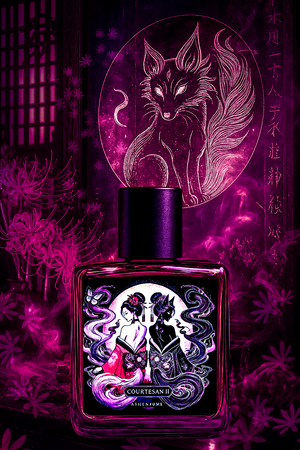 Found in
Courtesan II
Costus root beneath the flowers of the fox courtesan’s perfume.
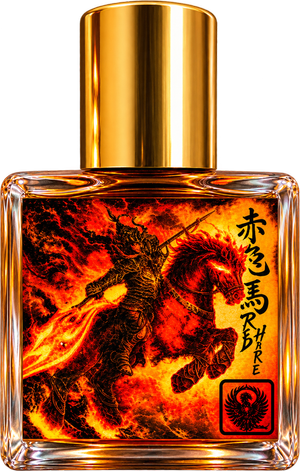 Found in
Red Hare
The Costus Root Accord in the heart of the warhorse of the Three Kingdoms.
AppendixFor the perfumer
The extraction, composition, odorants, standards, substitutes and dated trade figures behind costus root oil, set out for reference at the bench.
- Extraction and yields
- Physical character
- Composition
- Odorants
- Skin sensitivity
- Standards
- Substitutes and tests
- Trade, dated
Extraction and yields
The classic still. Arctander describes steam distillation of comminuted dried root first macerated in water, so the process works with water and steam together. The oil separates poorly from the distillation water and was recovered from it with benzene2. The Food Chemicals Codex gives steam distillation of the dried, ground root, or solvent extraction followed by vacuum distillation of the resinoid3.
Cold solvent. The 1960 patent of India’s Council of Scientific and Industrial Research stirred powdered root for about four hours in petroleum ether (boiling 40 to 60°C), left it overnight, extracted twice more and concentrated under vacuum at about 40°C, because the lactones are thermolabile. Its oil was clear pale brown, with a density of 1.048, a rotation of +31.47° and a refractive index of 1.5288. Costunolide, melting at 108°C, crystallised from it on standing, and about 250 g of mixed lactones came from about 450 g of oil47.
Heat and the lactones. A cold diethyl ether percolate held dehydrocostus lactone as its single main component, and hydrodistillation broke that compound down46.
The yields below come from single studies of different roots, ages and stills, and they span two orders of magnitude. Read each row as that study’s figure.
| Method | Root | Yield | Source |
|---|---|---|---|
| Hydrodistillation, 3 h | Korea and China | 0.02 and 0.01 | 60 |
| Hydrodistillation, 6 h | Uttarakhand, cultivated | 0.02 | 13 |
| Hydrodistillation, 6 h | Indian and Iranian markets | 0.37 and 0.5 | 61 |
| Hydrodistillation, 6 h, Clevenger | Lahaul, cultivated | 1.44 unfertilised, about 2.1 to 2.2 fertilised | 35 |
| Reported by Bose and colleagues, 1961 | India | 1.39 | 6 |
| Steam, 3 h, with solvent recovery from the water | Saudi market | 3 | 62 |
| Cold petroleum ether | Kashmir and Kulu | 6.2 and 3.7 | 47 |
Labour in a kilogram. At 2 percent, one kilogram of oil takes 50 kilograms of dried root. At 0.02 percent it takes 5 tonnes1335.
Solvent forms. Benzene or petroleum ether at modest temperature gives a concrete sold as costus resinoid. Alcohol extraction of it gives the absolute, at a yield Arctander puts close to the steam oil’s. Spent distillation root re-extracted gives a resinous, faintly aromatic material once sold as costus resins and used for cutting2.
Traditional qust oil. Root soaked overnight in 25 percent ethanol, then boiled in sesame oil until the water is driven off. Its volatile content measured 0.1 percent, against 0.5 percent for the root essential oil63.
Physical character
The oil. Pale yellow to brownish yellow and very viscous2, light yellow to brown in the Food Chemicals Codex. It dissolves in most fixed oils and in mineral oil, and is insoluble in glycerin and propylene glycol3.
The absolute. A semi-solid mass or very viscous liquid, pale amber to brownish amber264.
Dehydrocostus lactone. C15H18O2, molecular weight 230, melting at 59.5°C in the 1984 isolation (60.5 to 61.5°C in the earlier literature)20.
On the blotter. Substantivity of 316 hours at full strength65.
Composition
Published analyses of costus oil vary widely with root origin, age at harvest, distillation time and the analyst’s identifications. Each table gives one study.
| Molecule | Percent |
|---|---|
| (7Z,10Z,13Z)-Hexadecatrienal | 25.5 |
| Dehydrocostus lactone | 16.7 |
| Elemol | 5.84 |
| Valerenol | 4.20 |
| α-Ionone | 3.91 |
| Geranyl acetone | 3.82 |
| Dehydrosaussurea lactone | 3.24 |
| Costus lactone | 2.61 |
| (E)-Caryophyllene | 2.31 |
| β-Ionone | 2.30 |
| β-Elemene | 2.10 |
| γ-Costol | 1.80 |
| Molecule | Percent | Range across fertiliser trials |
|---|---|---|
| Linoleic acid | 16.44 | 14.42 to 16.27 |
| Valerenol | 7.85 | 6.16 to 7.99 |
| Eremanthin | 7.10 | 5.87 to 7.18 |
| α-Costol | 4.41 | 3.95 to 6.62 |
| Germacrene B | 4.44 | 4.10 to 5.89 |
| γ-Costol | 3.86 | 2.55 to 3.87 |
| Caryophyllene oxide | 2.99 | 0.51 to 3.35 |
| β-Elemene | 2.64 | 2.54 to 2.70 |
| Geranyl acetone | 2.44 | 2.29 to 2.92 |
| Dihydro-α-ionone | 1.83 | 1.63 to 2.05 |
| (E)-β-Ionone | 1.58 | 1.53 to 1.58 |
| Molecule | India % | Iran % |
|---|---|---|
| 1,3-Cyclooctadiene (as identified) | 19.27 | 16.10 |
| Elema-1,3,11(13)-trien-12-ol | 10.03 | 11.56 |
| β-Elemene | 8.84 | 5.90 |
| Dehydrocostus lactone | 8.41 | 17.73 |
| Valerenol | 6.46 | 5.28 |
| trans-Caryophyllene | 5.34 | 4.37 |
| α-Costol | 4.15 | 3.74 |
| Elemol | 1.81 | 2.70 |
| Costunolide | none found | 0.34 |
| Molecule | Korea % | China % |
|---|---|---|
| (7Z,10Z,13Z)-Hexadecatrienal | 21.20 | 23.32 |
| Dehydrocostus lactone | 10.30 | 10.97 |
| Valerenol | 5.30 | 4.15 |
| β-Elemene | 4.07 | 4.69 |
An old analysis. The 1916 German edition of Gildemeister and Hoffmann gave the oil’s approximate composition as aplotaxene about 20 percent, dihydrocostus lactone 15, costic acid 14, costus lactone 11, costol 7, and α- and β-costene about 6 each, with traces of camphene and phellandrene. Read it as a period estimate, made before gas chromatography66.
A lactone-rich oil. One hydrodistilled root oil gave dehydrocostus lactone at 46.75 percent and costunolide at 9.26, with sesquiterpenoids at 79.8 percent of the whole21.
In the root. Liquid chromatography of 66 Korean and Chinese root samples averaged 2.39 percent costunolide and 0.93 percent dehydrocostus lactone, with no separation by origin67. The Chinese Pharmacopoeia of 2020 requires the two together at 1.8 percent or more7.
The costols. The alcohol long called costol is an intimate mixture of several, with elemol among them. True costol was proved through crystalline costic acid in 196755.
CO2 extracts. A supercritical extract at 10 MPa carried eremanthin at 14.71 percent (33.87 at 48 MPa), α-ionone at 1.56 and dihydro-α-ionone at 0.6468.
Odorants
| Molecule | Odour | Notes |
|---|---|---|
| 4-Ethyloctanoic acid | Goaty14 | The most important odorant of the acid fraction. Threshold 1.8 ppb in water14. Also in male goat secretion52. |
| Dihydro-α-ionone | Woody, floral, berry, orris, powdery, violet, raspberry50 | 1.63 to 2.05% in Lahaul oil35 |
| α-Ionone and β-ionone | Violet | 3.91 and 2.30% in Uttarakhand oil13. Arctander credits the ketones and lactones with the odour2. |
| Aplotaxene | Costus51 | (Z,Z,Z)-1,8,11,14-heptadecatetraene. Also in burdock root51. |
| Dehydrocostus lactone | Nutty53 | The main lactone and a sensitiser57 |
Materials with a costus note. Costus valerolactone (warm, fatty, animal, costus, coconut) and methyl (E)-2-octenoate (hairy, costus, violet)59. Dihydro-α-ionone carries the violet and orris side50.
Skin sensitivity
The 1974 study. Ten volunteers sensitised to costus absolute were patch-tested with 26 sesquiterpene lactones at 1 percent in petrolatum. Eight reacted to two or more, and the authors named the sesquiterpene lactones as the main sensitisers56.
The haptens. Costunolide and dehydrocostus lactone. Passed over aminoethyl polystyrene, the oil lost them, and the treated oil failed to sensitise guinea pigs in the Freund complete adjuvant test, where untreated oil succeeded57. Up to 13 percent of the essential oil bound to the polymer, more than 99 percent of the dehydrocostus lactone was removed, and the effect on odour was left open69.
Screening. Maximisation testing by the fragrance industry’s research institute found 22 sensitisers among 604 fragrance materials, costus oil among them70. The diagnostic sesquiterpene lactone mix is 0.1 percent in petrolatum, in equal parts alantolactone, costunolide and dehydrocostus lactone71.
Standards
| Date | Measure | Source |
|---|---|---|
| 1974 | The International Fragrance Association’s first costus standard | 58 |
| 1998 and 2002 | Revisions of the standard | 58 |
| 9 December 2003 | The European scientific committee lists costus root oil among perfumery materials to be banned, citing sensitisation | 72 |
| 20 June 2005 | Commission Directive 2005/42/EC adds costus root oil (Saussurea lappa Clarke) used as a fragrance ingredient to the prohibited list, entry 1133 | 18 |
| 31 March 2006 | Products that do not comply may no longer be placed on the European market or sold | 18 |
| 2006 | Amendment 40: costus root oil, absolute and concrete are prohibited as fragrance ingredients, for dermal sensitisation | 58 |
The table is a history. Standards and laws change with each amendment, and other markets keep their own lists, so check the current texts before formulating.
Substitutes and tests
The record. Arctander calls costus oil quite expensive and subject to frequent and extensive adulteration, with elecampane root oil the usual substitute2.
| Material | How it is told apart |
|---|---|
| Vladimiria souliei (chuan mu xiang) | γ-Patchoulene, longicyclene, β-gurjunene, humulene 1,2-epoxide and β-patchoulene. True costus shows α-ionone, terpinen-4-ol, trans-α-bergamotene, γ-selinene and camphene73. |
| Inula helenium and I. racemosa (tu mu xiang) | Alantolactone and isoalantolactone7 |
| Aristolochia roots (qing mu xiang) | Banned for aristolochic acid, a kidney toxin7 |
| Burdock root, Arctium lappa | Secretory cavities about 40 µm, against up to 400 µm in costus6111 |
Trade, dated
Each figure keeps its year. Root and oil figures, wild and cultivated root, and Indian and Chinese markets are different measures and are not added together.
| Year | Figure | Source |
|---|---|---|
| About 1840 | 10,000 to 12,000 khurwars of root a year from Kashmir, about 2,000,000 lb, valued at the depot at 2s. 4d. a hundredweight | 1 |
| 1950 | About 600 ha under kuth in Himachal Pradesh, 300 to 400 t a year | 12 |
| Late 1960s | 240 to 280 ha in Lahaul and Spiti | 9 |
| 1982 to 1997 | China exports 4,371 t of root, Hong Kong re-exports 723 t, India exports 168 t | 9 |
| 1985/86 to 1992/93 | Indian output falls from 348 t to 66 t, and area from 174 ha to 35 ha | 9 |
| 1988/89 to 2000/01 | 304.05 t of Lahaul kuth traded at Rs 20.40 to 56 a kg | 11 |
| 1990s | US$0.7 to 5.7 a kg in India, up to US$52 a kg retail in Hong Kong | 9 |
| 1994 | India exports 4,200 bottles of oil, reportedly for Grasse | 9 |
| 2003/04 | India imports 398,480 kg of root | 11 |
| 2012/13 to 2014/15 | Kanol village price falls from Rs 118.33 to Rs 74.35 a kg, on 1,250 to 2,950 kg of dried root a year | 12 |
| 2021 and 2024 | Chinese national sales about 6,000 t and over 8,300 t | 7 |
| 2024 | Rs 200 a kg from a local trader, Rs 300 in Delhi | 74 |
Protection. Listed under the international convention on wildlife trade on 1 July 1975, moved to its strictest appendix on 1 August 19859. One later paper gives 1980 for the move12. India placed it on Schedule VI of its wildlife law, which makes cultivation subject to licence, and banned its export in crude or processed form116. A conservation assessment workshop in Lucknow recorded a 70 percent decline over ten years9. Between 1989 and 1996 single seizures of smuggled root in India ran from 2,500 to 19,000 kilograms75.
The Kuth Act. Most papers date the Jammu and Kashmir Kuth Act to 1978, and one gives it as “1978 (AD 1921)”, which reads as a Vikram Samvat year. It was re-enacted in 2002 and 2005 with a complete ban on wild harvest1125.
Related foliosMore from the Materia
 ✦ Folio No. 3
Red Champaca
The flower of the heart in Courtesan II and the top of Red Hare, above the costus.
Read the folio
 ✦ Folio No. 4
Tuberose
The night flower beside the champaka, warmed from below by costus in both fragrances.
Read the folio
 ✦ Folio No. 7
Deer Musk
The animal the house builds as an accord, rising with the costus in the base of Courtesan II.
Read the folio
 ✦ Folio No. 26
Indian Patchouli
Another leaf of the Kashmir shawl trade, and a cousin of the cocoa patchouli in Courtesan II.
Read the folio
 ✦ Folio No. 1
Meghalayan Oud
The jungle-grown oud beneath the costus in the base of Red Hare.
Read the folio
 ✦ The violet root
Orris
The iris root whose ionones costus shares, the powder and violet of both.
Folio to come
✦ ✦ ✦
Sources & image credits75 references
- Falconer H., Description of Aucklandia, a new genus of Compositae, read at the Linnean Society of London, 17 November 1840, communicated by J.F. Royle, via BioStor.↑
- Arctander S., Perfume and Flavor Materials of Natural Origin, entries Costus absolute and Costus oil, published by the author, Elizabeth, New Jersey (1960), pp. 145 to 147.↑
- United States Pharmacopeia, Costus root oil, Food Chemicals Codex (2008).↑
- Royal Botanic Gardens, Kew, Dolomiaea costus (Falc.) Kasana &, A.K.Pandey, Plants of the World Online.↑
- Kasana S., Dwivedi M.D., Uniyal P.L., Pandey A.K., An updated circumscription of Saussurea (Cardueae, Asteraceae) and allied genera based on morphological and molecular data, Phytotaxa 450(2), 173-187 (2020), species treatment via Plazi.↑
- Pandey M.M., Rastogi S., Rawat A.K.S., Saussurea costus: botanical, chemical and pharmacological review of an ayurvedic medicinal plant, Journal of Ethnopharmacology 110(3), 379-390 (2007).↑
- Chen J., Zhao Z., Lin L., Wang G., Yang H., Wang X., Frontiers in Pharmacology 16, 1659831 (2025), review of Aucklandia lappa.↑
- Honigberger J.M., Thirty-five Years in the East (1852), quoting O’Shaughnessy W.B., The Bengal Dispensatory (1841), via Search Kashmir.↑
- Schippmann U., Medicinal Plants Significant Trade Study, German Federal Agency for Nature Conservation (2001).↑
- Bano H. et al., Plant Archives 18(1), 963-968 (2018), seed germination of Saussurea costus.↑
- Kuniyal C.P., Rawat D.S., Sundriyal R.C., Cultivation of Saussurea costus cannot be treated as ’artificially propagated’, Current Science 108(9), 1587-1589 (2015).↑
- Kuniyal C.P., Heinen J.T., Negi B.S., Kaim J.C., Is cultivation of Saussurea costus sustaining its conservation?, Journal of Threatened Taxa 11(13), 14745-14752 (2019).↑
- Gwari G., Bhandari U., Andola H.C., Lohani H., Chauhan N., Pharmacognosy Research 5(3), 179-182 (2013), volatile oil of costus roots cultivated in Uttarakhand.↑
- Boelens M.H., Perfumer &, Flavorist 21 (January/February 1996), on the odour of carboxylic acids.↑
- Pliny the Elder, Natural History, Book XII, chapter 25: Costus, trans. Bostock J., Riley H.T. (1855).↑
- Theophrastus, Enquiry into Plants 9.7.3, trans. Hort A., Loeb Classical Library (1916), ToposText.↑
- Palme K., Review of the status, use, adulteration, cultivation, and trade of three threatened and intensively used medicinal plant taxa from the Himalayan region, MSc thesis, University of Vienna (2015).↑
- European Commission, Commission Directive 2005/42/EC of 20 June 2005 amending Council Directive 76/768/EEC concerning cosmetic products, annex.↑
- Ara S. et al., Bee flora of Kashmir, Journal of Pharmacognosy and Phytochemistry 8(2), 2172-2181 (2019).↑
- Malik M.M., Naqvi S.H.M., Isolation and identification of an insect repellent compound from Saussurea lappa, Pakistan Journal of Scientific and Industrial Research 27(3), 144-145 (1984).↑
- Liu Z.L., He Q., Chu S.S., Wang C.F., Du S.S., Deng Z.W., Parasitology Research 110(6), 2125-2130 (2012), on costus root oil and Aedes albopictus larvae (abstract).↑
- Cai X. et al., Frontiers in Chemistry 10, 872480 (2022), on antifungal lactones of costus root.↑
- Liu J., Xie M., Li X. et al., Directory of Open Access Journals record, on allelochemicals in the rhizosphere soil of Saussurea lappa.↑
- Himalayan Voices, Cultivation protocol for Saussurea costus, factsheet (undated).↑
- Shah N.C., Kuṣṭha, Saussurea costus: its unexplored history from the Atharvaveda, Indian Journal of History of Science 54(4), 421-434 (2019).↑
- Griffith R.T.H. (trans.), Hymns of the Atharvaveda, Book V, hymn 4 (1895 to 1896).↑
- Kiran V., Singh D.C., Thakur V., AYUSHDHARA 3(1), 491-499 (2016), review of kushtha in the classical texts.↑
- Theophrastus, Concerning Odours, sections 28 and 34, trans. Hort A., Loeb Classical Library (1926), LacusCurtius.↑
- Gildemeister E., Hoffmann F., The Volatile Oils, vol. 1: Oil of costus root, trans. Kremers E. (1913).↑
- Pliny the Elder, Natural History, Book XIII, chapters 15 to 18, trans. Rackham H. (1952).↑
- Schoff W.H. (trans.), The Periplus of the Erythraean Sea, sections 39, 48 and 49, Longmans, Green (1912), Wikisource.↑
- Periplus of the Erythraean Sea, World History Encyclopedia.↑
- Brand E., The list of ingredients in the Temple incense, on Babylonian Talmud, Keritot 6a.↑
- Sahih al-Bukhari 5692 and 5693, Book of Medicine, sunnah.com.↑
- Vishvamitera S. et al., Frontiers in Plant Science 14, 1179183 (2023), on Saussurea costus under fertiliser levels in the Lahaul cold desert.↑
- Sawer J.Ch., Odorographia: a natural history of raw materials and drugs used in the perfume industry, first series, Gurney and Jackson, London (1892), pp. 104 and 109 to 113, quoting Baden Powell, Punjab Products.↑
- United States Department of Agriculture, Bureau of Plant Industry, Plant Immigrants, no. 178, p. 8, entry 51852, after Mueller, Select Extra-Tropical Plants.↑
- Dey K.L., Mair W., The Indigenous Drugs of India, 2nd edition, Thacker, Spink and Co., Calcutta (1896), pp. 287 to 288.↑
- Yule H., Burnell A.C., ed. Crooke W., Hobson-Jobson: A Glossary of Colloquial Anglo-Indian Words and Phrases, s.v. Putchock, new edition, John Murray, London (1903).↑
- Cheng W., Putchock of India and Radix China: herbal exchange around maritime Asia via the VOC during the 17th and 18th centuries, Journal of Social Sciences and Philosophy 30(1), 75-117, Academia Sinica (2018).↑
- Singh D.P., Kuth cultivation in Lahaul and its future, Indian Forester 77(1), 71-74 (1951).↑
- People and their land, HimKatha 5(1), Nature Conservation Foundation (Spring 2024).↑
- Lahaul and Spiti district administration, History, Government of Himachal Pradesh.↑
- Thakur M. et al., Indian Journal of Traditional Knowledge 19(4), 761-775 (2020), on plant use in Lahaul.↑
- Srivastava T.N., Kapahi B.K., Sarin Y.K., Ancient Science of Life 11(3-4), 126-130 (1992), on medicinal plants of Lahaul.↑
- Raghav C.S. et al., Investigation of costus root oil composition, Indian Journal of Plant Genetic Resources (abstract).↑
- Kelkar G.R., Bhattacharyya S.C. (Council of Scientific and Industrial Research), Preparation of costus root oil and the products thereof, US Patent 2,946,783 (1960).↑
- Gildemeister E., Hoffmann Fr., trans. Kremers E., The Volatile Oils, Pharmaceutical Review Publishing Co., Milwaukee (1900), p. 32 and p. 690.↑
- Ohloff G., Importance of minor components in flavors and fragrances, Perfumer and Flavorist 3 (1978), 11-22.↑
- The Good Scents Company, Dihydro-alpha-ionone.↑
- The Good Scents Company, Aplotaxene.↑
- Sugiyama T. et al., Agricultural and Biological Chemistry 45(11), 2655-2658 (1981), on 4-ethyl fatty acids in male goat secretion.↑
- The Good Scents Company, Dehydrocostus lactone.↑
- Rao A.S., Kelkar G.R., Bhattacharyya S.C., Costunolide, a new sesquiterpene lactone from costus root oil, Tetrahedron 9(3-4), 275-283 (1960).↑
- Bawdekar A.S., Kelkar G.R., Bhattacharyya S.C., Tetrahedron 23(4), 1993-1996 (1967), on costol.↑
- Mitchell J.C., Epstein W.L., Archives of Dermatology 110(6), 871-873 (1974), on contact sensitivity to costus absolute.↑
- Cheminat A., Stampf J.L., Benezra C., Farrall M.J., Fréchet J.M.J., Acta Dermato-Venereologica 61(6), 525-529 (1981), on removing the haptens of costus oil.↑
- International Fragrance Association, Standard: costus root oil, absolute and concrete, Amendment 40 (2006).↑
- The Good Scents Company, Costus odour type.↑
- Chang K.M., Kim G.H., Journal of Food Science and Nutrition 13, 128-133 (2008), volatile components of Korean and Chinese costus roots.↑
- Ebadi N. et al., Research Journal of Pharmacognosy 5(4), 25-32 (2018), costus roots from Indian and Iranian markets.↑
- Abdelwahab S.I. et al., Tropical Journal of Pharmaceutical Research 18(10), 2155-2160 (2019), costus root essential oil.↑
- Bagheri S. et al., Preparation of Saussurea costus traditional oil and investigation of different parameters for standardization, Research Journal of Pharmacognosy 5(2), 51-56 (2018).↑
- The Good Scents Company, Costus root absolute.↑
- The Good Scents Company, Costus root oil, citing Luebke W. (1983).↑
- Gildemeister E., Hoffmann Fr., Die ätherischen Öle, 2nd edition, vol. III, Schimmel and Co., Miltitz bei Leipzig (1916), p. 709.↑
- Eom M.R. et al., Korean Journal of Pharmacognosy 44(3), 235-241 (2013), costunolide and dehydrocostus lactone in costus root samples.↑
- Ahmed H.Y. et al., Antioxidants 11, 1960 (2022), supercritical carbon dioxide extracts of costus root.↑
- Benezra C., Cheminat A., Fréchet J.M.J., Perfumer &, Flavorist 6(6) (1981 to 1982), on removing allergenic lactones from costus oil.↑
- Opdyke D.L.J., Perfumer &, Flavorist 1 (1976), on the safety testing of fragrance materials.↑
- Salapovic H., Geier J., Reznicek G., Scientia Pharmaceutica 81, 807-818 (2013), on sesquiterpene lactones and the patch-test mix.↑
- Scientific Committee on Cosmetic Products and Non-Food Products, Opinion SCCNFP/0771/03 on fragrance ingredients restricted or prohibited by the fragrance industry, adopted 9 December 2003.↑
- Yan X. et al., Analytical and Bioanalytical Chemistry 412(7), 1535-1549 (2020), GC-MS fingerprints of Aucklandiae and Vladimiriae Radix (abstract).↑
- Sharma D., Chaudhary V.K., Dev I., International Journal of Economic Plants 11(2), 160-165 (2024), on farm incomes from medicinal and aromatic plants.↑
- Trading in contraband, Down To Earth (20 July 2012).↑
Photographs
Costus flower heads and plants on the trail from Ghangaria to Hemkund, Valley of Flowers National Park: Vinayaraj, CC BY-SA 4.0. Valley of Flowers meadow, 3 August 2010: Alosh Bennett, CC BY 2.0. Valley of Flowers in cloud, August 2022: Sudipto2cool, CC BY 4.0. Costus seeds, Yaroslavl, and dried costus root: Plantagenet, CC BY-SA 4.0. Baisaran meadow, Pahalgam: Vinayaraj, CC BY-SA 3.0. Thenu village, Lahaul: Jen, CC BY-SA 3.0. Codex Cashmiriensis folio (Whitney and Lanman 1905): public domain. FIGCREDITS Orris iris (Iris pallida): Pamwik, CC BY-SA 4.0. All via Wikimedia Commons. Bottle images: Ashenfume.
Join the discussionHave you grown kuth, bought putchuk in a bazaar, kept it among your woollens or worked with its oil? Add what you know, or ask a question.