Provenance Materia Oud Trat
MATERIA · THE BEAVER MOON COLLECTION
Trat Oud
The agarwood of Thailand’s eastern border, and its fermented cousin
In 1678 an Englishman who had lived four years in Ayutthaya, the capital of Siam, wrote the East India Company a report on the kingdom’s trade. His editor names him as George White. He began with wood. The head sort, Agulah Bannah, was esteemed above any in the world, a rich perfume that grew in the forests near the borders of Cambodia1. A Persian in the king’s service, Okphra Si Manorat, had held its trade for years, and its buyers were Muslims in India, Turkey and Arabia, who used it at their devotions in Medina and Mecca12. Along that border lie the provinces of Chanthaburi and Trat, where the botanist A. F. G. Kerr found the tree most abundant in 1941, on the mainland and on the larger islands off the coast3. Trat held more than four million planted trees of it by 20224. This is their oud, and its fermented cousin, the same wood soaked in water before it meets the still.
Explore this folio
- IWhat it smells like
- IIIn the house
- IIIThe tree of the eastern hills
- IVA wound, a moth and a hornet
- VWood from the borders of Cambodia
- VIKritsana in Thai life
- VIIThe planted forests of Trat
- VIIIBefore the still, and after
- IXThe perfumer’s agarwood
- XThe worth of a planted tree
- ✦Appendix: For the perfumer


IWhat it smells like
The trade knows Trat oil for its sweetness. A shop in Bangkok’s Arab quarter told a reporter that its best seller was a Trat oil, because people love its sweet aroma10. The house works with two oils from the province. One comes from Bo Rai, the district on the Cambodian border, and goes into Courtesan II. The other is the fermented cousin, its wood soaked in water before the still, and it goes into Beaver Moon.
- The Bo Rai oil, opening
Ripe and sweet. Mango, lychee, jackfruit, star apple and papaya, with frangipani, white lotus and the juice of white grapes, growing stronger through the first hours.
- The Bo Rai oil, heart and drydown
The heart turns to incense, pale copal touched with dark storax, laced through the fruit and flowers. Then clean oud wood, which stays on a strip for more than four days.
- The fermented oil, the first forty minutes
Dark woods and a cloud of horse, close and animal. It asks for patience on the strip.
- The fermented oil, heart and drydown
Wood upon wood: spiced incense, old cedar, smoked guaiac and a smooth sandalwood heart, in warm resin close to myrrh. Ripe fruit, cocoa and mandarin peel rise through it, with old leather and a hint of spikenard. Over a week it settles to wood, labdanum, amber and fruit.
IIIn the house
Thai oud sits in the heart of Beaver Moon, the house’s perfume of the November moon, where the house’s own notes give it leathery fruit tones, darkened by age and quiet fire. The oil is the fermented cousin, distilled from planted Aquilaria crassna of Trat whose wood was soaked in water before it went to the still. It is a dark amber oil, slightly thick, and it shows best in the cold months.
In Beaver Moon the oud lies beneath black copal, Siberian rhododendron, Siberian fir and balsam fir absolute, and above the castoreums, Siberian cedar, Haitian vetiver and Kua myrrh. Its horse and old leather lead down into the castoreum, and its warm resin meets the Kua myrrh. The tree itself is told in the Oud folio, and India’s jungle-grown oil in Meghalayan Oud.
From the same province
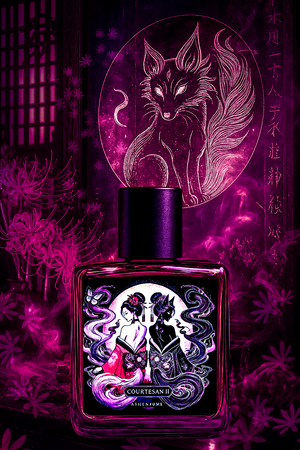
Courtesan II, the perfume of the fox courtesan, carries the Bo Rai oil in its base. Bo Rai is the district of Trat that meets Cambodia on the north and east11. The oil is jewel red and pours freely. Its ripe fruit and white flowers rise into the red champaka and tuberose of the perfume’s heart, and its incense and clean wood stay below.

IIIThe tree of the eastern hills
The tree that makes Trat oud is Aquilaria crassna, of the Thymelaeaceae, the family of the daphnes. The name was Pierre’s and the description Lecomte’s, published in the Bulletin of the Botanical Society of France in the volume for 1914, issued in 19155. It grows wild in Thailand, Laos, Cambodia and Vietnam. In Thailand its range runs from Chiang Rai, Phrae and Nan in the north, through Nakhon Ratchasima, Buriram and Prachin Buri, to Chanthaburi and Trat in the east12.

It is a plain tree to look at. It grows as tall as 30 metres, straight, with light grey bark, and its young twigs and flower stalks carry short soft hairs. The flowers come in small clusters of four to six, with white, softly hairy petals. The fruit is a capsule two and a half to three and a half centimetres long that splits as it dries, around a seed about a centimetre long1314. Thai foresters gather the seed in May and June15.
Thailand has five species of Aquilaria9, and its planters favour this one. About 99 percent of the agarwood trees planted in the country are crassna16.
The wood is soft and pale and has no true heartwood. The fragrant resin forms in the living wood, beside the strands of inner bark that run through it, after the tree is wounded17. Everything the distiller wants lies in those darkened places.
A name from the old books
In Thai the tree and its scented wood are both kritsana, กฤษณา6. Kerr called krisna the best known of all the Thai scented woods. He gave mai hawm, fragrant wood, as a name for the tree, and believed the word kritsana must have come from an Indian source, though he could find no Indian tree called by it3. Sanskrit does have kṛṣṇāguru, black agaru, for the darkest aloeswood18. The link between the two words remains a guess.
The name is old in Thai writing. Traiphum Phra Ruang, the Buddhist cosmology composed at Sukhothai in about 1345 and one of the oldest works in the Thai language, sets sandalwood and kritsana among the fragrant trees that perfume the human world1920.
IVA wound, a moth and a hornet

A healthy crassna holds no perfume. The resin forms when the tree is hurt, by lightning, by grazing animals, by insects boring in, and by the fungi and bacteria that follow them through the wound21. The tree answers by flooding the injured wood with resin rich in volatile compounds, and that resin helps hold back the fungi21. The pale wood turns brown and black and becomes fragrant22. Among the fungi found in the darkened wood of crassna are Acremonium, Fusarium solani and Lasiodiplodia theobromae21.
Few trees are hurt in the right way. A review of 2022 puts the share of wild Aquilaria that become infected and make resin at about one in ten, after twenty years or more21. Kerr found the scented wood in only a small share of Thai trees, often in small quantity, and wrote that no one could be sure of it until the tree was felled and cut up3. Simon de La Loubère, the French envoy to Siam, had made the same observation in 1691: the wood lay only in certain rotten places of certain trees, so finding it took a long search through the forest23.
The moths of March
Over three flowering seasons, from March to May in 2006, 2007 and 2008, the researchers W. Tasen, S. Tangmitcharoen, M. Thakeaw and K. Ogata watched the insects that came to crassna flowers in a plantation in Trat and in the forest of Khao Yai. They recorded 103 species from 34 families, 61 of them moths and butterflies. The most frequent visitors at both sites were small pyralid moths of the genus Endotricha, which carried an average of sixteen pollen grains on the proboscis. Flowers sealed in bags set significantly less fruit than flowers pollinated by hand, so the tree depends on its insects, and the planted trees of Trat set fruit as well as the wild trees of Khao Yai24. In southern China the sister species A. sinensis is pollinated mainly by moths too25.
Seeds carried by hornets

The seeds of agarwood trees live only a few hours. In A. sinensis, seeds left in the sun on a hot, dry afternoon dry out in four hours and die within eight27. Hornets move them first. When a capsule opens, three species of Vespa take most of its seeds within minutes and drop them in damp shade, on average about 166 metres from the parent tree26. The hornets come for the fleshy appendage on each seed, and often eat it and leave the seed itself unharmed25.
The fruit calls them with the tree’s own alarm. An opened capsule gives off small aldehydes, ketones, alcohols and acids, and fourteen of the seventeen major compounds that hornet antennae respond to are also released by Aquilaria leaves chewed by caterpillars, a signal that brings in the caterpillars’ predators2627. No one has yet followed the seeds of crassna, so the hornets belong, for now, to its Chinese sister.
The caterpillar and the leaf

Leaves have their own enemy. In China’s plantations the caterpillar of a small moth, Heortia vitessoides, is the chief pest of A. sinensis. Larvae can strip whole leaves and young shoots within days, and a severe outbreak kills ten to thirty percent of the trees28. The moth flies in Thailand too, though no study has yet recorded it on Thai crassna.
For the perfumer the lesson of the forest is a simple one. The resin is the tree’s answer to injury, laid down against fungi in the wood around a wound21. Every drop of oud oil is distilled from that defence.
VWood from the borders of Cambodia
The forests of the old Khmer lands were famous for their aloeswood long before Siam traded it. In about 850 the geographer Ibn Khurradadhbih wrote of a country called Qmar that produced Qmari aloeswood and rice, and his editors read Qmar as probably Khmer Cambodia29. In Saudi Arabia Cambodian aloeswood is still usually the most treasured, and ‘ud itself simply means wood30. In the thirteenth century the Chinese official Zhao Rugua ranked the aloeswood reaching China’s ports. The best came from Chenla, Cambodia, and the second from Champa, and he graded each piece by whether it came from a living tree or a dead one31.
The wood of Siam
Siam sold its own wood east as well as west. In 1606 Tokugawa Ieyasu wrote to King Ekathotsarot of Ayutthaya asking for trade in Siamese eaglewood and firearms, and offered Japanese swords and armour in return32. Between 1602 and 1616, 206 ships sailed from Japan under the shogun’s red-seal permits, about four in five of them to Southeast Asia33. In 1618 the English merchant Richard Cocks, at Hirado, opened two chests come from Siam with calambac and silk34, and in 1623 King Song Tham’s presents to the shogun included four catties of scented wood35.

The report of 1678 shows how the trade ran at home. The Persian Okphra Si Manorat held the wood for several years by the king’s favour, and after his death the trade went back to the royal factors. The best sold at sixteen catties a picul, and much of the rest went on to Mocha on the Red Sea12. The writer ranked one wood higher still. Calambac from Cochinchina, he wrote, was the costlier perfume wood, much used in Japan, where it fetched three or four times its weight in silver1.

A few years later the French envoy set the same order. La Loubère ranked the aloeswood of Siam below the calambac of Cochinchina and above the aloeswood of every other country, and noted that it had once been very dear in Paris and could now be had at a reasonable rate23. Nicolas Gervaise, writing in 1688, placed agila wood, calambac and calamac in the forest on the Cambodian side. He found agila the commonest, calambac less common and calamac rarest of all, and saw many trees felled without the search proving fruitful3.
Kritsana stayed a royal monopoly until King Mongkut gave it up with the other monopolies3. The royal gifts went on. In 1822 the court’s return presents for the British envoy John Crawfurd included two piculs of eagle-wood36, and the treaty Sir John Bowring signed at Bangkok on 18 April 1855 put agilla wood on the list of exports that paid a single duty, two ticals3736.
A border that moved
Trat itself changed hands. France took the province with Koh Kong on 22 January 1904. The treaty of 23 March 1907 returned Trat to Siam in exchange for Battambang, Siem Reap and Sisophon38, and at nine in the morning on 6 July 1907 a French official read out the letter of transfer at Trat town hall39. The Cardamom Mountains still mark the province’s eastern edge with Cambodia38.
VIKritsana in Thai life
In Siam the wood perfumed cloth and skin before it perfumed anything in a bottle. Thai has a word, ram, for perfuming cloth, and kritsana is among the aromatic woods of the traditional mix for it, beside frankincense, sandalwood, musk and jasmine40. The old scented powder, paeng ram, was perfumed with benzoin, cinnamon, clove, sandalwood and kritsana41.
The poets’ kritsana
In 1809 a page of the Front Palace named In, remembered by his title as Nai Narinthibet, marched south with the army sent against the Burmese at Thalang and Chumphon, and wrote 143 verses of longing for the woman he had left42. In one of them the wind comes down to stroke a kritsana tree and carries its scent to him, and he wonders whether it is the trace of her perfumed clothes, drying in the lane43.
A generation later kritsana entered a lesson on friendship. From 1831, under King Rama III, the old proverb verses of the Khlong Lokanit were refined by Prince Dechadisorn and cut into the stone of Wat Pho in Bangkok4445. Two verses stand side by side. Wrap pla ra, fermented fish, in grass and the grass stinks of fish, as a man takes on the faults of fools. Wrap kritsana in a leaf and the leaf comes away sweet, as a man takes on the good of the wise. Another verse asks who makes the chilli hot, who sharpens the thorn, and who perfumes the sandalwood and the kritsana, and answers that the wise are wise by their own nature46.
Fragrant medicine
Thai medicine counted kritsana among the woods of ya hom, the aromatic powders taken for faintness and wind. The old texts prescribe its heartwood and resin for dizziness, the heart, wind, fever and weakness6, and in the Ministry of Public Health’s list of household traditional remedies of 1999, two of the four ya hom formulas, Inthajak and Nawakot, carry kritsana among their ingredients47.

The market on Soi Nana
The trade now gathers in Bangkok. Sukhumvit Soi 3, Soi Nana, is the country’s largest agarwood market. A study published in 2023 counted twenty-four agarwood businesses in the city, every one selling chips. Their traders bought chipped wood from Prachinburi, Chanthaburi, Nakhon Nayok and Trat, contracted whole trees from Trat farmers, and laid the chips out on glass counters for buyers to test by burning a sliver48. The streets around them, called Little Arab Town, draw visitors from Qatar, Saudi Arabia, Oman and the Emirates49.

VIIThe planted forests of Trat

Trat is wet country. The windward east of Thailand, Trat above all, takes more than 4,000 millimetres of rain a year8, and the Thai rains run from about the middle of May to the middle of October50. Crassna wants rain in at least five months of the year15. Offshore, Ko Chang, the country’s third-largest island, heads a marine park of more than forty smaller islands38.
No source found dates the first plantings in Trat. By 2007 a seedling trade was well established. Of 89 agarwood growers surveyed that year in Bo Phloi subdistrict, 85 sold seedlings, five induced resin and five distilled oil. The trees each grower had under treatment, 50 to 1,000 when they began, had grown to between 100 and 100,00051. By 2022 Trat held more than 4.1 million trees and was Thailand’s largest oud province4.
Making the wound
A trial on farmers’ plantations in Trat, published in 2016, shows the work. Researchers felled twelve trees, 12 to 14 years old, treated four ways. The best method drilled holes round the trunks of 12-year-old trees grown among rubber, pushed in bamboo sticks about 20 centimetres long painted with an undisclosed recipe, left the trees a year, treated them again and left them four months more. Those trees gave about 68 kilograms of agarwood each, a third of their trunk wood9.
The season of the wound matters. In a Kasetsart trial, holes drilled in the dry season formed nearly twice the resinous wood of holes drilled in the rains, and methyl jasmonate, a signal plants make when wounded, gave the most resin of all17.
Cutting out the dark wood
At harvest the tree is felled and the dark wood is carved free of the pale by hand. The chips are sorted by colour, white for plain wood and light yellow to dark brown for agarwood9. They dry in the sun four or five days, dry again in an oven, and go into sacks by grade, since every grade fetches its own price6. The Royal Forest Department grades by colour, from black for the first grade to brown threads in pale wood for the fourth15, and Trat growers in 2007 also graded by weight in water. The first grade sinks51.
VIIIBefore the still, and after
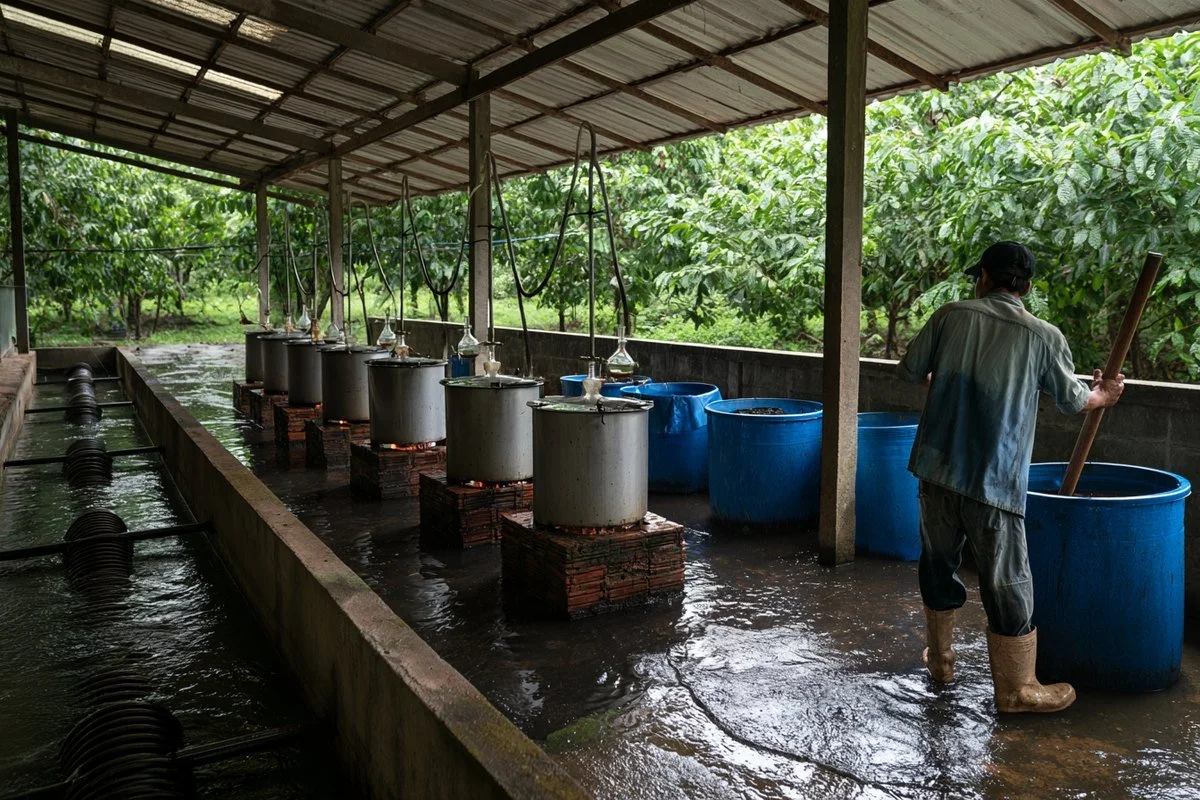
What happens between the chip and the still decides whether a batch becomes plain Trat oil or its fermented cousin. The dried chips are ground and soaked in water. In the Trat trial the soak lasted 10 to 14 days9. Across the border in Koh Kong, Cambodian distillers load 20 kilograms of powder into a 200-litre drum, pour in ground water until it stands 20 centimetres above the powder, and leave it about 35 days, stirring it through the soak with a spoon 170 centimetres long52. In Assam the soaks run 45 to 90 days53.
Thai distillers sell the difference. At a Thai trade fair in Muscat in May 2018, Suwattana, vice president of the Thai Agarwood Trade Association, set out four oils fermented for three months, one month, seven days and three days. A grower named Yok, whose trees were about thirty years old, told visitors that the longer the fermentation, the higher the cost, and recommended the week-long oil to those who liked a sweeter scent54.
What the water does
Water swells the wood and softens its cell walls, and microbes move into the opened resin53. In the soaking broth of three small distilleries at Hojai, in Assam, microbiologists found 105 kinds of bacteria and nine of fungi, led by Bacillus and the yeast-like Galactomyces, and their numbers rose through the first three weeks55. In an Indonesian trial with a Fusarium, the soak grew more acid week by week, from pH 8.1 to 5.1, and the oil’s balance of sesquiterpenes shifted56. In Assam, a 45-day soak brought agarospirol and two other compounds into resinous wood that had held none of them before53.
A Thai laboratory showed how much the microbes can change. Five days in the culture broth of lactic acid bacteria doubled the oil drawn from agarwood powder and added a trace of indole, which the plain water soak lacked57. Indole smells floral when faint and animal when strong58. Brewer’s yeast raised phenylacetaldehyde, a sweet, honeyed note, from under one percent of the oil to ten5759.
No study has yet named the molecules behind the deep animal character of a long-fermented oud. Commercial Assam oils carry short fatty acids, and one grade held 4-ethylphenol53, the molecule that marks the medicinal taint the yeast Brettanomyces leaves in wine60. The paper does not tie it to the soak. The smell of the fermented cousin is known to the nose and the market, and its chemistry still waits for a laboratory.
The still
Then the fire. The Trat farmers ran their soaked powder for nine to ten days, in a stainless steel pot under a vertical glass condenser, or in a copper pot whose vapour ran through a steel condenser sunk in a water tank. A three-hour run in a small portable steam unit gave no oil at all9. In Koh Kong the pan is held at 100 °C for up to ten days and stirred every three hours, and the water that overflows is fed back into the pan52. Arctander called this return of the distillation waters cohobation, and judged it necessary for any reasonable yield61. The run stops when no more drops reach the glass where the oil parts from the water52. The Thai producers at Muscat gave ten days to two weeks, and said gas had replaced the wood fire54.
The yield is tiny. The best Trat method gave 0.75 grams of oil from a kilogram of chips, less than a tenth of one percent9. Eight-year-old crassna from Chanthaburi, Trat and Rayong, soaked ten days and distilled seven, gave 31 millilitres from 15 kilograms62.
After the still, the oil is drawn off and kept. In a study on Trat wood, hotter runs gave more oil and darker oil, which seemed to last longer on the skin63. For local use the oil is often thinned into an attar with sandalwood oil or a vegetable oil such as sesame61.

IXThe perfumer’s agarwood
When Steffen Arctander wrote his reference on natural perfume materials in 1960, agarwood oil was made only on firm orders. He named crassna as the tree of Indochina, and described a very viscous oil, pale yellow to dark amber, with a rich, sweet-woody, almost balsamic odour whose sweetness recalls sandalwood. He suggested it for oriental, woody-aldehydic, chypre and fougère bases, with vetiver, sandalwood, geranium and methylionones61.
Thai crassna oil is a crowd of sesquiterpenes. In oil from eight-year-old trees of Chanthaburi, Trat and Rayong, γ-selinene led at about 14 percent, with valerianol, also called kusunol, agarospirol and jinkoh-eremol behind it62. Oil from Trat wood distilled at 100 °C held aristolene, 1,5-diphenyl-3-pentanone and agarospirol as its largest peaks63.
What the nose follows
The largest peaks are seldom what the nose follows. In 2011 chemists in Thailand smelled Thai oils of three Aquilaria species as each compound left a gas chromatograph, and found 74 odour-active components. β-Agarofuran, benzylacetone, furfural and benzaldehyde led the aroma, and jinkoh-eremol, kusunol and agarospirol, small in share, still mattered to it64. A molecule’s share of an oil and its strength in the nose are different measures. Ohloff defined a molecule’s odour value as its concentration divided by its odour threshold, so a trace with a very low threshold can outweigh a major component65. Benzylacetone itself smells sweet, floral and balsamic66.

Heat and the chromones
The heaviest fragrant molecules of agarwood never reach the oil. The 2-(2-phenylethyl)chromones stay in the wood through hydrodistillation and come out only with solvents or carbon dioxide67. Agarwood smells faintly at room temperature and opens when it is heated67, and heated, the chromone agarotetrol breaks down into benzylacetone and other small aromatic molecules68. The sweetness of a smouldering chip and the sweetness of the oil meet in that one molecule.
A carbon dioxide extract keeps what the still leaves behind. Crassna from Khanh Hoa in Vietnam, extracted with CO2, carried 6-methoxy-2-(2-phenylethyl)chromone at 7.28 percent and 2-(2-phenylethyl)chromone at 5.07, and neither led in the oils distilled from the same wood69.
Grading and stretching
The trade grades by nose and hand. Bangkok dealers grade chips and oil A, B or C by colour, weight and scent, each grade about half the price of the one above48. In the Trat trial the oil was judged by a trader on Soi Nana on two things only, its scent and how long the scent lasts9. By 2021 Thai oils were sold as A, AA, AAA, Super and DBS70. Buyers differ in what they seek, and in 2022 Thai producers were still learning the scent preferences of Saudi buyers, which run apart from those of their Asian customers4.
The trade also stretches the oil. Plasticisers are added for profit, and one adulterated sample held more than 40 percent diethyl phthalate. Raman spectroscopy can now sort pure oils by origin and flag the spiked ones71. For wood, the chromones are the test of true agarwood. Of 83 pieces seized by UK Border Force and checked at Kew, 58 percent were authentic, and the fakes included dyed and scented pine72.
XThe worth of a planted tree
Wild crassna is critically endangered, in an assessment of 20187. A count of 2007 found 397,411 agarwood trees in 24 protected areas of Thailand, 68,655 of them in Khao Yai22, and poachers still go in after them73.

The oil of Trat comes from planted trees. Thai law counts agarwood a conserved plant, and exports must come from plantations registered with the Department of Agriculture74. An online register opened in 2017, and since 2022 owners give five days’ notice before a harvest16. A standing tree can even serve as security for a loan74.
The trade grew as the plantations came of age. Thailand exported 1,193 kilograms of oud oil in 2011 and 7,537 in 201375. By 2022 Trat’s oud exports were worth more than 130 million dollars a year, and about three quarters went to the Middle East4.
One tree shows the arithmetic. The best tree of the Trat trial grew twelve years and was wounded for sixteen months more. Felled, chipped, soaked and distilled for ten days, it gave about 4.2 tola of oil, some 50 grams, which a trader on Soi Nana valued at 4,200 baht a tola, about 17,700 baht for the tree9. By 2021 Thai oil sold at 6,000 baht a tola for grade A and up to 35,000 for the finest70.
Trat oud through the centuries
- About 850
Ibn Khurradadhbih names Qmari aloeswood from Qmar, probably Cambodia29.
- About 1345
Traiphum Phra Ruang names kritsana among the fragrant trees20.
- 1606
Tokugawa Ieyasu asks King Ekathotsarot for Siamese eaglewood32.
- 1678
An English report ranks the wood from the borders of Cambodia above any in the world1.
- 1691
La Loubère ranks Siamese aloeswood second only to calambac23.
- 1809
Nai Narinthibet writes of the wind in the kritsana tree42.
- 1831
Work begins on the Wat Pho inscriptions, the Khlong Lokanit among them4544.
- 1855
The Bowring treaty sets a single export duty on agilla wood36.
- 1907
Trat returns to Siam38.
- 1915
Aquilaria crassna is published, in the volume for 19145.
- 1941
Kerr finds crassna most abundant in Chanthaburi and Trat3.
- 2007
Bo Phloi’s growers are surveyed, seedlings to stills51.
- 2013
Thailand exports 7,537 kilograms of oud oil75.
- 2018
Wild crassna is assessed as critically endangered7.
- 2022
Trat holds more than 4.1 million planted trees4.
 Found in
Beaver Moon
The fermented Trat oud in the heart of the November moon.
AppendixFor the perfumer
The names, the tree, the resin trials, the grades, the soak and the still, the chemistry, the tests and the trade behind Trat oud, set out for reference at the bench. For agarwood across all its regions, see the Oud folio.
- Names and species
- The tree in the field
- Inducing resin
- Grades
- Soak, ferment and still
- Composition
- Authenticity and adulteration
- Trade, prices and rules
- The old records
Names and species
| Name | Language or record | Meaning and note | Source |
|---|---|---|---|
| Kritsana, กฤษณา | Thai | The tree and its scented wood. Royal Institute romanisation krit-sa-na | 6 |
| Mai hawm | Thai, after Kerr 1941 | Fragrant wood, a name for the tree | 3 |
| Kissina, calamba | Kaempfer, 1712, after Kerr | Common pieces against choice pieces | 3 |
| Agulah, Agulah Bannah | English report, 1678 | The wood of Siam, and its head sort | 1 |
| Wood Aquila, aloes | La Loubère, English edition 1693 | Siamese aloeswood | 23 |
| Agilla wood | Bowring treaty tariff, 1855 | Export article, single duty | 36 |
| Eagle-wood | English, via Portuguese aguila | From Sanskrit agaru. The eagle is a folk explanation | 76 |
| Qmari aloeswood | Arabic, about 850 | From Qmar, probably Khmer Cambodia | 29 |
| Kalamphak, กะลำพัก | Thai medicine | A different material: the dark core of old Euphorbia antiquorum. Listed beside kritsana in ya hom as a separate ingredient | 77347 |
| Species | Thai name | Note | Source |
|---|---|---|---|
| A. crassna | กฤษณา | About 99 percent of planted agarwood trees in Thailand | 2216 |
| A. malaccensis | ไม้หอม, พวมพร้าว | Planted mainly in the south | 229 |
| A. subintegra | กำแย | Used in Thai laboratory oil studies | 2257 |
| A. hirta | จะแน | 22 | |
| A. rugosa | กฤษณาดอย | First recorded for Thailand in 2007, montane forest at 900 to 1,200 m, Phitsanulok and Chiang Mai | 14 |
Species lists differ. The 2016 Trat paper lists five species with A. rugosa. The ITTO review of 2022 lists A. malaccensis, A. crassna, A. hirta, A. subintegra and Gyrinops vidalii, and leaves A. rugosa out916.
The tree in the field
| Measure | Figure | Species and place | Source |
|---|---|---|---|
| Aquilaria crassna | |||
| Flowering studied | March to May, 2006 to 2008 | Trat plantation and Khao Yai | 24 |
| Flower visitors | 103 species, 34 families: 61 Lepidoptera, 26 Hymenoptera, 8 Coleoptera, 8 Diptera | Trat and Khao Yai | 24 |
| Pollen on an Endotricha proboscis | 16.29 ± 5.36 grains (n = 9) | Trat and Khao Yai | 24 |
| Seed collected | May to June | Thailand | 15 |
| Fruit | Capsule 25 to 35 by 20 to 25 mm | Thailand | 14 |
| Aquilaria sinensis, the sister species | |||
| Natural fruit set | 11.4% (2014), 8.6% (2015) | Jiangcheng, Yunnan | 25 |
| Main floral scent | (E,E)-α-farnesene 61.9%, trans-ocimene 16.6%, benzyl salicylate 4.6% | Yunnan | 25 |
| Seeds taken by hornets | 33.7% of diaspores from 141 capsules within three days | Yunnan | 25 |
| Mean dispersal distance | About 80 m (2016), about 166 m (2022) | China | 2526 |
| Seed life in hot, dry sun | Dry in 4 hours, dead within 8 | China | 27 |
| Heortia vitessoides generations a year | 8 to 10 Hainan, 6 to 8 Guangdong, 5 to 6 Guangxi, 4 to 5 India | Plantations | 28 |
Inducing resin
| Technique | Planting | Age | Induction | Wood per tree | Agarwood per tree |
|---|---|---|---|---|---|
| 1. Holes with recipe, sprinkler at base and crown | Monoculture, 2 × 2 m | 12 years | 8 months | 81.20 kg | 21.87 kg (27.99%) |
| 2. Spiral holes, plastic tubes, capsules of recipe | Monoculture, 2 × 2 m | 13 years | 43 months | 82.50 kg | 9.07 kg (12.37%) |
| 3. Holes to 5 m, 20 cm apart, with recipe | Monoculture, 2 × 4 m | 14 years | 12 months | 105.57 kg | 11.20 kg (10.85%) |
| 4. Holes with bamboo sticks painted with recipe, treated twice | With para rubber, 4 × 5 m | 12 years | 16 months | 211.77 kg | 67.87 kg (32.21%) |
How to read the trial. Three trees were felled per technique, twelve in all, on farmers’ plantations in Trat. The recipe was not disclosed, and no fungal inoculum was used. The authors suggest decay set in during the long 43-month induction9.
| Trial | Result | Source |
|---|---|---|
| Wang Nam Khiew, Nakhon Ratchasima, 18-year-old trees, 8 mm holes 2 cm deep, 10 cm apart, 17 treatments, 12 months | Best: methyl jasmonate 0.1 M, then 0.01 M, then Ethrel 5% and 10%. Bamboo pegs and steel nails gave little. Dry-season holes (14 March 2006) 268 mm³ of resinous wood each, rainy-season holes (23 September 2006) 152 mm³ | 17 |
| Phu Ruea, Loei, 4-year-old trees wounded from February 2001 | Pale after 1 month, yellow-brown after 3, dark brown after 8 to 10, black with a burning scent within 20 months | 78 |
| Same, width of staining after 10 months | 0.76 mm narrow chisel, 0.75 mm 1.27 cm screws, 0.50 mm hammer blows | 79 |
Grades
| System | Grades | Source |
|---|---|---|
| Royal Forest Department, by colour | 1 black, 2 dark brown, 3 brown, 4 brown threads in pale wood | 15 |
| Bo Phloi growers, Trat, 2007, by specific gravity | 1 about 1.01, sinks. 2 sinks. 3 about 0.62, floats. 4 about 0.39, floats | 51 |
| Bangkok traders, chips and oil | A, B, C by colour, weight and scent. Each grade about half the price of the one above | 48 |
| Thai oil, 2021 | A, AA, AAA, Super, DBS | 70 |
| Trade in general | No common biochemical standard. Market letters A to D vary from trader to trader | 16 |
Soak, ferment and still
| Place | Soak | Distillation | Source |
|---|---|---|---|
| Trat farmers, about 2015 | 10 to 14 days, ground chips | 9 to 10 days, steel or copper pot | 9 |
| Chanthaburi, Trat and Rayong wood, laboratory | 10 days, 15 kg powder | 7 days | 62 |
| Trat cooperative wood, laboratory | Wood to water 1 to 9 | 64 hours at 80, 100 and 120 °C | 63 |
| Thai oils shown at Muscat, 2018 | 3 days, 7 days, 1 month, 3 months | 10 days to 2 weeks | 54 |
| Koh Kong, Cambodia | About 35 days (30 in one passage), 20 kg powder in a 200 L drum | Up to 10 days at 100 °C | 52 |
| Khanh Hoa, Vietnam, laboratory | 3 weeks | 72 hours | 69 |
| Assam distilleries | 45 to 90 days | 53 |
| Material and method | Yield | Source |
|---|---|---|
| Trat crassna chips, 16-month induction, 14-day soak, 10-day copper pot | 0.749 g/kg, about 0.075% | 9 |
| Same, 11-day soak, 10-day steel pot | 0.689 g/kg | 9 |
| Chanthaburi, Trat and Rayong crassna, 8 years | 31 mL from 15 kg, about 0.2% | 62 |
| Induced crassna, water and steam (Kasetsart) | 0.11% | 80 |
| Khanh Hoa crassna, 3-week soak, 72 hours | 0.25% | 69 |
| Young Cambodian plantation crassna | About 1,000 kg of wood a litre | 16 |
| Wild chips | About 144 kg a litre | 16 |
| Study | Finding | Source |
|---|---|---|
| A. malaccensis, Assam, 45-day water soak | 10S,11S-himachala-3(12),4-diene, agarospirol and i-propyl-12-methyltetradecanoate appear in soaked resinous wood and in commercial oils, absent from unsoaked wood. Presence only, no percentages | 53 |
| Hojai, Assam, distillery broth, days 0 to 21 | 105 bacterial and 9 fungal isolates, Bacillus and Galactomyces leading. Counts rise to day 21 | 55 |
| A. malaccensis chips, 45 days with a Fusarium | γ-Eudesmol, agarospirol and aristolene appear | 81 |
| A. subintegra, Thailand, 5 days in microbial culture broth | Yield: water 0.22%, yeast up to 0.25%, lactic acid bacteria up to 0.45%. Indole 0.09% with lactic bacteria only. Yeast: phenylacetaldehyde 10.32% against 0.91%, furfural 5.21%. No smell panel | 57 |
| Agarwood, Indonesia, Fusarium 1 to 4 weeks | Yield 0.02% to 0.07%. pH 8.1 to 5.1. β-Guaiene 4.30% to 12.74%. Benzylacetone 2.74% control, 0.74 to 1.75% fermented | 56 |
| A. subintegra, 6 against 14 days of water | 0.0625% against 0.135% | 82 |
| White-rot fungus soak against water | 0.58% against 0.27% | 83 |
What is known of the animal note. Indole is the only classic animal molecule reported after a fermentation treatment. 4-Ethylphenol turned up in one commercial Assam grade, and C6 to C10 fatty acids in all three, untied to the soak. No paper read for this folio reports butyric acid, isovaleric acid, p-cresol or skatole in agarwood oil, and none ran a smell panel on fermented oil5753.
Composition
| Compound | Water distilled | CO2 | CO2 with ethanol |
|---|---|---|---|
| γ-Selinene | 13.66 | 0.29 | 1.02 |
| Valerianol (kusunol) | 4.87 | 0.69 | 1.62 |
| Agarospirol | 3.66 | 1.31 | 2.14 |
| Jinkoh-eremol | 2.31 | 0.14 | 0.26 |
| Hexadecanoic acid | 1.36 | 1.07 | 0.86 |
| α-Selinene | 0.60 | not detected | not detected |
| δ-Guaiene | 0.33 | 0.11 | 0.16 |
| Dihydrokaranone | 0.21 | 0.70 | 0.33 |
| Benzylacetone | not detected | not detected | 0.12 |
Source: 62.
| 80 °C | 100 °C | 120 °C |
|---|---|---|
| Agarospirol 7.3 | Aristolene 8.0 | Aromadendrene epoxide 9.2 |
| Alloaromadendrene 7.3 | 1,5-Diphenyl-3-pentanone 7.4 | Agarospirol 8.1 |
| Valencene 6.7 | Agarospirol 6.0 | α-Gurjunene 6.7 |
| Valerenol 6.1 | 10-epi-γ-Eudesmol 4.3 | 2-Naphthaleneethanol 6.7 |
A unit to check. The same study prints its yields as 455 to 612 mg per gram, which would be half the wood, while its figure axis reads micrograms per gram, about 0.05 percent. The micrograms reading fits every other yield here63.
| Compound | Role or note | Source |
|---|---|---|
| β-Agarofuran, benzylacetone, furfural, benzaldehyde | Main contributors to the aroma of Thai oils, by GC-olfactometry. 74 odour-active components in all | 64 |
| Jinkoh-eremol, kusunol, agarospirol | Minor in share, important to the aroma | 64 |
| Benzylacetone (4-phenyl-2-butanone) | Sweet, floral, balsamic. Released when the chromone agarotetrol is heated | 6668 |
| Indole | Floral when faint, animal when strong | 58 |
| Phenylacetaldehyde | Sweet, honeyed | 59 |
| 2-(2-Phenylethyl)chromones | Heavy and of low volatility. Taken by solvents and CO2, absent from hydrodistilled oil. In Vietnamese crassna they rose from 66.42% of an ether extract after 2 years of formation to 81.39% after 4 | 6784 |
Authenticity and adulteration
Tests in use today
Raman spectroscopy. With chemometrics it separated 30 oil batches from China, Cambodia, Indonesia, Laos and Thailand by origin and extraction method, and flagged phthalate-spiked oils, one holding diethyl phthalate at 42.01% and diethylhexyl phthalate at 5.33%71.
Near-infrared, for wood. At Kew, 58% of 83 samples seized by UK Border Force were authentic. Chromones are the marker, and an overnight wash stripped them and spoiled the test. The model recognised 95% of authentic samples72.
Ways the trade stretches agarwood
Oil. Plasticisers added for profit71. Diethyl and dibutyl phthalate found in a commercial Assam grade53. A synthetic oud sells for about a tenth of the natural price16.
Wood. Non-agarwood chips impregnated with resin and low-grade oil, sold for about 400 dollars a kilogram. Beads of other woods soaked in oil. Wild wood mixed into plantation wood of the same quality16. Dyed and fragranced pine among seized fakes72.
Trade, prices and rules
How to read the trade figures. Each figure keeps its year and its source. The tola is 12 grams in the Trat trial, 12 cc in Thai PBS and 12.5 cc in Thairath. Tree counts conflict: Arab News, citing Federation of Thai Industries data, gives Trat more than 4.1 million trees in 2022, and an industry spokesman told TRT World 25 million410.
| Year | Item | Price | Source |
|---|---|---|---|
| About 2015 | Trat trial oil, trader’s estimate | 4,200 to 4,500 baht a tola | 9 |
| 2015 | Top-grade oil | 30,000 to 40,000 baht a tola | 85 |
| 2016 to 2020 | Bangkok oil, grade A, B, C | 1,200 to 4,500, 700 to 3,500, 600 to 2,500 baht a tola | 48 |
| 2016 to 2020 | Bangkok chips, grade A, B, C | 10,000 to 42,000, 5,000 to 30,000, 5,000 to 15,000 baht a kg | 48 |
| 2016, 2017, 2018 | Whole Trat trees on contract | 800 to 900, 900 to 1,000, 1,000 to 1,200 baht a tree | 48 |
| 2016 to 2018 | Chipped wood for distilling | 75 to 110 baht a kg | 48 |
| 2021 | Oil A, AA, AAA, Super, DBS | 6,000, 9,500, 12,500, 15,000, 35,000 baht a tola | 70 |
| 2022 | Chips at a Bangkok shop | Up to 5,300 dollars a kg | 4 |
| Year | Figure | Source |
|---|---|---|
| 2011 | 1,193 kg of oud oil | 75 |
| 2013 | 7,537 kg of oud oil (8,000 kg of oil and 15,000 kg of chips in a report to the wildlife-trade convention, the UAE the largest buyer) | 7586 |
| 2010 to 2020 | More than 99% of traded A. crassna from plantations. Top importers Saudi Arabia, the UAE, Taiwan and Singapore | 87 |
| 2016 to 2020 | 3,257,595 kg of agarwood in all forms, second only to Indonesia | 16 |
| About 2022 | Trat oud exports over 130 million dollars a year, about 75% to the Middle East | 4 |
| Year | Measure | Source |
|---|---|---|
| 1855 | Agilla wood pays a single export duty of 2 ticals under the Bowring treaty | 36 |
| 2014 | Electronic registration of agarwood begins | 86 |
| 2016 | Thailand’s scientific export finding for A. crassna | 16 |
| 2017 | Online national register of growers, nurseries and trade | 16 |
| 2018 | Cabinet approves a Forest Act amendment letting growers harvest high-value trees. Agarwood among 58 species usable as loan collateral | 74 |
| 1 March 2022 | Agarwood chips exempted from export duty | 88 |
| From 2022 | Five days’ notice before a harvest, stating chips or oil | 16 |
Rules change. Check the current Thai and destination-country requirements before buying or shipping agarwood.
The old records
| Date | Record | Source |
|---|---|---|
| About 850 | Ibn Khurradadhbih: Qmar produces Qmari aloeswood and rice | 29 |
| Thirteenth century | Zhao Rugua: Chenla best, Champa second. The wood of Teng-liu-mei, possibly Ligor, the most aromatic, by his translators’ reading | 31 |
| 1606 | Ieyasu asks Ekathotsarot for Siamese eaglewood and firearms. Some sources date a second letter 1607 | 32 |
| 1618 | Cocks opens two chests from Siam with calambac and silk | 34 |
| 1623 | Song Tham sends the shogun four catties of scented wood and two of camphor | 35 |
| 1678 | Agulah Bannah, from the woods near Cambodia. Trade held by a Persian, then the royal factors. Best at 16 catties a picul. Calambac three or four times its weight in silver in Japan | 12 |
| 1688 | Gervaise: agila, calambac and calamac in the forest on the Cambodian side. Agila common, calamac rarest, many trees felled for nothing | 3 |
| 1691 | La Loubère: below the calambac of Cochinchina, above the aloeswood of any other country | 23 |
| 1822 | Return presents to Crawfurd include two piculs of eagle-wood | 36 |
| 1855 | Bowring treaty tariff: agilla wood, 2 ticals | 3637 |
| 1941 | Kerr: most abundant in Chanthaburi and Trat, a royal monopoly until King Mongkut | 3 |
Units in the old records. A picul is the load a man carries, about 60 kilograms. In the 1678 report the catty is the Siamese chang, a weight of silver, and the Thai translation of 1919 gives the price as 16 chang a picul. The Bowring tariff prints its unit on the first row only, so the 2 ticals for agilla wood is read here as per picul with that caution236.
The Beaver Moon collectionMore from the November moon
 ✦ Folio No. 1
Oud
The wood of the wounded tree, its chemistry, its history and every region on the map.
Read the folio
 ✦ Oud by region
Meghalayan Oud
Jungle-grown in the wettest hills on Earth, soaked six weeks before the still.
Read the folio
 ✦ Folio No. 17
Castoreum
The animal warmth beneath the oud in the base of Beaver Moon.
Read the folio
 ✦ Folio No. 24
Siberian Rhododendron
The cold fruit that blooms beside the oud in the heart.
Read the folio
 ✦ Folio No. 25
Siberian Cedar
The stone pine of the Sayan taiga, faintly peppery in the base.
Read the folio
 ✦ Folio No. 28
Siberian Fir
Crisp needles over the oud in the heart of the November moon.
Read the folio
✦ ✦ ✦
Sources & image credits88 references
- White G. (attributed), Report on the trade of Siam, written in 1678, in Anderson J., English Intercourse with Siam in the Seventeenth Century, Kegan Paul, Trench, Trübner, London (1890), Appendix E, pp. 421-428, via the Internet Archive.↑
- รายงานการค้าขายในกรุงสยามครั้งแผ่นดินสมเด็จพระนารายน์ (Report on the trade of Siam in the reign of King Narai), Thai translation of the 1678 report in Prachum Phongsawadan, part 18 (1919), via Thai Wikisource (in Thai).↑
- Kerr A., Notes on the scented woods of Thailand, Bulletin of the Thailand Research Society (Natural History) 13, 35-41 (1941), via the Siam Society.↑
- Sangkhapat P., Coveted Thai oud is heady new entry into Saudi perfume market, Arab News (27 October 2022).↑
- Royal Museum for Central Africa, Aquilaria crassna Pierre ex H. Lec., Tervuren Xylarium Wood Database, citing Bull. Soc. Bot. France 61, 411 (1914, issued 1915).↑
- Department of Thai Traditional and Alternative Medicine, Ministry of Public Health, กฤษณา (Krisana), herbal monograph, 44-46 (in Thai).↑
- Aquilaria crassna, Wikipedia, citing the IUCN Red List assessment (2018).↑
- Land Development Department, Ministry of Agriculture and Cooperatives, Rainfall, Thailand.↑
- Moungsrimuangdee B., Sangwanit U., Jamroenprucksa M., Results of agarwood inducement in the stems of Aquilaria crassna growing in the farmers' plantations, Trat Province, Thai Journal of Forestry 35(1), 34-44 (2016).↑
- Wizards of oud: how a rare Thai oil coveted by Saudis became "liquid gold", TRT World.↑
- อำเภอบ่อไร่ (Bo Rai district), Thai Wikipedia (in Thai).↑
- Piewluang C., Liengsiri C., Bhodthipuks J., Saiwaew K., Effect of sowing media on germination of Aquilaria crassna Pierre seeds, Forest Research and Seed Management, Royal Forest Department (in Thai, undated).↑
- Faculty of Pharmacy, Mahidol University, กฤษณา Aquilaria crassna, medicinal plant information sheet (in Thai).↑
- Eiadthong W., Aquilaria rugosa (Thymelaeaceae): a new record for Thailand, The Thailand Natural History Museum Journal 2(1), 63-66 (2007).↑
- Forest Technology Development and Transfer Group, Royal Forest Department, ไม้กฤษณา (Kritsana wood), information leaflet, Bangkok (in Thai, undated).↑
- Thompson I.D., Lim T., Turjaman M., Expensive, exploited and endangered: a review of the agarwood-producing genera Aquilaria and Gyrinops, ITTO Technical Series 51, International Tropical Timber Organization (October 2022).↑
- Eiadthong W., Treatment techniques to stimulate incensed resinous wood formation of agarwood (Aquilaria crassna Pierre ex Lec.) by intentional wounding, Thai Journal of Forestry 28(1), 1-16 (2009).↑
- Kṛṣṇāgaru (black aloe wood), Wisdom Library dictionary compilation.↑
- Li Thai, King of Sukhothai (attributed), ไตรภูมิพระร่วง, มนุสสภูมิ (Traiphum Phra Ruang, the human realm), via Thai Wikisource (in Thai).↑
- ไตรภูมิพระร่วง (Traiphum Phra Ruang), Thai Wikipedia (in Thai).↑
- Shivanand P., Arbie N.F., Krishnamoorthy S., Ahmad N., Agarwood, the fragrant molecules of a wounded tree, Molecules 27(11), 3386 (2022).↑
- ทำไม “กฤษณา” ไม้หอมยังมีราคาแพง และไม่เสื่อมความนิยม (Why kritsana is still expensive and still popular), Thai PBS (30 July 2021, in Thai).↑
- La Loubère S. de, A New Historical Relation of the Kingdom of Siam, Part I, chapter IV, “Of the Productions of Siam, and first of the Woods”, printed by F.L. for Tho. Horne, London (1693), via the Oxford Text Archive.↑
- Tasen W., Tangmitcharoen S., Thakeaw M., Ogata K., Insect pollination of Aquilaria crassna (Thymelaeaceae): effect of moths for the fruit setting in Thailand, Journal of the Faculty of Agriculture, Kyushu University 54(2), 321-328 (2009), record via FAO AGRIS.↑
- Chen G., Liu C., Sun W., Pollination and seed dispersal of Aquilaria sinensis (Lour.) Gilg (Thymelaeaceae): an economic plant species with extremely small populations in China, Plant Diversity 38(5), 227-232 (2016).↑
- Qin R.-M., Wen P., Corlett R.T., Zhang Y., Wang G., Chen J., Plant-defense mimicry facilitates rapid dispersal of short-lived seeds by hornets, Current Biology 32(15), 3429 (2022).↑
- Xishuangbanna Tropical Botanical Garden, Chinese Academy of Sciences, Rapid seed dispersal by hornets facilitates reproduction of agarwood plants, EurekAlert! news release (30 June 2022).↑
- Yin Z., Chen Y., Xue H., Li X., Li B., Liang J., Zhu Y., Long K., Yang J., Pang J., Li K., Ye S., Heortia vitessoides infests Aquilaria sinensis: a systematic review of climate drivers, management strategies, and molecular mechanisms, Insects 16(7), 690 (2025).↑
- Ibn Khurradadhbih, Kitab al-masalik wa’l-mamalik (c. 850), extract, Arabic text ed. de Goeje (Leiden 1889), after Tibbetts, in Materials for the Medieval History of Indonesia, Universität Hamburg (2009).↑
- Hansen E., The hidden history of scented wood, Saudi Aramco World 51(6), 2-13 (2000).↑
- Hirth F., Rockhill W.W. (trans.), Chau Ju-kua: his work on the Chinese and Arab trade in the twelfth and thirteenth centuries, entitled Chu-fan-chï, “Gharu-wood”, 204-208, Imperial Academy of Sciences, St Petersburg (1911).↑
- Ekathotsarot, SamuraiWiki, citing Polenghi C., Samurai of Ayutthaya (2009).↑
- Kohara T., The warlord who most actively pursued overseas trade (in Japanese), PRESIDENT Online (12 March 2025).↑
- Yule H., Burnell A.C., Hobson-Jobson, entry CALAMBAC, John Murray, London, via Wikisource.↑
- Giles F.H., Analysis of Van Vliet’s Account of Siam, part seven, Journal of the Siam Society 30(3), 288.↑
- Bowring J., The Kingdom and People of Siam, vol. 2, London (1857), pp. 23 and 225 and the Crawfurd and Roberts mission chapters, via the Internet Archive.↑
- Treaty of Friendship and Commerce between Great Britain and Siam, signed at Bangkok, 18 April 1855, “The World and Japan” Database, project leader Tanaka Akihiko.↑
- Trat province, Wikipedia.↑
- France return Trat, Museum Thailand, citing Lord Sakorn Kotchaket, Archives of Memories.↑
- Queen Sirikit Museum of Textiles, Aromatic herbs, woods, barks or gums for perfuming (เครื่องหอมที่ใช้ร่ำผ้า), Bangkok (2012), via Google Arts and Culture.↑
- How to make paeng ram powder: women’s beauty products of the old days (in Thai), Thairath Online (4 April 2018).↑
- นิราศนรินทร์ (Nirat Narin), Thai Wikipedia (in Thai).↑
- Narinthibet (In), Nai, นิราศนรินทร์ (Nirat Narin), verse 80, via Thai Wikisource (in Thai).↑
- โคลงโลกนิติ (Khlong Lokanit), Thai Wikipedia (in Thai).↑
- UNESCO Memory of the World Committee for Asia and the Pacific, Epigraphic Archives of Wat Pho, register entry (inscribed 2011).↑
- Dechadisorn, Prince (Krom Phraya Dechadisorn), โคลงโลกนิติ (Khlong Lokanit), verses from the stone inscriptions of Wat Phra Chetuphon (Wat Pho), Bangkok, via Thai Wikisource (in Thai).↑
- Temsiri-Ruksakul R., จะเลือกใช้ยาหอมอย่างไรจึงจะดี (How to choose ya hom wisely), Faculty of Pharmacy, Mahidol University (in Thai).↑
- Pama A., Suksard S., Pattaratuma A., Marketing of agarwood (Aquilaria spp.) products in Bangkok, Thai Journal of Forestry 42(1), 108-120 (2023).↑
- Al-Kinani M., Bangkok’s Little Arab Town: a cultural hub but an intellectual property minefield, Arab News (24 February 2024).↑
- National Statistical Office, Statistical Yearbook Thailand 2024, natural resources and environment statistics, citing the Thai Meteorological Department (2024).↑
- Pattaratuma S., Lertsiri S., Development of fragrant agarwood production for business of agarwood growers at Boh-Ploy Subdistrict, Trad Province, Kasetsart Journal (Social Sciences) 28(2), 240-249 (2007).↑
- Forestry Administration of Cambodia and AFoCO, Agarwood oil extraction methodology, from local practices of Koh Kong province, Phnom Penh (April 2024).↑
- Sen S., Talukdar N.C., Khan M., A simple metabolite profiling approach reveals critical biomolecular linkages in fragrant agarwood oil production from Aquilaria malaccensis, a traditional agro-based industry in North East India, Current Science 108(1), 63-71 (10 January 2015).↑
- Smell and choose the note, it is oud, Oman Observer (2 May 2018), from the Thai Trade Exhibition, Oman Convention and Exhibition Centre, Muscat.↑
- Islam M.R., Chakraborty C., Banu S., Isolation and characterization of bacteria and fungi associated with agarwood fermentation, Current Microbiology 79, 313 (2022).↑
- Defiza, Ningsih H.R., Musdja M.Y., Supandi, Aldrat H., Pengaruh praperlakuan fermentasi Fusarium terhadap rendemen dan profil kimia hidrodistilasi minyak gaharu (in Indonesian), Pharmaceutical and Biomedical Sciences Journal 6(2), 108-117 (2024).↑
- Monggoot S., Kulsing C., Wong Y.F., Pripdeevech P., Incubation of Aquilaria subintegra with microbial culture supernatants enhances production of volatile compounds and improves quality of agarwood oil, Indian Journal of Microbiology 58(2), 201-207 (2018).↑
- The Good Scents Company, Indole.↑
- Acree T., Arn H., Flavornet: odorants listed by odor, Cornell University (accessed 2026).↑
- The Australian Wine Research Institute, Brettanomyces: frequently asked questions, AWRI, Adelaide (accessed 2026).↑
- Arctander S., Perfume and Flavor Materials of Natural Origin, entry “Agar oil”, p. 41, Elizabeth, New Jersey (1960).↑
- Wetwitayaklung P., Thavanapong N., Charoenteeraboon J., Chemical constituents and antimicrobial activity of essential oil and extracts of heartwood of Aquilaria crassna obtained from water distillation and supercritical fluid carbon dioxide extraction, Silpakorn University Science and Technology Journal 3(1), 25-33 (2009).↑
- Pornpunyapat J., Chetpattananondh P., Tongurai C., Mathematical modeling for extraction of essential oil from Aquilaria crassna by hydrodistillation and quality of agarwood oil, Bangladesh Journal of Pharmacology 6(1), 18-24 (2011).↑
- Pripdeevech P., Khummueng W., Park S.-K., Identification of odor-active components of agarwood essential oils from Thailand by solid phase microextraction-GC/MS and GC-O, Journal of Essential Oil Research 23(4), 46-53 (2011).↑
- Ohloff G., Importance of minor components in flavors and fragrances, Perfumer and Flavorist 3 (1978), 11-22.↑
- The Good Scents Company, Benzyl acetone.↑
- Kao W.-Y., Hsiang C.-Y., Ho S.-C., Ho T.-Y., Lee K.-T., Chemical profiles of incense smoke ingredients from agarwood by headspace gas chromatography-tandem mass spectrometry, Molecules 23(11), 2969 (2018).↑
- Takamatsu S., Ito M., Agarotetrol: a source compound for low molecular weight aromatic compounds from agarwood heating, Journal of Natural Medicines 72(2), 537-541 (2018).↑
- Dinh T.T.T., Tran T.T., Nguyen Q.C., Tran T.T.T., Hoang T.B., Tran Q.T., Comparative study on volatile compounds of agarwood from Khanh Hoa province extracted by different methods, Vietnam Journal of Science and Technology 56(4A), 266-272 (2018).↑
- “ไม้กฤษณา” ปลูกได้ไม่ต้องลักลอบตัด ทำเงินในตลาดยุโรป-ตะวันออกกลาง (Agarwood can be grown without illegal felling), Thai PBS (30 July 2021, in Thai).↑
- Huang X., Li H., Ruan Y., Li Z., Yang H., Xie G., Yang Y., Du Q., Ji K., Yang M., An integrated approach utilizing Raman spectroscopy and chemometrics for authentication and detection of adulteration of agarwood essential oils, Frontiers in Chemistry 10, 1036082 (2022).↑
- Grosskopf E.K., Simmonds M.S.J., Wallis C.J., Combining near-infrared (NIR) analysis and modelling as a fast and reliable method to determine the authenticity of agarwood (Aquilaria spp.), Analytica 4(2), 231-238 (2023).↑
- Military joins hunt for agarwood poachers in Khao Yai National Park, The Thaiger (June 2024).↑
- Arunmas P., Farmers urged to cash in on high-value trees, Bangkok Post (16 June 2022).↑
- Treedom seeks to become world’s biggest supplier of fragrant oil oud, The Nation (3 April 2015).↑
- Yule H., Burnell A.C., Hobson-Jobson, entry EAGLE-WOOD, John Murray, London, via Wikisource.↑
- Department of Thai Traditional and Alternative Medicine, Ministry of Public Health, กระลำพัก (Kralumpak), herbal monograph, 22-23 (in Thai).↑
- Pojanagaroon S., Kaewrak C., Mechanical methods to stimulate aloes wood formation in Aquilaria crassna Pierre ex H.Lec. (Kritsana) trees, Acta Horticulturae 676, 161-166 (2005).↑
- Pojanagaroon S., Kaewrak C., Preliminary study on the suitable method for formation of aloeswood in Kritsana tree, Thai Agricultural Research Journal 21(1), 59-71 (2003).↑
- Extraction and analysis of the components of agarwood oil (Aquilaria crassna), SciMath, Thailand (in Thai).↑
- Sen S., Dehingia M., Talukdar N.C., Khan M. et al., Chemometric analysis reveals links in the formation of fragrant bio-molecules during agarwood (Aquilaria malaccensis) and fungal interactions, Scientific Reports 7, 44406 (2017).↑
- Abdul Rahim A.F., Jamaluddin N., Kadri A., Idris S.S., Abd Rahman N., Microwave-assisted hydrodistillation of Aquilaria subintegra, Journal of Advanced Research in Fluid Mechanics and Thermal Sciences 72(2), 1-12 (2020).↑
- Yusoff N.A., Tajuddin S.N., Hisyam A., Omar N.A.M., Production of agarwood essential oil: study on effectiveness pre-treatment technique of hydrodistillation extraction, Borneo Journal of Resource Science and Technology 5(2), 62-69 (2015).↑
- Yang J.L. et al., Characterization and analysis of 2-(2-phenylethyl)-chromone derivatives from agarwood (Aquilaria crassna) by artificial holing for different times, Molecules 21(7), 911 (2016).↑
- ตะลึง! แก๊งค้าไม้หอมขายได้ กก.ละ 3 แสน (Agarwood gang sells at 300,000 baht a kilo) (in Thai), Thairath (5 November 2015).↑
- Plants Committee of the Convention on International Trade in Endangered Species, Report of the Asian regional workshop on the management of wild and planted agarwood taxa, Guwahati, 19-23 January 2015, document PC22 Inf. 1 (Rev.1) (2015).↑
- Fabro K.A., Global agarwood trade heavily dependent on wild, threatened trees: study, Mongabay (23 April 2025), reporting Lai K., Zhang H., Yang F., Gale S.W., Global Ecology and Conservation 59, e03560 (2025).↑
- ข่าวจริง! ก.คลังประกาศลดอัตราอากร (Finance Ministry cuts and exempts export duties on timber and wood products) (in Thai), MGR Online (8 March 2022).↑
Photographs and plates
Ko Chang at dawn and the islands off Ko Chang: Nina R, CC BY 2.0. Agarwood in the core of a dó bầu: Ngantramhuong, CC BY-SA 4.0. Soi Dao and Khao Soi Dao: Adirach Toumlamoon, CC BY-SA 4.0. Aquilaria crassna at Doi Suthep: Lannafolium, CC0. Aquilaria crassna wood, sample 3316: Cirad, public domain. Lesser banded hornet and Heortia vitessoides: Len Worthington, CC BY-SA 2.0. Siamese ship from Tōsen no zu: Matsura Historical Museum, photograph by Jun Kimura, public domain. Ayutthaya: Simon de La Loubère, 1691, public domain. Soi Arab, Bangkok: Michael LaPalme, CC BY-SA 2.0. Namtok Khlong Kaeo: Chaiyathat, CC BY-SA 4.0. Agarwood oil in Assam: Papori Bora, CC BY-SA 4.0. Burning agarwood: Phương Huy, CC BY-SA 4.0. Crassna in Khao Yai: Blaise Droz, CC BY-SA 3.0. Agarwood in Malaysia: Rohitjahnavi, CC0. Cherrapunji: JakilDedhia, CC BY-SA 4.0. Castoreum Canadense, Deutsches Apothekenmuseum, Heidelberg: H. Zell, CC BY-SA 3.0. Rhododendron adamsii: Anbudilin, CC BY-SA 4.0. Siberian pine cone: Vyacheslav Argenberg, CC BY 4.0. Siberian fir near Beloretsk: Aleksandr Zykov, CC BY-SA 2.0. All via Wikimedia Commons. The Trat still house: illustration, Ashenfume. Beaver Moon key art and Courtesan II bottle: Ashenfume.
Join the discussionHave you walked a Trat plantation, watched a still in the east of Thailand or worn a fermented oud through a long night? Add what you know, or ask a question.